Browse by Category
Fiction
- Action & Adventure
- African American
- Anthologies
- Children's Fiction
- Classics
- Comics & Graphic Novels
- Coming of Age
- Contemporary
- Cultural & Regional
- Drama
- Erotica
- Fantasy
- General
- Historical Fiction
- Horror
- Humor & Satire
- Literary Fiction
- Mystery, Thriller & Suspense
- Poetry
- Religious & Inspirational
- Romance
- Science Fiction
- Short Stories
- War & Military
- Westerns
- Women's Fiction
- Young Adult
Non-Fiction
- Antiques & Collectibles
- Arts & Photography
- Biographies & Memoirs
- Business & Money
- Children's Non-Fiction
-
Computers & Technology
- Artificial Intelligence
- Computer Science
- Cybersecurity & Cryptography
- Data Science & Analytics
- Databases & Big Data
- Game Development & Design
- General
- Hardware & DIY
- Mobile App Development
- Networking & Cloud Computing
- Operating Systems
- Programming
- Robotics
- Software
- Software Engineering
- User Experience (UX) & Design
- Web Development & Design
- Cooking, Food & Wine
- Crafts, Hobbies & Home
- Education & Teaching
- Engineering
- General
- Health, Fitness & Dieting
-
History
- African History
- African History - North Africa
- African History - Sub-Saharan Africa
- American History
- American History - 20th Century
- American History - Civil War
- American History - Colonial Period
- Ancient History
- Asian History
- Asian History - China
- Asian History - India
- Asian History - Japan
- Asian History - Southeast Asia
- European History
- European History - Ancient Greece
- European History - Ancient Rome
- European History - Medieval
- European History - Modern
- European History - Renaissance
- General
- Middle Eastern History
- Military History
- Military History - Aviation
- Military History - Naval
- Social & Cultural History
- World History
- Humor & Entertainment
- Industrial Technology
- Language Learning
- Law
- LGBTQ+ Non-Fiction
- Literary Criticism
- Medical Books
- Parenting & Relationships
- Philosophy
- Politics & Social Sciences
- Reference
- Religion & Spirituality
-
Science & Math
- Agricultural Sciences
- Astronomy & Space Science
- Behavioral Sciences
- Biological Sciences
- Botany & Plant Science
- Chemistry
- Earth Sciences
- Engineering - Chemical
- Engineering - Civil
- Engineering - Electrical
- Engineering - Mechanical
- Environment
- General
- Geology
- Mathematics
- Nature & Ecology
- Oceanography
- Paleontology
- Physics
- Statistics
- Self-Help
- Sports & Outdoors
- Study Aids
- Sustainability & Green Living
- Textbooks
- Transportation
- Travel
- True Crime
- Urban Planning & Development
- Veterinary Medicine
- Writing & Publishing
Jump to Section
MixCache.com Total Access
Unlimited reading and audiobooks for every book published by MixCache.com.
Included titles carry the MTA badge.
Learn more →
A History of Walt Disney Company (The)
MTA
The Story of an S&P 500 Company
About this book:
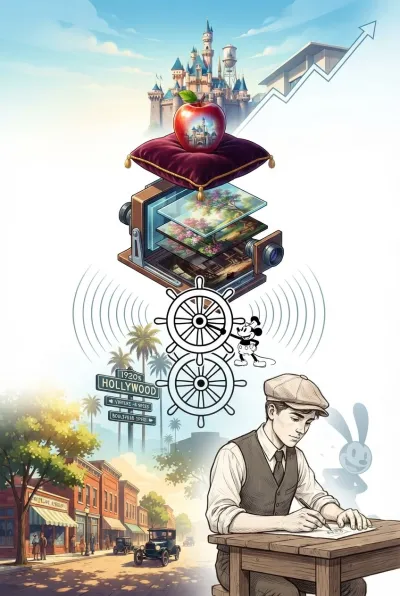
The Walt Disney Company’s journey began with Walt Disney’s humble origins in Chicago and Marceline, Missouri, where early hardships and a love for drawing fostered a resilient creative spirit. After the bankruptcy of his first studio, Laugh-O-Gram Films, Walt moved to Hollywood and, with his brother Roy, founded the Disney Brothers Cartoon Studio. The loss of their character Oswald the Lucky Rabbit to a distributor spurred the creation of Mickey Mouse, whose debut in the groundbreaking sound cartoon *Steamboat Willie* (1928) revolutionized animation. Throughout the 1930s, the *Silly Symphonies* series served as a laboratory for innovation, introducing Technicolor and the multiplane camera, culminating in the historic release of *Snow White and the Seven Dwarfs* (1937), the first feature-length animated film, which established animation as a legitimate cinematic art form and funded a new studio in Burbank.
World War II forced the studio to pivot to military production, creating training films and propaganda that kept the company afloat but halted feature animation momentum. The post-war era saw a recovery driven by "package films," live-action ventures like *Treasure Island*, nature documentaries (*True-Life Adventures*), and a prescient embrace of television. Walt leveraged the *Disneyland* anthology series on ABC to fund his most ambitious project: Disneyland, which opened in Anaheim in 1955 and redefined family entertainment. Before his death in 1966, Walt envisioned EPCOT, an experimental prototype community, a dream his brother Roy realized in modified form with the opening of Walt Disney World’s Magic Kingdom in 1971.
Following the founders' deaths, the company navigated a period of creative stagnation and corporate vulnerability until the 1984 arrival of Michael Eisner, Frank Wells, and Jeffrey Katzenberg. This leadership team sparked the "Disney Renaissance" (*The Little Mermaid*, *Beauty and the Beast*, *The Lion King*), expanded theme parks globally (Tokyo, Paris, Hong Kong, Shanghai), and acquired Capital Cities/ABC—bringing ESPN into the fold. Under CEO Bob Iger (2005–2020), Disney executed a transformative acquisition strategy, purchasing Pixar, Marvel, and Lucasfilm (*Star Wars*), securing unparalleled intellectual property. Iger then orchestrated the $71.3 billion acquisition of 21st Century Fox assets and launched Disney+ in 2019, pivoting the company decisively toward direct-to-consumer streaming just as the COVID-19 pandemic accelerated the shift away from linear TV.
Today, Disney stands as a diversified S&P 500 titan balancing a legacy of storytelling with the demands of the digital age. The company faces the dual challenge of sustaining profitability in the fiercely competitive streaming wars while managing the immense operational costs of its global theme park empire. As it integrates emerging technologies like AI, VR, and AR into content creation and guest experiences, Disney continues to grapple with cultural scrutiny regarding representation, labor practices, and political engagement. Its future hinges on leveraging its vast franchise portfolio—Marvel, *Star Wars*, Pixar, and classic Disney—to fuel a synergistic ecosystem spanning theatrical releases, streaming series, immersive park attractions, and consumer products, ensuring the "magic" endures for new generations worldwide.
What You'll Find Inside:
- The complete evolution from Walt Disney's early animation experiments in Kansas City to the global entertainment conglomerate it is today, including the pivotal creation of Mickey Mouse and the revolutionary Steamboat Willie.
- In-depth analysis of Disney's strategic acquisitions that reshaped the media landscape, including Capital Cities/ABC, Pixar, Marvel, Lucasfilm, and 21st Century Fox, and how they were integrated into a synergistic empire.
- The history and global expansion of Disney's theme parks, from the original Disneyland and Walt Disney World to international destinations in Tokyo, Paris, Hong Kong, and Shanghai, detailing the Imagineering innovations behind them.
- The company's transformation through leadership eras—from Walt and Roy through Eisner, Iger, and Chapek—navigating the animation renaissance, the pivot to streaming with Disney+, and the challenges of the COVID-19 pandemic.
- A comprehensive look at Disney's financial journey as an S&P 500 company, its corporate social responsibility efforts, navigation of public controversies, and the technological future of storytelling across all platforms.
Who's It For:
This book is ideal for business professionals and students studying corporate strategy and media conglomerates, Disney enthusiasts and historians seeking a comprehensive authorized narrative, and investors analyzing the S&P 500 company's financial evolution. It also serves entertainment industry professionals interested in the interplay between creative innovation, intellectual property management, and technological disruption over nearly a century.
Table of Contents:
- Introduction
- Chapter 1 The Mouse's Genesis: Walt Disney's Early Life and Vision
- Chapter 2 Animation's Dawn: Laugh-O-Gram Studio to Disney Brothers Cartoon Studio
- Chapter 3 The Birth of an Icon: Mickey Mouse and the Advent of Sound
- Chapter 4 Technicolor Dreams: Silly Symphonies and Animation Innovation
- Chapter 5 Feature-Length Ambition: Snow White and the Seven Dwarfs
- Chapter 6 Wartime and Reimagining: Disney's Contribution to the War Effort and Post-War Recovery
- Chapter 7 Live-Action Ventures and Television: Expanding Beyond Animation
- Chapter 8 A Magical Kingdom Rises: The Creation of Disneyland
- Chapter 9 Walt's Final Years: EPCOT and the Future Vision
- Chapter 10 The Company After Walt: Navigating a New Era
- Chapter 11 Renaissance and Resurgence: Animation's Comeback in the 1980s
- Chapter 12 Strategic Acquisitions: Expanding the Disney Empire
- Chapter 13 Theme Park Expansion: Global Growth and New Experiences
- Chapter 14 Digital Frontiers: Pixar, Computer Animation, and New Technologies
- Chapter 15 Media Network Powerhouse: ESPN and the Disney Channel
- Chapter 16 The Eisner Era: Leadership and Transformation
- Chapter 17 From Iger to Chapek: A New Generation of Leadership
- Chapter 18 Streaming Wars: Disney+ and the Direct-to-Consumer Shift
- Chapter 19 Marvel, Star Wars, and Beyond: Franchises and Fandom
- Chapter 20 International Expansion and Global Markets
- Chapter 21 Innovation in Storytelling: Pushing Creative Boundaries
- Chapter 22 Financial Growth and Market Influence: A Look at the S&P 500 Journey
- Chapter 23 Challenges and Controversies: Navigating Public Scrutiny
- Chapter 24 Corporate Social Responsibility and Community Engagement
- Chapter 25 The Future of Disney: Innovation, Legacy, and What Lies Ahead
Author:
Published By:
Date Published:
October 25, 2026
Type:
Nonfiction
Language:
English
Word Count:
45,382 words
Reading Time:
3 hours 11 minutes
Sample:
Order:
Order A History of Walt Disney Company (The) (Paperback) on MixCache.com:
Buy NowPrint copy is made to order and ships worldwide. Includes the ebook free, ready to read instantly.
$5 account credit for all new MixCache.com accounts, usable toward any ebook purchase!*