Browse by Category
Fiction
- Action & Adventure
- African American
- Anthologies
- Children's Fiction
- Classics
- Comics & Graphic Novels
- Coming of Age
- Contemporary
- Cultural & Regional
- Drama
- Erotica
- Family Life
- Fantasy
- General
- Historical Fiction
- Horror
- Humor & Satire
- Literary Fiction
- Mystery, Thriller & Suspense
- Poetry
- Religious & Inspirational
- Romance
- Science Fiction
- Short Stories
- War & Military
- Westerns
- Women's Fiction
- Young Adult
Non-Fiction
- Antiques & Collectibles
- Arts & Photography
- Biographies & Memoirs
- Business & Money
- Children's Non-Fiction
-
Computers & Technology
- Artificial Intelligence
- Computer Science
- Cybersecurity & Cryptography
- Data Science & Analytics
- Databases & Big Data
- Game Development & Design
- General
- Hardware & DIY
- Mobile App Development
- Networking & Cloud Computing
- Operating Systems
- Programming
- Robotics
- Software
- Software Engineering
- User Experience (UX) & Design
- Web Development & Design
- Cooking, Food & Wine
- Crafts, Hobbies & Home
- Education & Teaching
- Engineering
- General
- Health, Fitness & Dieting
-
History
- African History
- African History - North Africa
- African History - Sub-Saharan Africa
- American History
- American History - 20th Century
- American History - Civil War
- American History - Colonial Period
- Ancient History
- Asian History
- Asian History - China
- Asian History - India
- Asian History - Japan
- Asian History - Southeast Asia
- European History
- European History - Ancient Greece
- European History - Ancient Rome
- European History - Medieval
- European History - Modern
- European History - Renaissance
- General
- Middle Eastern History
- Military History
- Military History - Aviation
- Military History - Naval
- Social & Cultural History
- World History
- Humor & Entertainment
- Industrial Technology
- Language Learning
- Law
- LGBTQ+ Non-Fiction
- Literary Criticism
- Medical Books
- Parenting & Relationships
- Philosophy
- Politics & Social Sciences
- Reference
- Religion & Spirituality
-
Science & Math
- Agricultural Sciences
- Astronomy & Space Science
- Behavioral Sciences
- Biological Sciences
- Botany & Plant Science
- Chemistry
- Earth Sciences
- Engineering - Chemical
- Engineering - Civil
- Engineering - Electrical
- Engineering - Mechanical
- Environment
- General
- Geology
- Mathematics
- Nature & Ecology
- Oceanography
- Paleontology
- Physics
- Statistics
- Self-Help
- Sports & Outdoors
- Study Aids
- Sustainability & Green Living
- Textbooks
- Transportation
- Travel
- True Crime
- Urban Planning & Development
- Veterinary Medicine
- Writing & Publishing
Jump to Section
MixCache.com Total Access
Unlimited reading and audiobooks for every book published by MixCache.com.
Included titles carry the MTA badge.
Learn more →
A History of Dover Corporation
MTA
The Story of an S&P 500 Company
About this book:
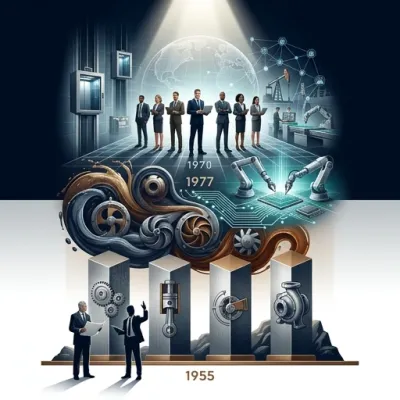
Dover Corporation's history traces a remarkable evolution from a 1955 consolidation of four niche industrial businesses—C. Lee Cook, Rotary Lift, W.C. Norris, and Peerless—into a diversified S&P 500 giant. Founded by investor George L. Ohrstrom Sr. and led initially by Fred Durham, the company established a unique decentralized philosophy, empowering acquired management teams to "run it like you own it." This autonomy fostered entrepreneurial agility, allowing Dover to navigate post-war industrial expansion and the volatile 1970s with strategic acquisitions in fluid handling (Blackmer, Waukesha) and a pivotal 1977 entry into electronics automation via Universal Instruments. This diversified portfolio, spanning elevators, energy equipment, pumps, and high-tech assembly, provided inherent resilience against economic cycles.
Throughout the 1980s and 1990s, under leaders like Thomas Sutton and Gary Roubos, Dover accelerated its global reach and embraced the digital revolution, integrating intelligence into its mechanical products. A rigorous approach to portfolio management defined this era; the company divested non-core assets like Peerless (1977) and, most significantly, its flagship Elevator division (1999) for $1.1 billion. This bold move unlocked capital to double down on higher-growth, technology-intensive segments such as product identification (Markem-Imaje) and specialized fluid management. The strategy refined Dover into a focused collection of market-leading platforms characterized by strong cash flow, recurring revenue from aftermarket services, and defensible niche positions.
In the 21st century, Dover has continuously adapted to globalization, the Great Recession, and the COVID-19 pandemic by leveraging its decentralized model for rapid, localized decision-making. The company has pivoted decisively toward "Intelligent and Connected Solutions," embedding sensors, software, and data analytics into pumps, fueling systems, and printing technologies to drive predictive maintenance and operational efficiency for customers. Sustainability has become a core growth vector, with investments in clean energy infrastructure like hydrogen dispensing and EV charging. Disciplined bolt-on acquisitions and a commitment to operational excellence have maintained financial robustness, ensuring consistent shareholder returns through dividends and buybacks.
Today, Dover stands as a legacy of innovation and resilience, built not on a single product but on a culture of distributed accountability and pragmatic problem-solving. Its transformation from a holding company for mechanical components to a provider of sophisticated, digitally enabled industrial solutions illustrates the power of its founding principles. By maintaining a decentralized structure that balances entrepreneurial freedom with corporate financial discipline, Dover has sustained its relevance across seven decades, quietly enabling the critical infrastructure, energy systems, and manufacturing processes that underpin modern global commerce.
What You'll Find Inside:
- The evolution of Dover's distinctive decentralized management philosophy—'run it like you own it'—from its 1955 founding through its role in fostering agility, innovation, and resilience across seven decades.
- A detailed chronicle of strategic portfolio management, including pivotal acquisitions (Universal Instruments, Markem-Imaje, Blackmer Pump) and transformative divestitures (Dover Elevator, Peerless) that reshaped the company for higher-growth markets.
- How Dover navigated major economic cycles—from 1970s stagflation and oil crises to the dot-com bust, Great Recession, and COVID-19—leveraging its diversified industrial portfolio and autonomous operating model.
- The company's technological metamorphosis from mechanical industrial roots (piston rings, sucker rods, elevators) to a provider of intelligent, digitally connected solutions across fluid handling, product identification, and clean energy.
- Insights into Dover's S&P 500 journey, global expansion strategy, sustainability commitments, and the human capital culture that underpinned its enduring shareholder value creation.
Who's It For:
This book is ideal for business leaders, corporate strategists, and investors seeking a deep case study in long-term value creation through decentralized management and disciplined portfolio evolution. Students of industrial history and organizational design will gain practical insights into how a conglomerate maintains entrepreneurial agility across diverse sectors and economic eras. Professionals in M&A, operations, and innovation management will find actionable lessons in Dover's acquisition integration, divestiture timing, and digital transformation approaches.
Introduction
In the annals of American industry, certain companies stand as enduring testaments to innovation, adaptability, and sustained growth. Among these, Dover Corporation occupies a distinguished position, not merely as a constituent of the prestigious S&P 500, but as a dynamic force that has consistently shaped the landscape of diverse industrial sectors for decades. This book, A History of Dover Corporation: The Story of an S&P 500 Company, embarks on a comprehensive journey to chronicle the remarkable evolution of an enterprise that began with a singular vision and expanded into a global industrial giant.
This narrative is more than a mere corporate chronology; it is an exploration of the strategic decisions, technological breakthroughs, and human ingenuity that have defined Dover's trajectory. From its foundational years, characterized by a nascent yet ambitious drive for diversification, to its current standing as a diversified global manufacturer, Dover has consistently demonstrated a capacity to anticipate market shifts, embrace new opportunities, and overcome economic challenges. The chapters ahead will illuminate how the company navigated the complexities of various eras, from the economic booms and downturns of the mid-20th century to the transformative digital revolution and the ever-evolving demands for sustainable practices in the 21st century.
Enjoying it? The full book includes every chapter.
Table of Contents:
- Introduction Free
- Chapter 1 The Genesis of an Industrial Giant Free
- Chapter 2 Early Diversification and Growth (1955-1965)
- Chapter 3 Navigating the Economic Landscape of the 60s
- Chapter 4 Expansion and Acquisition Strategies (1970s)
- Chapter 5 The Energy Sector and Dover's Role
- Chapter 6 Innovation in Manufacturing and Technology
- Chapter 7 Leadership Transitions and New Visions
- Chapter 8 Global Reach: Expanding Beyond North America
- Chapter 9 Adapting to Market Shifts (1980s)
- Chapter 10 The Digital Revolution and Dover's Response
- Chapter 11 Strategic Divestitures and Core Focus
- Chapter 12 Environmental Responsibility and Sustainable Practices
- Chapter 13 The S&P 500 Journey: Milestones and Impact
- Chapter 14 Cultivating a Culture of Excellence
- Chapter 15 Dover's Contribution to Infrastructure Development
- Chapter 16 The 21st Century: New Challenges and Opportunities
- Chapter 17 Mergers and Acquisitions: Shaping the Portfolio
- Chapter 18 Financial Performance and Shareholder Value
- Chapter 19 Overcoming Economic Downturns
- Chapter 20 Research and Development: Fueling Future Growth
- Chapter 21 The Human Element: Employees and Community
- Chapter 22 Navigating Regulatory Environments
- Chapter 23 From Industrial Roots to Modern Solutions
- Chapter 24 The Future of Dover: Vision and Strategy
- Chapter 25 A Legacy of Innovation and Resilience
Included when you buy the full book.
Author:
Published By:
Date Published:
August 30, 2026
Type:
Nonfiction
Language:
English
Word Count:
37,201 words
Reading Time:
2 hours 36 minutes
Sample:
Order:
Order A History of Dover Corporation (Paperback) on MixCache.com:
Buy NowIncludes every chapter. Not sure yet? Read the opening free.
Print copy is made to order and ships worldwide. Includes the ebook free, ready to read instantly.
$5 account credit for all new MixCache.com accounts, usable toward any ebook purchase!*