Browse by Category
Fiction
- Action & Adventure
- African American
- Anthologies
- Children's Fiction
- Classics
- Comics & Graphic Novels
- Coming of Age
- Contemporary
- Cultural & Regional
- Drama
- Erotica
- Fantasy
- General
- Historical Fiction
- Horror
- Humor & Satire
- Literary Fiction
- Mystery, Thriller & Suspense
- Poetry
- Religious & Inspirational
- Romance
- Science Fiction
- Short Stories
- War & Military
- Westerns
- Women's Fiction
- Young Adult
Non-Fiction
- Antiques & Collectibles
- Arts & Photography
- Biographies & Memoirs
- Business & Money
- Children's Non-Fiction
-
Computers & Technology
- Artificial Intelligence
- Computer Science
- Cybersecurity & Cryptography
- Data Science & Analytics
- Databases & Big Data
- Game Development & Design
- General
- Hardware & DIY
- Mobile App Development
- Networking & Cloud Computing
- Operating Systems
- Programming
- Robotics
- Software
- Software Engineering
- User Experience (UX) & Design
- Web Development & Design
- Cooking, Food & Wine
- Crafts, Hobbies & Home
- Education & Teaching
- Engineering
- General
- Health, Fitness & Dieting
-
History
- African History
- African History - North Africa
- African History - Sub-Saharan Africa
- American History
- American History - 20th Century
- American History - Civil War
- American History - Colonial Period
- Ancient History
- Asian History
- Asian History - China
- Asian History - India
- Asian History - Japan
- Asian History - Southeast Asia
- European History
- European History - Ancient Greece
- European History - Ancient Rome
- European History - Medieval
- European History - Modern
- European History - Renaissance
- General
- Middle Eastern History
- Military History
- Military History - Aviation
- Military History - Naval
- Social & Cultural History
- World History
- Humor & Entertainment
- Industrial Technology
- Language Learning
- Law
- LGBTQ+ Non-Fiction
- Literary Criticism
- Medical Books
- Parenting & Relationships
- Philosophy
- Politics & Social Sciences
- Reference
- Religion & Spirituality
-
Science & Math
- Agricultural Sciences
- Astronomy & Space Science
- Behavioral Sciences
- Biological Sciences
- Botany & Plant Science
- Chemistry
- Earth Sciences
- Engineering - Chemical
- Engineering - Civil
- Engineering - Electrical
- Engineering - Mechanical
- Environment
- General
- Geology
- Mathematics
- Nature & Ecology
- Oceanography
- Paleontology
- Physics
- Statistics
- Self-Help
- Sports & Outdoors
- Study Aids
- Sustainability & Green Living
- Textbooks
- Transportation
- Travel
- True Crime
- Urban Planning & Development
- Veterinary Medicine
- Writing & Publishing
Jump to Section

Want unlimited access to all books published by MixCache.com (plus their audiobooks)? Try MixCache.com Total Access. Look for the MTA badge on book covers to identify included titles.
Access to infinite ebooks: Don't see the book you want? Suggest it and we'll create it (free!) for you from scratch with our powerful AI book writer. Then read it with MTA - besides profiting from any sales it makes!
Netherlands's Water Management
MTA
Engineering Diplomacy and Adaptation to Rising Seas
About this book:
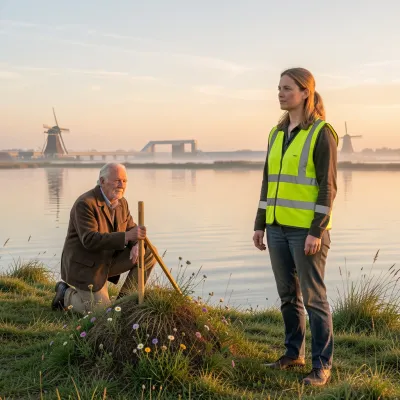
The Netherlands' relationship with water is a foundational element of its national identity, evolving from rudimentary survival strategies like *terpen* (artificial mounds) to sophisticated, large-scale engineering feats. Early communal efforts to build dikes and manage drainage laid the groundwork for enduring institutions such as the *waterschappen* (water boards), which established a model of collective responsibility and localized governance. Monumental projects like the Zuyderzee Works, which reclaimed vast inland seas into fertile polders and freshwater lakes, and the Delta Works, a response to the catastrophic 1953 flood featuring storm surge barriers like the Oosterscheldekering and Maeslantkering, transformed the landscape and established global benchmarks for flood protection and land reclamation.
This engineering prowess is deeply intertwined with a unique socio-political framework centered on collaboration and long-term planning. The polder system and water boards exemplify a centuries-old tradition of democratic, consensus-based management where beneficiaries directly fund and maintain water infrastructure. This model has evolved to integrate spatial planning, technological innovation, and environmental considerations, shifting from purely defensive strategies to approaches like "Room for the River" that give rivers more space to mitigate flood risk while enhancing ecology. Modern practices emphasize layered safety, combining hard infrastructure with building-with-nature principles such as the Sand Engine nourishment project, sustainable urban water management, and advanced monitoring systems driven by continuous research and development at institutes like Deltares and Delft University of Technology.
Facing 21st-century challenges of accelerating sea level rise and extreme weather, the Netherlands employs adaptive frameworks like the Delta Programme, projecting to 2100 and beyond. Strategies include expanding nature-based solutions, enhancing freshwater security, implementing smart technology and real-time data analytics, fostering public-private partnerships for innovation, and sharing expertise globally through networks like the Netherlands Water Partnership and the Delta Alliance. The enduring commitment to water safety, rooted in historical vulnerability and cultural resilience, ensures continuous investment, intergenerational stewardship, and a philosophy of living with water rather than merely fighting it, positioning the Dutch experience as a vital blueprint for global climate adaptation and sustainable water management.
What You'll Find Inside:
- Traces the historical development of Dutch water management from early terpen and dikes to monumental projects like the Zuiderzee Works and Delta Works.
- Explains the collaborative governance model of polders and water boards that enables collective decision-making, long-term planning, and shared responsibility.
- Highlights engineering innovations such as storm surge barriers, advanced pumping stations, and nature‑based solutions like Room for the River and the Sand Engine.
- Details contemporary adaptation strategies for climate change, including layered safety, coastal nourishment, adaptive pathways, and smart urban water design.
- Shows how Dutch expertise is shared globally through water diplomacy, public‑private partnerships, and knowledge export to help other nations address water challenges.
Who's It For:
This book is ideal for civil engineers, water resource managers, urban planners, policymakers, and environmental scientists seeking practical lessons from the Netherlands’ centuries‑long experience with flood protection and climate adaptation. It also serves as a valuable resource for students and researchers interested in resilient infrastructure, collaborative governance, and sustainable water practices, especially those working in low‑lying or coastal regions facing similar challenges.
Author:
Published By:
Date Published:
August 8, 2026
Type:
Nonfiction
Language:
English
Word Count:
37,875 words
Reading Time:
2 hours 39 minutes
Sample:
Order:
Order Netherlands's Water Management (Paperback) on MixCache.com:
Buy NowPrint copy is made to order and ships worldwide. Includes the ebook free, ready to read instantly.
$5 account credit for all new MixCache.com accounts, usable toward any ebook purchase!*