Browse by Category
Fiction
- Action & Adventure
- African American
- Anthologies
- Children's Fiction
- Classics
- Comics & Graphic Novels
- Coming of Age
- Contemporary
- Cultural & Regional
- Drama
- Erotica
- Fantasy
- General
- Historical Fiction
- Horror
- Humor & Satire
- Literary Fiction
- Mystery, Thriller & Suspense
- Poetry
- Religious & Inspirational
- Romance
- Science Fiction
- Short Stories
- War & Military
- Westerns
- Women's Fiction
- Young Adult
Non-Fiction
- Antiques & Collectibles
- Arts & Photography
- Biographies & Memoirs
- Business & Money
- Children's Non-Fiction
-
Computers & Technology
- Artificial Intelligence
- Computer Science
- Cybersecurity & Cryptography
- Data Science & Analytics
- Databases & Big Data
- Game Development & Design
- General
- Hardware & DIY
- Mobile App Development
- Networking & Cloud Computing
- Operating Systems
- Programming
- Robotics
- Software
- Software Engineering
- User Experience (UX) & Design
- Web Development & Design
- Cooking, Food & Wine
- Crafts, Hobbies & Home
- Education & Teaching
- Engineering
- General
- Health, Fitness & Dieting
-
History
- African History
- African History - North Africa
- African History - Sub-Saharan Africa
- American History
- American History - 20th Century
- American History - Civil War
- American History - Colonial Period
- Ancient History
- Asian History
- Asian History - China
- Asian History - India
- Asian History - Japan
- Asian History - Southeast Asia
- European History
- European History - Ancient Greece
- European History - Ancient Rome
- European History - Medieval
- European History - Modern
- European History - Renaissance
- General
- Middle Eastern History
- Military History
- Military History - Aviation
- Military History - Naval
- Social & Cultural History
- World History
- Humor & Entertainment
- Industrial Technology
- Language Learning
- Law
- LGBTQ+ Non-Fiction
- Literary Criticism
- Medical Books
- Parenting & Relationships
- Philosophy
- Politics & Social Sciences
- Reference
- Religion & Spirituality
-
Science & Math
- Agricultural Sciences
- Astronomy & Space Science
- Behavioral Sciences
- Biological Sciences
- Botany & Plant Science
- Chemistry
- Earth Sciences
- Engineering - Chemical
- Engineering - Civil
- Engineering - Electrical
- Engineering - Mechanical
- Environment
- General
- Geology
- Mathematics
- Nature & Ecology
- Oceanography
- Paleontology
- Physics
- Statistics
- Self-Help
- Sports & Outdoors
- Study Aids
- Sustainability & Green Living
- Textbooks
- Transportation
- Travel
- True Crime
- Urban Planning & Development
- Veterinary Medicine
- Writing & Publishing
Jump to Section

Want unlimited access to all books published by MixCache.com (plus their audiobooks)? Try MixCache.com Total Access. Look for the MTA badge on book covers to identify included titles.
Access to infinite ebooks: Don't see the book you want? Suggest it and we'll create it (free!) for you from scratch with our powerful AI book writer. Then read it with MTA - besides profiting from any sales it makes!
History of the Silk Road
MTA
Trade, Culture, and Empire Across Eurasia
About this book:
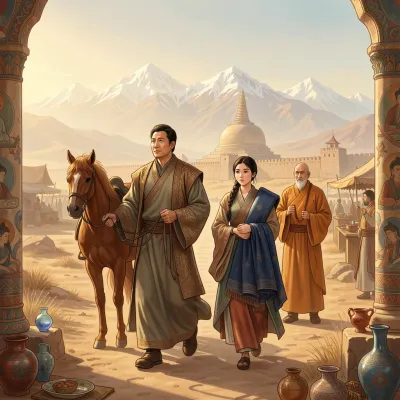
The Silk Road began as sporadic exchanges between settled agriculturalists and nomadic steppe peoples, gradually evolving into a network facilitated by horse domestication, wheeled transport, and early empires. The Han Dynasty’s westward push under Emperor Wu, sparked by the quest for allies against the Xiongnu and the desire for Ferghana horses, formalized routes and opened China to Central Asian goods like silk, jade, and new crops. Parthia and later the Sasanian Empire acted as crucial intermediaries between Han China and the Roman/Byzantine worlds, profiting from the transit of silk and other luxuries while also exporting Persian textiles, metalwork, and agricultural innovations. The Kushan Empire further transformed the route into a crossroads of Buddhism, art, and trade, linking India, China, Persia, and the Mediterranean through cities like Taxila and Mathura.
During the first millennium CE, the Silk Road flourished under the Tang Dynasty’s cosmopolitan capital Chang’an, which attracted Sogdian merchants—the lingua franca of trade—alongside Buddhist, Nestorian Christian, and Manichaean missionaries. The Islamic Caliphates inherited and expanded this network, establishing Baghdad as a global hub and facilitating the spread of paper, gunpowder, and printing from China to the West. The Mongol Empire’s Pax Mongolica then unified the vast Eurasian landmass under a single administration, securing the yam relay system, lowering trade barriers, and enabling unprecedented cultural and technological exchange—including the transmission of gunpowder and printing to Europe—while also inadvertently accelerating the spread of the Black Death, which devastated populations and disrupted overland commerce.
The Ming Dynasty’s retreat into isolation, the rise of maritime trade during the Age of Exploration, and the eventual European discovery of sea routes to Asia shifted global commerce away from the land-based Silk Road. Nevertheless, the route’s legacy endured in geopolitical rivalries, cultural memory, and modern initiatives such as China’s Belt and Road Initiative, which revives the ancient vision of Eurasian connectivity through infrastructure, trade, and digital networks. Throughout its history, the Silk Road was not merely a conduit for silk and spices but a dynamic vector for religions, ideas, technologies, crops, and diseases, shaping the interconnected world that underlies today’s globalization.
What You'll Find Inside:
- The Silk Road was a dynamic network enabling exchange of goods, ideas, technologies, and religions across Eurasia for millennia, transforming societies far beyond mere commerce.
- Key empires from Han China and Rome to Islamic Caliphates and the Mongols actively shaped, protected, and profited from Silk Road trade while facilitating cultural diffusion.
- Transformative technologies like paper-making, gunpowder, and printing spread westward from China, revolutionizing warfare, scholarship, and administration in Eurasia and Europe.
- Major religions including Buddhism, Christianity, Islam, and Manichaeism traveled the Silk Road, adapting to local cultures and permanently altering spiritual landscapes from India to East Asia.
- Though overland routes declined with maritime trade, the Silk Road's legacy endures in modern geopolitics, cultural memory, and initiatives like China's Belt and Road, demonstrating its relevance to contemporary globalization.
Who's It For:
This comprehensive history is particularly valuable for undergraduate and graduate students in history, anthropology, or international relations, as well as educated general readers fascinated by global interconnectedness. It offers deep insights for scholars studying Eurasian civilizations, the transmission of culture and technology, or the historical foundations of modern globalization. Readers interested in contemporary geopolitical initiatives like China's Belt and Road will appreciate the historical context provided. The book balances scholarly rigor with accessibility, making it suitable for both academic study and personal learning about how ancient trade routes shaped our interconnected world.
Author:
Published By:
Date Published:
August 7, 2026
Type:
Nonfiction
Language:
English
Word Count:
40,619 words
Reading Time:
2 hours 51 minutes
Sample:
Order:
Order History of the Silk Road (Paperback) on MixCache.com:
Buy NowPrint copy is made to order and ships worldwide. Includes the ebook free, ready to read instantly.
$5 account credit for all new MixCache.com accounts, usable toward any ebook purchase!*