
Browse by Category
Fiction
- Action & Adventure
- African American
- Anthologies
- Children's Fiction
- Classics
- Comics & Graphic Novels
- Coming of Age
- Contemporary
- Cultural & Regional
- Drama
- Erotica
- Fantasy
- General
- Historical Fiction
- Horror
- Humor & Satire
- Literary Fiction
- Mystery, Thriller & Suspense
- Poetry
- Religious & Inspirational
- Romance
- Science Fiction
- Short Stories
- War & Military
- Westerns
- Women's Fiction
- Young Adult
Non-Fiction
- Antiques & Collectibles
- Arts & Photography
- Biographies & Memoirs
- Business & Money
- Children's Non-Fiction
-
Computers & Technology
- Artificial Intelligence
- Computer Science
- Cybersecurity & Cryptography
- Data Science & Analytics
- Databases & Big Data
- Game Development & Design
- General
- Hardware & DIY
- Mobile App Development
- Networking & Cloud Computing
- Operating Systems
- Programming
- Robotics
- Software
- Software Engineering
- User Experience (UX) & Design
- Web Development & Design
- Cooking, Food & Wine
- Crafts, Hobbies & Home
- Education & Teaching
- Engineering
- General
- Health, Fitness & Dieting
-
History
- African History
- African History - North Africa
- African History - Sub-Saharan Africa
- American History
- American History - 20th Century
- American History - Civil War
- American History - Colonial Period
- Ancient History
- Asian History
- Asian History - China
- Asian History - India
- Asian History - Japan
- Asian History - Southeast Asia
- European History
- European History - Ancient Greece
- European History - Ancient Rome
- European History - Medieval
- European History - Modern
- European History - Renaissance
- General
- Middle Eastern History
- Military History
- Military History - Aviation
- Military History - Naval
- Social & Cultural History
- World History
- Humor & Entertainment
- Industrial Technology
- Language Learning
- Law
- LGBTQ+ Non-Fiction
- Literary Criticism
- Medical Books
- Parenting & Relationships
- Philosophy
- Politics & Social Sciences
- Reference
- Religion & Spirituality
-
Science & Math
- Agricultural Sciences
- Astronomy & Space Science
- Behavioral Sciences
- Biological Sciences
- Botany & Plant Science
- Chemistry
- Earth Sciences
- Engineering - Chemical
- Engineering - Civil
- Engineering - Electrical
- Engineering - Mechanical
- Environment
- General
- Geology
- Mathematics
- Nature & Ecology
- Oceanography
- Paleontology
- Physics
- Statistics
- Self-Help
- Sports & Outdoors
- Study Aids
- Sustainability & Green Living
- Textbooks
- Transportation
- Travel
- True Crime
- Urban Planning & Development
- Veterinary Medicine
- Writing & Publishing
Jump to Section

Want unlimited access to all books published by MixCache.com (plus their audiobooks)? Try MixCache.com Total Access. Look for the MTA badge on book covers to identify included titles.
Access to infinite ebooks: Don't see the book you want? Suggest it and we'll create it (free!) for you from scratch with our powerful AI book writer. Then read it with MTA - besides profiting from any sales it makes!
Serbia's Medieval Legacy
MTA
Monasteries Monuments and the Formation of National Consciousness
About this book:
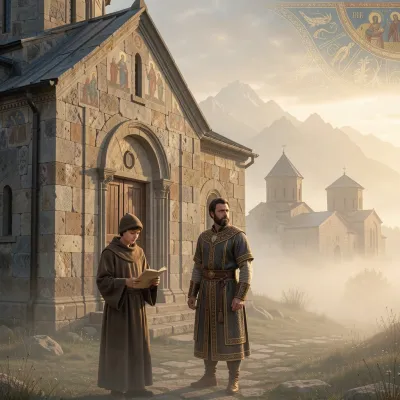
The book traces Serbia’s medieval origins from the settlement of Slavic tribes and their gradual Christianization under Byzantine influence, through the pivotal unification efforts of Stefan Nemanja, who forged the Nemanjić dynasty and laid the political and spiritual foundations of an independent Serbian state. It details the reigns of key Nemanjić rulers: Saint Sava’s establishment of an autocephalous Serbian Orthodox Church and his legal and educational reforms; the architectural and artistic patronage seen in monasteries such as Studenica and Žiča; the cultural flourishing under King Milutin, whose frescoes and churches exemplify the Palaiologan Renaissance; Stefan Dečanski’s monumental Visoki Dečani; and Dušan the Mighty’s imperial expansion, legal code, and brief imperial zenith. These chapters illustrate how religion, law, art, and monumental architecture intertwined to create a distinct Serbian identity rooted in Orthodoxy and a sense of divine sanction for rulership.
The narrative then shifts to the Ottoman conquest after the Battle of Kosovo in 1389, which, despite military defeat, became a foundational myth through epic poetry and the gusle, transforming loss into a spiritual triumph centered on Prince Lazar’s heavenly choice and Miloš Obilić’s heroic sacrifice. Under centuries of Ottoman rule, the Serbian Orthodox Church—particularly after the re‑establishment of the Patriarchate of Peć in 1557—monasteries, and oral tradition served as vital havens preserving literacy, religious texts, frescoes, and relics. The text highlights the resilience of monastic life, the role of the printing press (from Cetinje to Venetian émigré presses), and the continued artistic production in a post‑Byzantine style that kept alive the visual and theological heritage of the Nemanjić era despite political subjugation and cultural pressures.
Finally, the book examines how these preserved memories fueled the Serbian national awakening in the 18th and 19th centuries, with scholars like Jovan Rajić and Vuk Karadžić translating oral epics and historical chronicles into a modern national consciousness that inspired uprisings and the eventual establishment of an independent Serbian state. It discusses the legacy’s expression in modern art, literature, and architecture; the UNESCO protection of sites such as Stari Ras, Sopoćani, Studenica, Visoki Dečani, Gračanica, and the Patriarchate of Peć; and contemporary interpretations that continue to reimagine the medieval past as a living component of Serbian identity, balancing reverence with critical scholarship and acknowledging the enduring influence of the Nemanjić era’s spiritual, artistic, and political foundations on the modern nation.
What You'll Find Inside:
- The Nemanjić dynasty unified Serbian lands, secured autocephaly for the Serbian Orthodox Church, and laid the political‑spiritual foundations of a distinct national consciousness.
- Royal monasteries such as Studenica, Žiča, Gračanica and Visoki Dečani functioned as hubs of Orthodox theology, artistic patronage, manuscript production, and relic veneration, preserving Serbian heritage through centuries of change.
- The Battle of Kosovo was transmuted into the Kosovo Cycle of epic poetry, turning defeat into a moral myth of sacrifice, faith and resistance that shaped Serbian identity during Ottoman rule and beyond.
- Dušan’s comprehensive legal code and the intermittent restoration of the Patriarchate of Peć provided legal and ecclesiastical continuity, reinforcing statehood and Orthodox cohesion even under foreign domination.
- Today Serbia’s medieval legacy endures in UNESCO‑protected sites, contemporary art and literature, and living traditions such as the gusle and saint veneration, linking past glory to modern national self‑understanding.
Who's It For:
This book is suited for students and scholars of Balkan and medieval history, especially those exploring how religion, art, and law intertwine in nation‑building. It will also appeal to general readers interested in Serbia’s Orthodox heritage, epic traditions, and the role of memory in forming a lasting cultural identity. Educators, heritage professionals, and anyone fascinated by the preservation and reinterpretation of medieval monuments in a modern context will find valuable insights.
Author:
Published By:
Date Published:
August 7, 2026
Type:
Nonfiction
Language:
English
Word Count:
39,330 words
Reading Time:
2 hours 45 minutes
Sample:
Order:
Order Serbia's Medieval Legacy (Paperback) on MixCache.com:
Buy NowPrint copy is made to order and ships worldwide. Includes the ebook free, ready to read instantly.
$5 account credit for all new MixCache.com accounts, usable toward any ebook purchase!*


