Browse by Category
Fiction
- Action & Adventure
- African American
- Anthologies
- Children's Fiction
- Classics
- Comics & Graphic Novels
- Coming of Age
- Contemporary
- Cultural & Regional
- Drama
- Erotica
- Fantasy
- General
- Historical Fiction
- Horror
- Humor & Satire
- Literary Fiction
- Mystery, Thriller & Suspense
- Poetry
- Religious & Inspirational
- Romance
- Science Fiction
- Short Stories
- War & Military
- Westerns
- Women's Fiction
- Young Adult
Non-Fiction
- Antiques & Collectibles
- Arts & Photography
- Biographies & Memoirs
- Business & Money
- Children's Non-Fiction
-
Computers & Technology
- Artificial Intelligence
- Computer Science
- Cybersecurity & Cryptography
- Data Science & Analytics
- Databases & Big Data
- Game Development & Design
- General
- Hardware & DIY
- Mobile App Development
- Networking & Cloud Computing
- Operating Systems
- Programming
- Robotics
- Software
- Software Engineering
- User Experience (UX) & Design
- Web Development & Design
- Cooking, Food & Wine
- Crafts, Hobbies & Home
- Education & Teaching
- Engineering
- General
- Health, Fitness & Dieting
-
History
- African History
- African History - North Africa
- African History - Sub-Saharan Africa
- American History
- American History - 20th Century
- American History - Civil War
- American History - Colonial Period
- Ancient History
- Asian History
- Asian History - China
- Asian History - India
- Asian History - Japan
- Asian History - Southeast Asia
- European History
- European History - Ancient Greece
- European History - Ancient Rome
- European History - Medieval
- European History - Modern
- European History - Renaissance
- General
- Middle Eastern History
- Military History
- Military History - Aviation
- Military History - Naval
- Social & Cultural History
- World History
- Humor & Entertainment
- Industrial Technology
- Language Learning
- Law
- LGBTQ+ Non-Fiction
- Literary Criticism
- Medical Books
- Parenting & Relationships
- Philosophy
- Politics & Social Sciences
- Reference
- Religion & Spirituality
-
Science & Math
- Agricultural Sciences
- Astronomy & Space Science
- Behavioral Sciences
- Biological Sciences
- Botany & Plant Science
- Chemistry
- Earth Sciences
- Engineering - Chemical
- Engineering - Civil
- Engineering - Electrical
- Engineering - Mechanical
- Environment
- General
- Geology
- Mathematics
- Nature & Ecology
- Oceanography
- Paleontology
- Physics
- Statistics
- Self-Help
- Sports & Outdoors
- Study Aids
- Sustainability & Green Living
- Textbooks
- Transportation
- Travel
- True Crime
- Urban Planning & Development
- Veterinary Medicine
- Writing & Publishing
Jump to Section

Want unlimited access to all books published by MixCache.com (plus their audiobooks)? Try MixCache.com Total Access. Look for the MTA badge on book covers to identify included titles.
Access to infinite ebooks: Don't see the book you want? Suggest it and we'll create it (free!) for you from scratch with our powerful AI book writer. Then read it with MTA - besides profiting from any sales it makes!
A History of BMW Group
MTA
The Story of a Global Company
About this book:
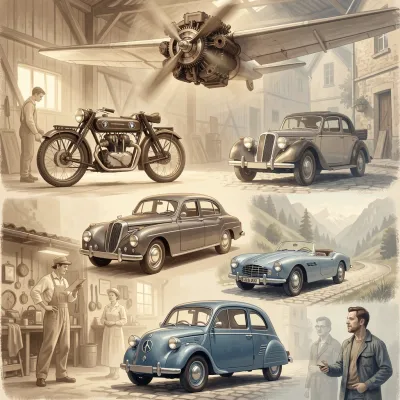
The BMW Group traces its origins to 1916 when Bayerische Motoren Werke emerged from the reorganization of Rapp Motorenwerke and Gustav Otto’s aircraft ventures, initially producing aircraft engines before being forced by the Treaty of Versailles to diversify into motorcycles, agricultural equipment, and other products. The breakthrough came in 1923 with the BMW R32 motorcycle, establishing the hallmark boxer engine and shaft drive, and in 1929 BMW entered automobile manufacturing by acquiring Fahrzeugfabrik Eisenach and rebadging the Dixi as the BMW 3/15. Throughout the 1930s the company forged its identity with the innovative BMW 303—featuring the first inline‑six engine and the iconic kidney grille—and the legendary BMW 328 sports car, while also maintaining a strong presence in aircraft engine production during World War II.
After the war, BMW survived through modest motorcycle production and the micro‑car Isetta, which kept the firm afloat financially. A near‑bankruptcy in the late 1950s was averted by Herbert Quandt’s intervention, setting the stage for the “Neue Klasse” of 1961—a new line of sporty, affordable sedans that revived the brand’s fortunes. This platform spawned the immensely popular 02 Series (notably the 2002), the New Six luxury line, and eventually the 3, 5, 6, and 7 Series models, establishing BMW as a producer of driver‑focused premium vehicles. Concurrently, BMW Motorrad continued to evolve, introducing iconic machines such as the R90S and later the K‑series, while the company’s engineering prowess was demonstrated through advancements in engine technology, safety systems, aerodynamics, and manufacturing excellence.
From the 1970s onward BMW expanded globally, opening plants in the United States, China, and South Africa, and pursued a multi‑brand strategy through the acquisition of the Rover Group (retaining Mini) and Rolls‑Royce Motor Cars. The firm blended performance with luxury, pioneered technologies such as turbocharging, electronic fuel injection, ABS, and iDrive, and achieved motorsport dominance in touring cars, Formula 1, and motorcycle racing. In the 21st century BMW embraced sustainability and electrification through Project i (i3, i8) and later fully electric models (iX, i4, iX3), while advancing digital connectivity, driver‑assistance systems, and autonomous‑driving research. Throughout, the Group has emphasized corporate social responsibility, environmental stewardship, and brand management, positioning itself as a leader in sustainable mobility, digitalization, and the future of transportation, guided by the enduring promise of “Sheer Driving Pleasure.”
What You'll Find Inside:
- Traces BMW's transformation from aircraft engine manufacturer to global automotive leader, covering pivotal moments like the Neue Klasse revival and strategic Mini/Rolls-Royce acquisitions.
- Details engineering innovations including boxer motorcycle engines, inline-six powerplants, V12 development, and breakthroughs in electric vehicle technology through Project i and Neue Klasse platform.
- Explores BMW's motorsport legacy from early motorcycle records to Formula 1 success and how racing achievements directly influenced road car development and the 'Sheer Driving Pleasure' brand ethos.
- Examines BMW's global expansion strategy, manufacturing excellence, and economic impact, including localized production in key markets like USA, China, and South Africa.
- Covers BMW's approach to modern challenges including sustainability initiatives, digitalization, autonomous driving, and corporate social responsibility while preserving core brand values.
Who's It For:
This book is ideal for automotive enthusiasts, business students, corporate strategists, and engineering professionals interested in understanding how a company navigates over a century of technological change, economic challenges, and market evolution. It will particularly appeal to readers fascinated by brand management, innovation case studies, and the automotive industry's transformation from traditional manufacturing to sustainable mobility solutions.
Author:
Published By:
Date Published:
July 28, 2026
Type:
Nonfiction
Language:
English
Word Count:
42,988 words
Reading Time:
3 hours 1 minutes
Sample:
Order:
Order A History of BMW Group (Paperback) on MixCache.com:
Buy NowPrint copy is made to order and ships worldwide. Includes the ebook free, ready to read instantly.
$5 account credit for all new MixCache.com accounts, usable toward any ebook purchase!*