
Browse by Category
Fiction
- Action & Adventure
- African American
- Anthologies
- Children's Fiction
- Classics
- Comics & Graphic Novels
- Coming of Age
- Contemporary
- Cultural & Regional
- Drama
- Erotica
- Fantasy
- General
- Historical Fiction
- Horror
- Humor & Satire
- Literary Fiction
- Mystery, Thriller & Suspense
- Poetry
- Religious & Inspirational
- Romance
- Science Fiction
- Short Stories
- War & Military
- Westerns
- Women's Fiction
- Young Adult
Non-Fiction
- Antiques & Collectibles
- Arts & Photography
- Biographies & Memoirs
- Business & Money
- Children's Non-Fiction
-
Computers & Technology
- Artificial Intelligence
- Computer Science
- Cybersecurity & Cryptography
- Data Science & Analytics
- Databases & Big Data
- Game Development & Design
- General
- Hardware & DIY
- Mobile App Development
- Networking & Cloud Computing
- Operating Systems
- Programming
- Robotics
- Software
- Software Engineering
- User Experience (UX) & Design
- Web Development & Design
- Cooking, Food & Wine
- Crafts, Hobbies & Home
- Education & Teaching
- Engineering
- General
- Health, Fitness & Dieting
-
History
- African History
- African History - North Africa
- African History - Sub-Saharan Africa
- American History
- American History - 20th Century
- American History - Civil War
- American History - Colonial Period
- Ancient History
- Asian History
- Asian History - China
- Asian History - India
- Asian History - Japan
- Asian History - Southeast Asia
- European History
- European History - Ancient Greece
- European History - Ancient Rome
- European History - Medieval
- European History - Modern
- European History - Renaissance
- General
- Middle Eastern History
- Military History
- Military History - Aviation
- Military History - Naval
- Social & Cultural History
- World History
- Humor & Entertainment
- Industrial Technology
- Language Learning
- Law
- LGBTQ+ Non-Fiction
- Literary Criticism
- Medical Books
- Parenting & Relationships
- Philosophy
- Politics & Social Sciences
- Reference
- Religion & Spirituality
-
Science & Math
- Agricultural Sciences
- Astronomy & Space Science
- Behavioral Sciences
- Biological Sciences
- Botany & Plant Science
- Chemistry
- Earth Sciences
- Engineering - Chemical
- Engineering - Civil
- Engineering - Electrical
- Engineering - Mechanical
- Environment
- General
- Geology
- Mathematics
- Nature & Ecology
- Oceanography
- Paleontology
- Physics
- Statistics
- Self-Help
- Sports & Outdoors
- Study Aids
- Sustainability & Green Living
- Textbooks
- Transportation
- Travel
- True Crime
- Urban Planning & Development
- Veterinary Medicine
- Writing & Publishing
Jump to Section
MixCache.com Total Access
Unlimited reading and audiobooks for every book published by MixCache.com.
Included titles carry the MTA badge.
Learn more →
A History of Hitachi
MTA
The Story of a Global Company
About this book:
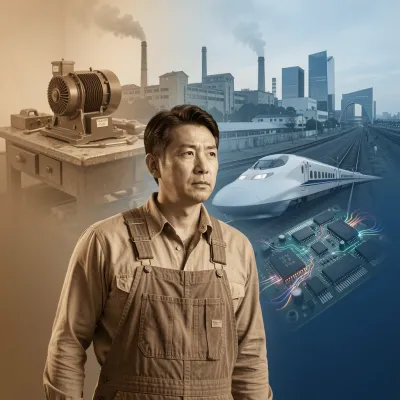
Hitachi began in 1910 when Namihei Odaira built Japan’s first 5‑horsepower induction motor in a small repair shop in Hitachi, Ibaraki Prefecture, embodying a vision of industrial self‑reliance for Japan. The company quickly diversified into generators, transformers, railway equipment, and consumer appliances, surviving the devastation of World War II by shifting from armaments to post‑war reconstruction and becoming a cornerstone of Japan’s economic miracle through heavy industry, power generation, and infrastructure projects. In the 1950s and 1960s Hitachi entered electronics, producing Japan’s first transistor computer (HIPAC 101) and contributing to the Shinkansen’s control systems, while establishing early overseas subsidiaries that laid the groundwork for global expansion.
The 1970s‑1980s saw Hitachi become a leader in semiconductors, mainframe and minicomputer systems, and industrial automation, navigating oil crises and the bubble economy by investing heavily in DRAM, microprocessors, and energy‑efficient technologies. The burst of the bubble in the early 1990s forced aggressive restructuring: divestments of underperforming units, decentralization, and a pivot toward IT services and integrated solutions. This set the stage for the formal adoption of the Social Innovation Business around 2010, which fused operational technology (OT) with information technology (IT) to deliver outcome‑based platforms like Lumada for smart grids, intelligent transportation, healthcare, and industrial automation, supported by strategic acquisitions such as Ansaldo STS/Breda and ABB Power Grids.
Today Hitachi is a global powerhouse focused on sustainable, intelligent solutions across IT, Energy, Industry, Mobility, and Life Sciences. Its core strategy leverages the IT × OT convergence, advanced AI, IoT, and data analytics to address climate change, urbanization, and aging populations, while maintaining ambitious carbon‑neutrality targets and a commitment to corporate social responsibility. The company’s evolution—from a single motor in a local workshop to a diversified, innovation‑driven conglomerate—reflects a century‑long pursuit of contributing to society through superior, original technology.
What You'll Find Inside:
- Hitachi's origins in 1910 with Namihei Odaira's first Japanese-made induction motor, establishing the founding vision of industrial self-reliance and societal contribution through superior technology.
- Strategic diversification from electrical machinery into heavy industry, electronics, computing, and global markets, driven by innovation and adaptation to Japan's modernization needs.
- Resilience through world wars, economic bubbles, and globalization, demonstrating how core values of Harmony, Sincerity, and Pioneering Spirit guided adaptation to crises and opportunities.
- Evolution into a Social Innovation Business integrating Operational Technology (OT) and Information Technology (IT) to address societal challenges like sustainability, urbanization, and healthcare.
- Current status as a global leader in digital solutions, energy systems, mobility, and life sciences, with ambitious sustainability goals including net-zero emissions by 2050.
Who's It For:
This book is ideal for business historians, corporate strategists, technology professionals, and students interested in the evolution of global industrial conglomerates. It particularly benefits readers seeking to understand how companies navigate technological shifts, economic volatility, and societal challenges while maintaining a long-term commitment to innovation and social contribution through detailed case studies of Hitachi's century-long journey.
Table of Contents:
- Introduction
- Chapter 1 The Foundations of Hitachi: A Vision for Japan
- Chapter 2 Early Diversification and Growth: Beyond the Motors
- Chapter 3 Navigating the World Wars: Challenges and Resilience
- Chapter 4 Post-War Reconstruction and the Rise of Heavy Industry
- Chapter 5 The Dawn of Electronics: Entering a New Era
- Chapter 6 Global Expansion: Establishing an International Presence
- Chapter 7 Innovation in the 1970s: Computing and Beyond
- Chapter 8 The Bubble Economy and Hitachi's Strategic Responses
- Chapter 9 Restructuring and Reinvention in the 1990s
- Chapter 10 Digital Transformation and the Internet Age
- Chapter 11 Global Economic Shifts and Hitachi's Adaptability
- Chapter 12 Focus on Social Innovation Business
- Chapter 13 Advancements in Infrastructure Systems
- Chapter 14 The Evolution of Hitachi's IT Solutions
- Chapter 15 Contributions to Healthcare and Life Sciences
- Chapter 16 Research and Development: Driving Future Growth
- Chapter 17 Mergers, Acquisitions, and Strategic Partnerships
- Chapter 18 Corporate Social Responsibility and Sustainability
- Chapter 19 Hitachi's Role in Emerging Markets
- Chapter 20 Challenges and Opportunities in a Globalized World
- Chapter 21 The Future of Mobility and Transportation
- Chapter 22 Energy Solutions and Environmental Technologies
- Chapter 23 Robotics and Artificial Intelligence at Hitachi
- Chapter 24 Leadership and Corporate Culture Throughout the Years
- Chapter 25 Hitachi Today: A Global Powerhouse in the 21st Century
Author:
Published By:
Date Published:
July 24, 2026
Type:
Nonfiction
Language:
English
Word Count:
36,454 words
Reading Time:
2 hours 33 minutes
Sample:
Order:
Order A History of Hitachi (Paperback) on MixCache.com:
Buy NowPrint copy is made to order and ships worldwide. Includes the ebook free, ready to read instantly.
$5 account credit for all new MixCache.com accounts, usable toward any ebook purchase!*


