Browse by Category
Fiction
- Action & Adventure
- African American
- Anthologies
- Children's Fiction
- Classics
- Comics & Graphic Novels
- Coming of Age
- Contemporary
- Cultural & Regional
- Drama
- Erotica
- Fantasy
- General
- Historical Fiction
- Horror
- Humor & Satire
- Literary Fiction
- Mystery, Thriller & Suspense
- Poetry
- Religious & Inspirational
- Romance
- Science Fiction
- Short Stories
- War & Military
- Westerns
- Women's Fiction
- Young Adult
Non-Fiction
- Antiques & Collectibles
- Arts & Photography
- Biographies & Memoirs
- Business & Money
- Children's Non-Fiction
-
Computers & Technology
- Artificial Intelligence
- Computer Science
- Cybersecurity & Cryptography
- Data Science & Analytics
- Databases & Big Data
- Game Development & Design
- General
- Hardware & DIY
- Mobile App Development
- Networking & Cloud Computing
- Operating Systems
- Programming
- Robotics
- Software
- Software Engineering
- User Experience (UX) & Design
- Web Development & Design
- Cooking, Food & Wine
- Crafts, Hobbies & Home
- Education & Teaching
- Engineering
- General
- Health, Fitness & Dieting
-
History
- African History
- African History - North Africa
- African History - Sub-Saharan Africa
- American History
- American History - 20th Century
- American History - Civil War
- American History - Colonial Period
- Ancient History
- Asian History
- Asian History - China
- Asian History - India
- Asian History - Japan
- Asian History - Southeast Asia
- European History
- European History - Ancient Greece
- European History - Ancient Rome
- European History - Medieval
- European History - Modern
- European History - Renaissance
- General
- Middle Eastern History
- Military History
- Military History - Aviation
- Military History - Naval
- Social & Cultural History
- World History
- Humor & Entertainment
- Industrial Technology
- Language Learning
- Law
- LGBTQ+ Non-Fiction
- Literary Criticism
- Medical Books
- Parenting & Relationships
- Philosophy
- Politics & Social Sciences
- Reference
- Religion & Spirituality
-
Science & Math
- Agricultural Sciences
- Astronomy & Space Science
- Behavioral Sciences
- Biological Sciences
- Botany & Plant Science
- Chemistry
- Earth Sciences
- Engineering - Chemical
- Engineering - Civil
- Engineering - Electrical
- Engineering - Mechanical
- Environment
- General
- Geology
- Mathematics
- Nature & Ecology
- Oceanography
- Paleontology
- Physics
- Statistics
- Self-Help
- Sports & Outdoors
- Study Aids
- Sustainability & Green Living
- Textbooks
- Transportation
- Travel
- True Crime
- Urban Planning & Development
- Veterinary Medicine
- Writing & Publishing
Jump to Section
MixCache.com Total Access
Unlimited reading and audiobooks for every book published by MixCache.com.
Included titles carry the MTA badge.
Learn more →
Education In Suriname
MTA
A Comprehensive Overview from Early Childhood to Higher Education
About this book:
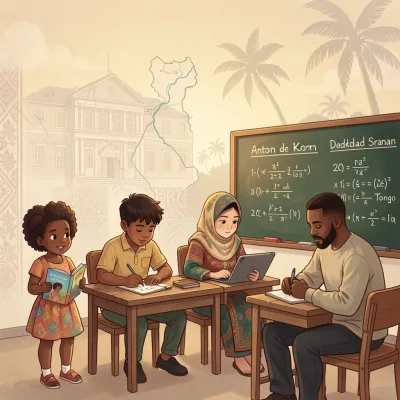
Education in Suriname has evolved from a colonial system designed to serve Dutch interests and maintain social hierarchies into a post‑independent nation‑building effort that seeks to balance Dutch‑language instruction with the country’s rich linguistic and cultural diversity. Early missionary schools provided limited literacy to enslaved and Indigenous peoples, and the 1876 compulsory education law (instruction in Dutch) laid the groundwork for a structured system. After independence in 1975, the Ministry of Education, Science and Culture (MinOWC) centralized policy, the Anton de Kom University of Suriname (AdeKUS) was founded in 1968 and renamed in 1980, and successive reforms have attempted to “Surinamize” curricula, expand access, and address the legacy of Eurocentric content while maintaining ties to Dutch higher education standards.
The Surinamese educational pathway begins with non‑compulsory early childhood education in creches and kleuterscholen, followed by six years of compulsory Basisonderwijs (primary) for ages 6‑12. Secondary education splits into four‑year junior secondary (VOJ) and three‑year senior secondary (VOS), with VOS offering academic streams (VWO for university preparation, HAVO for higher vocational) and vocational tracks. Parallel vocational and technical programs (LBO/MBO) provide practical training aligned with industry needs. Teacher training colleges prepare primary educators, while secondary teachers typically combine subject‑specific degrees with pedagogical qualifications. Higher education is centered on AdeKUS, which encompasses faculties of Medical Sciences, Social Sciences, Technological Sciences, Humanities, and Agricultural Production, supplemented by specialized colleges offering diplomas and associate degrees. Assessment relies on national examinations at the end of each cycle, and Dutch remains the primary language of instruction, necessitating transitional strategies for students whose mother tongues are Sranantongo, Indigenous languages, or other Creoles.
The system faces persistent challenges including uneven resource distribution between urban coastal and remote interior areas, infrastructure deficits, teacher recruitment and retention difficulties—exacerbated by brain drain—and high repetition and dropout rates, particularly among non‑Dutch‑speaking learners. Opportunities lie in leveraging Suriname’s multiculturalism through bilingual education, expanding technology access and digital literacy, strengthening public‑private partnerships, modernizing vocational curricula, and fostering inclusive education for students with special needs. International cooperation—especially with the Netherlands, CARICOM, UNESCO, and the World Bank—supports curriculum reform, teacher training, and infrastructure projects. Case studies illustrate successful culturally responsive schooling in Indigenous communities, industry‑linked vocational training, inclusive learning centers, and university‑driven agricultural research that boosts local livelihoods. Overall, education is viewed as both a social right and an engine of economic development, with ongoing reforms aiming to improve quality, relevance, and equity while aligning skill production with labor market demands and national development goals.
What You'll Find Inside:
- A comprehensive breakdown of Suriname's tiered educational system, from early childhood and primary to secondary, vocational, and higher education at the Anton de Kom University.
- The persistent challenges of multilingualism and language of instruction, where Dutch is the official medium despite a majority of students speaking Sranantongo or other mother tongues at home.
- The critical role of vocational and technical education (LBO/MBO) in developing a skilled workforce and addressing labor market demands in sectors like healthcare, engineering, and technology.
- An analysis of systemic hurdles including resource constraints, teacher recruitment and retention, brain drain of educated professionals, and disparities between urban and remote rural schools.
- Ongoing educational reforms aimed at curriculum modernization, integrating technology, promoting inclusive education, and strengthening ties between schooling and national economic development.
Who's It For:
This book is essential for policymakers and government officials involved in educational planning and reform in Suriname, as well as for educators and school administrators seeking a deeper understanding of the national system's structure and challenges. Researchers in comparative and international education will find it a valuable resource for case studies on post-colonial education, multilingualism, and development. It also serves as an insightful guide for NGOs, international development partners, and anyone invested in the socio-economic progress of Suriname and its human capital development.
Table of Contents:
- Introduction
- Chapter 1: Historical Foundations of Surinamese Education
- Chapter 2: The Structure of the Surinamese Educational System
- Chapter 3: Early Childhood Education: Creches and Kleuterscholen
- Chapter 4: Primary Education: A Foundation for Learning
- Chapter 5: Secondary Education: Junior and Senior Levels
- Chapter 6: Vocational and Technical Education (LBO/MBO)
- Chapter 7: Teacher Training and Professional Development
- Chapter 8: Higher Education Institutions in Suriname
- Chapter 9: The Anton de Kom University of Suriname (AdeKUS)
- Chapter 10: Curriculum Development and Educational Standards
- Chapter 11: Language of Instruction and Multilingualism in Schools
- Chapter 12: Inclusive Education: Addressing Special Needs
- Chapter 13: Education in Rural and Indigenous Communities
- Chapter 14: The Role of Government in Educational Policy
- Chapter 15: Private Schools and Their Contribution to Education
- Chapter 16: Challenges and Opportunities in Surinamese Education
- Chapter 17: Funding and Financing of Education
- Chapter 18: International Cooperation and Educational Exchange
- Chapter 19: The Impact of Technology on Education
- Chapter 20: Adult Education and Lifelong Learning Initiatives
- Chapter 21: Assessment and Evaluation in the Educational System
- Chapter 22: Brain Drain and its Effect on Human Capital
- Chapter 23: Educational Reforms and Future Directions
- Chapter 24: The Link Between Education and Economic Development
- Chapter 25: Case Studies and Success Stories in Surinamese Education
Author:
Published By:
Date Published:
July 5, 2026
Type:
Nonfiction
Language:
English
Word Count:
45,675 words
Reading Time:
3 hours 12 minutes
Sample:
Order:
Order Education In Suriname (Paperback) on MixCache.com:
Buy NowPrint copy is made to order and ships worldwide. Includes the ebook free, ready to read instantly.
$5 account credit for all new MixCache.com accounts, usable toward any ebook purchase!*