Browse by Category
Fiction
- Action & Adventure
- African American
- Anthologies
- Children's Fiction
- Classics
- Comics & Graphic Novels
- Coming of Age
- Contemporary
- Cultural & Regional
- Drama
- Erotica
- Fantasy
- General
- Historical Fiction
- Horror
- Humor & Satire
- Literary Fiction
- Mystery, Thriller & Suspense
- Poetry
- Religious & Inspirational
- Romance
- Science Fiction
- Short Stories
- War & Military
- Westerns
- Women's Fiction
- Young Adult
Non-Fiction
- Antiques & Collectibles
- Arts & Photography
- Biographies & Memoirs
- Business & Money
- Children's Non-Fiction
-
Computers & Technology
- Artificial Intelligence
- Computer Science
- Cybersecurity & Cryptography
- Data Science & Analytics
- Databases & Big Data
- Game Development & Design
- General
- Hardware & DIY
- Mobile App Development
- Networking & Cloud Computing
- Operating Systems
- Programming
- Robotics
- Software
- Software Engineering
- User Experience (UX) & Design
- Web Development & Design
- Cooking, Food & Wine
- Crafts, Hobbies & Home
- Education & Teaching
- Engineering
- General
- Health, Fitness & Dieting
-
History
- African History
- African History - North Africa
- African History - Sub-Saharan Africa
- American History
- American History - 20th Century
- American History - Civil War
- American History - Colonial Period
- Ancient History
- Asian History
- Asian History - China
- Asian History - India
- Asian History - Japan
- Asian History - Southeast Asia
- European History
- European History - Ancient Greece
- European History - Ancient Rome
- European History - Medieval
- European History - Modern
- European History - Renaissance
- General
- Middle Eastern History
- Military History
- Military History - Aviation
- Military History - Naval
- Social & Cultural History
- World History
- Humor & Entertainment
- Industrial Technology
- Language Learning
- Law
- LGBTQ+ Non-Fiction
- Literary Criticism
- Medical Books
- Parenting & Relationships
- Philosophy
- Politics & Social Sciences
- Reference
- Religion & Spirituality
-
Science & Math
- Agricultural Sciences
- Astronomy & Space Science
- Behavioral Sciences
- Biological Sciences
- Botany & Plant Science
- Chemistry
- Earth Sciences
- Engineering - Chemical
- Engineering - Civil
- Engineering - Electrical
- Engineering - Mechanical
- Environment
- General
- Geology
- Mathematics
- Nature & Ecology
- Oceanography
- Paleontology
- Physics
- Statistics
- Self-Help
- Sports & Outdoors
- Study Aids
- Sustainability & Green Living
- Textbooks
- Transportation
- Travel
- True Crime
- Urban Planning & Development
- Veterinary Medicine
- Writing & Publishing
Jump to Section
MixCache.com Total Access
Unlimited reading and audiobooks for every book published by MixCache.com.
Included titles carry the MTA badge.
Learn more →
Education In The Marshall Islands
MTA
A Comprehensive Overview from Early Childhood to Higher Education
About this book:
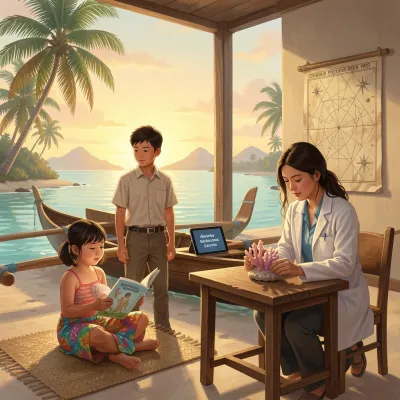
Education in the Republic of the Marshall Islands (RMI) is deeply influenced by its cultural heritage and colonial history. Traditional learning, emphasizing community, oral traditions, and practical skills like navigation and resource management, provided the foundation for knowledge transmission. Colonial influences from Germany, Japan, and the U.S. introduced Western educational models, with the latter having the most enduring impact, establishing English as the primary language of instruction and shaping the current system. This duality of preserving indigenous identity while embracing global engagement defines the educational landscape, where bilingual education aims to balance Marshallese and English to ensure both cultural and international competencies.
The RMI’s education system spans early childhood through higher education, with distinct stages like primary (grades 1–8), secondary (grades 9–12), and vocational/technical education (VTE). Geographic isolation and resource disparities between urban centers and outer islands create significant challenges in ensuring equitable access and quality. Teachers often struggle with bilingual instruction and adapting curricula to local contexts, while infrastructure and funding—heavily reliant on the Compact of Free Association (COFA) and international donors—remain persistent issues. The College of the Marshall Islands (CMI) and University of the South Pacific (USP) regional campus are central to tertiary education, offering locally relevant programs and pathways for global opportunities.
Emerging priorities include integrating Education for Sustainable Development and Climate Change education into all levels, as the RMI’s environmental vulnerability underscores the need for adaptive curricula and resilient infrastructure. Special education and inclusive practices are gaining traction, though resource limitations persist. Technology and distance learning initiatives, such as online programs and digital literacy, help bridge gaps caused by geographic dispersion. International partnerships are vital for funding, curriculum development, and teacher training, with efforts to ensure these collaborations are culturally sensitive and aligned with local needs. Health education, community engagement, and culturally responsive pedagogies further enhance the holistic development of students.
Looking ahead, reforms focus on deepening cultural relevance, strengthening early childhood education, expanding vocational programs, and enhancing teacher training with emphasis on bilingual and inclusive methods. Climate resilience will be embedded in school infrastructure and policy, while equitable funding and technology access remain priorities. The RMI aims to build a self-reliant educational system that honors its heritage while preparing students to tackle global challenges, ensuring education remains a cornerstone for national development and sustainability in the face of environmental threats.
What You'll Find Inside:
- Historical foundations of Marshallese education from traditional indigenous knowledge systems through missionary, colonial, and American trusteeship influences to the present day.
- Comprehensive examination of the education system structure from early childhood through higher education, including curriculum, access challenges, and quality issues across geographically dispersed atolls.
- Analysis of critical cross-cutting themes: bilingual language policy (Marshallese and English), teacher training and development, special education/inclusive practices, and education for sustainable development.
- Exploration of climate change impacts on educational infrastructure, technology integration initiatives, distance learning solutions, and international partnerships supporting educational development.
- Discussion of educational policy, governance, funding mechanisms, assessment systems, and future reform directions for building a resilient, equitable, and culturally responsive education system.
Who's It For:
This book is an invaluable resource for educators working in or studying Marshallese and Pacific education systems, policymakers involved in education planning for small island developing states, researchers interested in indigenous knowledge systems, post-colonial education dynamics, or climate change impacts on education, and anyone seeking a comprehensive understanding of educational complexities and aspirations in the Republic of the Marshall Islands.
Table of Contents:
- Introduction
- Chapter 1 Historical Foundations of Marshallese Education
- Chapter 2 Traditional Learning and Indigenous Knowledge Systems
- Chapter 3 The Impact of Colonialism on Education
- Chapter 4 Early Childhood Education: Foundations and Frameworks
- Chapter 5 Access and Equity in Early Childhood Programs
- Chapter 6 Primary Education: Curriculum and Instruction
- Chapter 7 Challenges and Opportunities in Primary Schooling
- Chapter 8 Secondary Education: Structure and Pathways
- Chapter 9 Vocational and Technical Education in the Marshall Islands
- Chapter 10 The Role of Language in Education: Marshallese and English
- Chapter 11 Teacher Training and Professional Development
- Chapter 12 Higher Education Institutions and Programs
- Chapter 13 Access to Higher Education and Scholarship Opportunities
- Chapter 14 Distance Learning and Online Education Initiatives
- Chapter 15 Special Education and Inclusive Practices
- Chapter 16 Education for Sustainable Development
- Chapter 17 Health Education and Well-being in Schools
- Chapter 18 The Role of Community in Education
- Chapter 19 Funding and Financing of Education
- Chapter 20 Educational Policy and Governance
- Chapter 21 Assessment and Evaluation in the Education System
- Chapter 22 The Impact of Climate Change on Education
- Chapter 23 Technology Integration in Marshallese Classrooms
- Chapter 24 International Partnerships and Educational Aid
- Chapter 25 Future Directions and Reforms in Marshallese Education
Author:
Published By:
Date Published:
July 2, 2026
Type:
Nonfiction
Language:
English
Word Count:
41,555 words
Reading Time:
2 hours 55 minutes
Sample:
Order:
Order Education In The Marshall Islands (Paperback) on MixCache.com:
Buy NowPrint copy is made to order and ships worldwide. Includes the ebook free, ready to read instantly.
$5 account credit for all new MixCache.com accounts, usable toward any ebook purchase!*