
Browse by Category
Fiction
- Action & Adventure
- African American
- Anthologies
- Children's Fiction
- Classics
- Comics & Graphic Novels
- Coming of Age
- Contemporary
- Cultural & Regional
- Drama
- Erotica
- Fantasy
- General
- Historical Fiction
- Horror
- Humor & Satire
- Literary Fiction
- Mystery, Thriller & Suspense
- Poetry
- Religious & Inspirational
- Romance
- Science Fiction
- Short Stories
- War & Military
- Westerns
- Women's Fiction
- Young Adult
Non-Fiction
- Antiques & Collectibles
- Arts & Photography
- Biographies & Memoirs
- Business & Money
- Children's Non-Fiction
-
Computers & Technology
- Artificial Intelligence
- Computer Science
- Cybersecurity & Cryptography
- Data Science & Analytics
- Databases & Big Data
- Game Development & Design
- General
- Hardware & DIY
- Mobile App Development
- Networking & Cloud Computing
- Operating Systems
- Programming
- Robotics
- Software
- Software Engineering
- User Experience (UX) & Design
- Web Development & Design
- Cooking, Food & Wine
- Crafts, Hobbies & Home
- Education & Teaching
- Engineering
- General
- Health, Fitness & Dieting
-
History
- African History
- African History - North Africa
- African History - Sub-Saharan Africa
- American History
- American History - 20th Century
- American History - Civil War
- American History - Colonial Period
- Ancient History
- Asian History
- Asian History - China
- Asian History - India
- Asian History - Japan
- Asian History - Southeast Asia
- European History
- European History - Ancient Greece
- European History - Ancient Rome
- European History - Medieval
- European History - Modern
- European History - Renaissance
- General
- Middle Eastern History
- Military History
- Military History - Aviation
- Military History - Naval
- Social & Cultural History
- World History
- Humor & Entertainment
- Industrial Technology
- Language Learning
- Law
- LGBTQ+ Non-Fiction
- Literary Criticism
- Medical Books
- Parenting & Relationships
- Philosophy
- Politics & Social Sciences
- Reference
- Religion & Spirituality
-
Science & Math
- Agricultural Sciences
- Astronomy & Space Science
- Behavioral Sciences
- Biological Sciences
- Botany & Plant Science
- Chemistry
- Earth Sciences
- Engineering - Chemical
- Engineering - Civil
- Engineering - Electrical
- Engineering - Mechanical
- Environment
- General
- Geology
- Mathematics
- Nature & Ecology
- Oceanography
- Paleontology
- Physics
- Statistics
- Self-Help
- Sports & Outdoors
- Study Aids
- Sustainability & Green Living
- Textbooks
- Transportation
- Travel
- True Crime
- Urban Planning & Development
- Veterinary Medicine
- Writing & Publishing
Jump to Section
MixCache.com Total Access
Unlimited reading and audiobooks for every book published by MixCache.com.
Included titles carry the MTA badge.
Learn more →
New Delhi Through Partition
MTA
Personal stories, archival research, and the city's transformation after 1947
About this book:
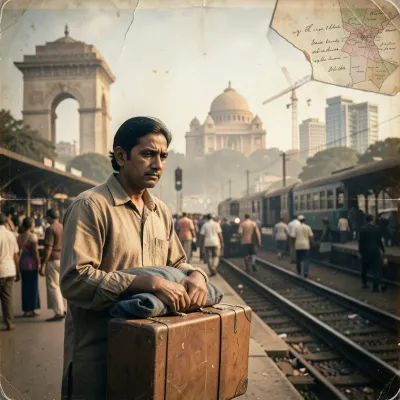
The book traces how New Delhi, conceived as an ordered imperial capital, was overturned by the humanitarian emergency of Partition in 1947. As Hindu and Sikh refugees streamed in from West Punjab and Muslim residents fled toward Pakistan, the city’s railway stations, forts, and open spaces became sites of desperate shelter—most notably Purana Qila and Kingsway Camp—where makeshift communities endured scarcity, disease, and violence. These temporary camps gradually evolved into permanent colonies such as Lajpat Nagar, Karol Bagh, Patel Nagar, and Rajendra Nagar, reshaping Delhi’s demographic core from a Mughal‑Urdu milieu to a Punjabi‑dominated metropolis. The influx not only doubled the city’s population but also introduced new languages, cuisines, entrepreneurial networks, and cultural practices that redefined everyday life.
Resettlement was mediated through the legal framework of evacuee property, whereby homes and shops abandoned by Muslim migrants were allotted, auctioned, or otherwise transferred to refugees, spurring a contentious housing market and informal economies. Women’s labor—ranging from domestic work and piece‑rate stitching to managing community kitchens and savings groups—proved vital to household survival and economic recovery, while refugee entrepreneurs revived markets like Sarojini Nagar and Gaffar Market, turning adversity into commercial dynamism. Schools, temples, and gurdwaras sprang up in the new colonies, preserving Punjabi language and Sikh and Hindu rituals, while Urdu‑medium institutions declined among the remaining Muslim minority. Politically, refugees became a decisive voting bloc, influencing party machines and local governance, and their demands for compensation, infrastructure, and rights stimulated both state rehabilitation efforts and broader democratic participation.
The transformation left enduring imprints: water, power, and sanitation systems, designed for a smaller population, remain strained and unequal; the legacy of evacuee property disputes lingered in courts for decades; and Muslim “pocketed survivals” in Old Delhi persisted amid suspicion and marginalization, their cultural spaces often silenced or repurposed. Subsequent wars in 1965 and 1971 reactivated anxieties of displacement, prompting new refugee inflows (e.g., Bengali settlers in Chittaranjan Park) and testing the city’s capacity to absorb successive waves. Ultimately, the book argues that Delhi’s post‑Partition story offers lessons for twenty‑first‑century cities facing mass migration—highlighting the resilience of informal networks, the necessity of scalable infrastructure, the political empowerment of newcomers, and the long‑term social and spatial aftershocks of rupture.
What You'll Find Inside:
- How Partition transformed New Delhi from a planned imperial capital into a refugee-shaped metropolis through the evolution of temporary camps into permanent colonies like Lajpat Nagar and Karol Bagh.
- The demographic and cultural revolution that saw Delhi shift from Urdu/Muslim dominance to Punjabi/Hindu-Sikh character, fundamentally altering its linguistic landscape, cuisine, and social fabric.
- The emergence of refugee entrepreneurship and informal economies that drove Delhi's economic recovery, with displaced Punjabi traders rebuilding markets from Sarojini Nagar to Gaffar Market through ingenuity and community networks.
- The complex legal and social aftermath of evacuee property distribution, which created both housing opportunities for refugees and decades of legal disputes that reshaped Delhi's property ownership patterns.
- How Partition's legacy continued through subsequent conflicts (1965, 1971 wars) and influenced Delhi's political development, with refugee communities becoming a powerful voting bloc that shaped party politics and civic engagement.
Who's It For:
This book would be most valuable for urban historians, South Asian studies scholars, and city planners interested in understanding how mass displacement transforms cities. It offers crucial insights for policymakers dealing with refugee resettlement and post-conflict urban reconstruction, while also appealing to general readers fascinated by Delhi's layered history and the human stories behind its Partition transformation.
Table of Contents:
- Introduction
- Chapter 1 A City at the Faultline
- Chapter 2 The Summer of 1947: Rumors, Departures, Returns
- Chapter 3 Railheads and Refuge: Old Delhi Station and Purana Qila
- Chapter 4 Camps to Colonies: From Kingsway Camp to Lajpat Nagar
- Chapter 5 Evacuee Property and the Making of a Housing Market
- Chapter 6 Drawing New Lines: Cartographies of a Divided Capital
- Chapter 7 Neighborhoods Remade: Karol Bagh, Patel Nagar, Rajendra Nagar
- Chapter 8 Markets and Memory: Bazaars from Ballimaran to Sarojini Nagar
- Chapter 9 Women’s Journeys and the Labors of Resettlement
- Chapter 10 Language, Schooling, and the Politics of Belonging
- Chapter 11 Temples, Gurdwaras, and the Remapping of Sacred Space
- Chapter 12 Policing, Militia, and Everyday Security
- Chapter 13 Water, Power, and the Infrastructures of Survival
- Chapter 14 Work, Guilds, and the Refugee Entrepreneur
- Chapter 15 Cinema Halls and the Public Sphere
- Chapter 16 The State Plans a Capital: From DIT to DDA
- Chapter 17 Voting New Delhi: Refugee Franchise and Party Machines
- Chapter 18 Lines of Caste and Community After Partition
- Chapter 19 Muslim Delhi: Silences, Returns, and Pocketed Survivals
- Chapter 20 The Making of the Punjabi Capital
- Chapter 21 Memory, Testimony, and the Ethics of Listening
- Chapter 22 Maps, Walls, and Boundaries in the Lifeworld
- Chapter 23 The City in Photographs: Family Albums as Archive
- Chapter 24 Aftershocks: 1965, 1971, and the Long Tail of Displacement
- Chapter 25 Lessons for the Twenty-First-Century City
Author:
Published By:
Date Published:
June 4, 2026
Type:
Nonfiction
Language:
English
Word Count:
42,939 words
Reading Time:
3 hours
Sample:
Order:
Order New Delhi Through Partition (Paperback) on MixCache.com:
Buy NowPrint copy is made to order and ships worldwide. Includes the ebook free, ready to read instantly.
$5 account credit for all new MixCache.com accounts, usable toward any ebook purchase!*


 Includes Audiobook


