Browse by Category
Fiction
- Action & Adventure
- African American
- Anthologies
- Children's Fiction
- Classics
- Comics & Graphic Novels
- Coming of Age
- Contemporary
- Cultural & Regional
- Drama
- Erotica
- Family Life
- Fantasy
- General
- Historical Fiction
- Horror
- Humor & Satire
- Literary Fiction
- Mystery, Thriller & Suspense
- Poetry
- Religious & Inspirational
- Romance
- Science Fiction
- Short Stories
- War & Military
- Westerns
- Women's Fiction
- Young Adult
Non-Fiction
- Antiques & Collectibles
- Arts & Photography
- Biographies & Memoirs
- Business & Money
- Children's Non-Fiction
-
Computers & Technology
- Artificial Intelligence
- Computer Science
- Cybersecurity & Cryptography
- Data Science & Analytics
- Databases & Big Data
- Game Development & Design
- General
- Hardware & DIY
- Mobile App Development
- Networking & Cloud Computing
- Operating Systems
- Programming
- Robotics
- Software
- Software Engineering
- User Experience (UX) & Design
- Web Development & Design
- Cooking, Food & Wine
- Crafts, Hobbies & Home
- Education & Teaching
- Engineering
- General
- Health, Fitness & Dieting
-
History
- African History
- African History - North Africa
- African History - Sub-Saharan Africa
- American History
- American History - 20th Century
- American History - Civil War
- American History - Colonial Period
- Ancient History
- Asian History
- Asian History - China
- Asian History - India
- Asian History - Japan
- Asian History - Southeast Asia
- European History
- European History - Ancient Greece
- European History - Ancient Rome
- European History - Medieval
- European History - Modern
- European History - Renaissance
- General
- Middle Eastern History
- Military History
- Military History - Aviation
- Military History - Naval
- Social & Cultural History
- World History
- Humor & Entertainment
- Industrial Technology
- Language Learning
- Law
- LGBTQ+ Non-Fiction
- Literary Criticism
- Medical Books
- Parenting & Relationships
- Philosophy
- Politics & Social Sciences
- Reference
- Religion & Spirituality
-
Science & Math
- Agricultural Sciences
- Astronomy & Space Science
- Behavioral Sciences
- Biological Sciences
- Botany & Plant Science
- Chemistry
- Earth Sciences
- Engineering - Chemical
- Engineering - Civil
- Engineering - Electrical
- Engineering - Mechanical
- Environment
- General
- Geology
- Mathematics
- Nature & Ecology
- Oceanography
- Paleontology
- Physics
- Statistics
- Self-Help
- Sports & Outdoors
- Study Aids
- Sustainability & Green Living
- Textbooks
- Transportation
- Travel
- True Crime
- Urban Planning & Development
- Veterinary Medicine
- Writing & Publishing
Jump to Section
MixCache.com Total Access
Unlimited reading and audiobooks for every book published by MixCache.com.
Included titles carry the MTA badge.
Learn more →
Quantum Computing
Computing And Humanity's Next Frontier
About this book:

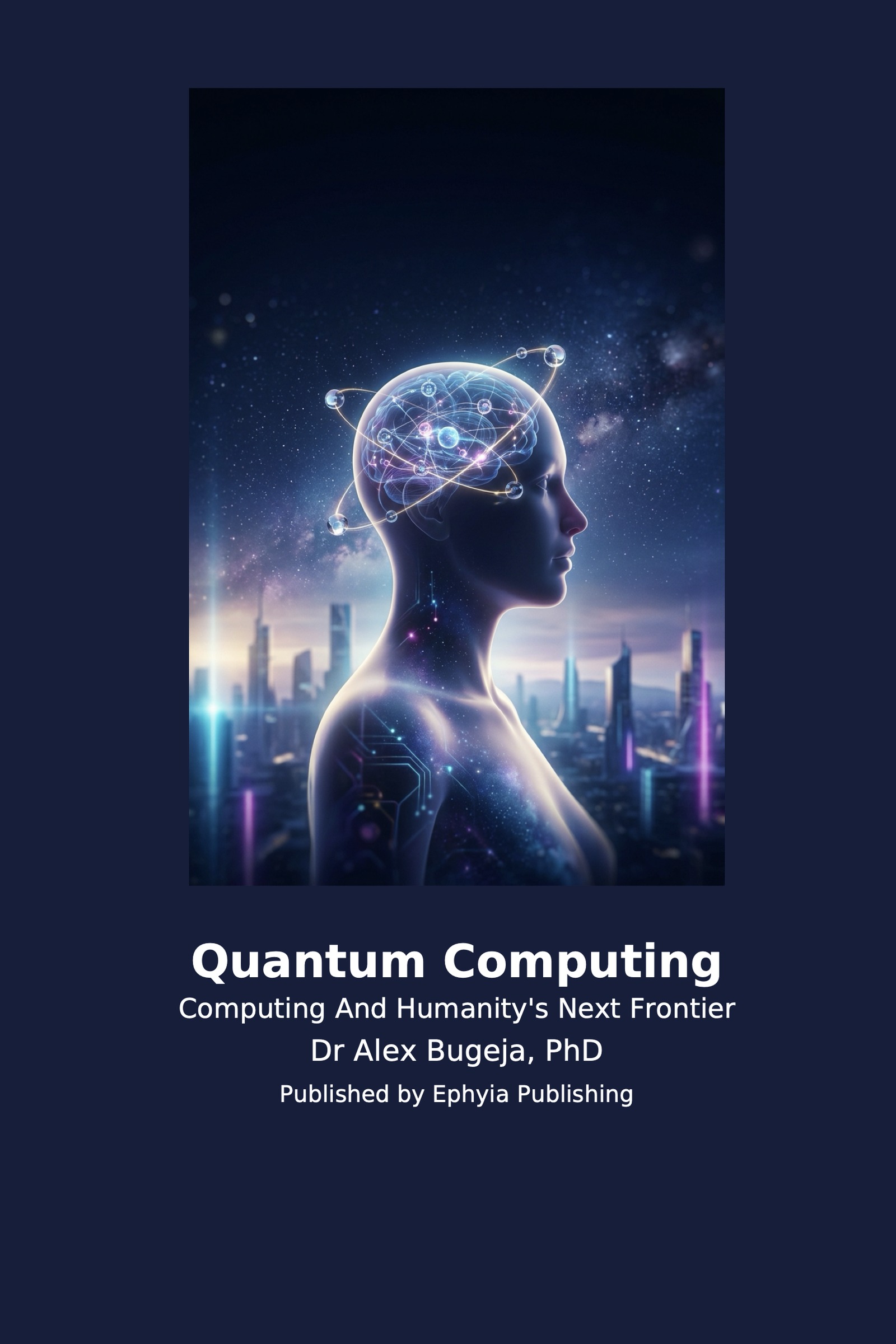
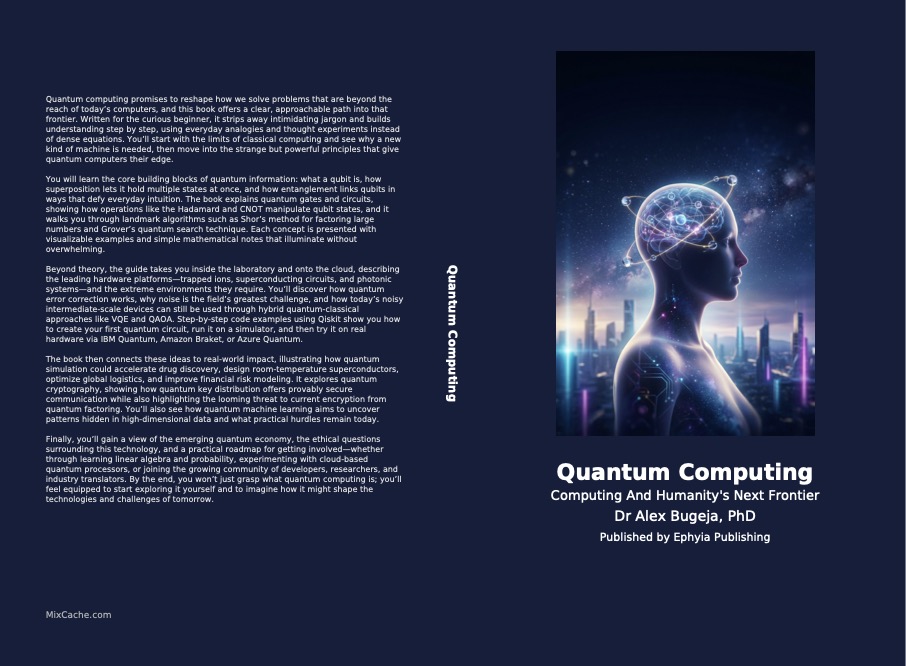
Quantum computing promises to reshape how we solve problems that are beyond the reach of today’s computers, and this book offers a clear, approachable path into that frontier. Written for the curious beginner, it strips away intimidating jargon and builds understanding step by step, using everyday analogies and thought experiments instead of dense equations. You’ll start with the limits of classical computing and see why a new kind of machine is needed, then move into the strange but powerful principles that give quantum computers their edge.
You will learn the core building blocks of quantum information: what a qubit is, how superposition lets it hold multiple states at once, and how entanglement links qubits in ways that defy everyday intuition. The book explains quantum gates and circuits, showing how operations like the Hadamard and CNOT manipulate qubit states, and it walks you through landmark algorithms such as Shor’s method for factoring large numbers and Grover’s quantum search technique. Each concept is presented with visualizable examples and simple mathematical notes that illuminate without overwhelming.
Beyond theory, the guide takes you inside the laboratory and onto the cloud, describing the leading hardware platforms—trapped ions, superconducting circuits, and photonic systems—and the extreme environments they require. You’ll discover how quantum error correction works, why noise is the field’s greatest challenge, and how today’s noisy intermediate‑scale devices can still be used through hybrid quantum‑classical approaches like VQE and QAOA. Step‑by‑step code examples using Qiskit show you how to create your first quantum circuit, run it on a simulator, and then try it on real hardware via IBM Quantum, Amazon Braket, or Azure Quantum.
The book then connects these ideas to real‑world impact, illustrating how quantum simulation could accelerate drug discovery, design room‑temperature superconductors, optimize global logistics, and improve financial risk modeling. It explores quantum cryptography, showing how quantum key distribution offers provably secure communication while also highlighting the looming threat to current encryption from quantum factoring. You’ll also see how quantum machine learning aims to uncover patterns hidden in high‑dimensional data and what practical hurdles remain today.
Finally, you’ll gain a view of the emerging quantum economy, the ethical questions surrounding this technology, and a practical roadmap for getting involved—whether through learning linear algebra and probability, experimenting with cloud‑based quantum processors, or joining the growing community of developers, researchers, and industry translators. By the end, you won’t just grasp what quantum computing is; you’ll feel equipped to start exploring it yourself and to imagine how it might shape the technologies and challenges of tomorrow.
What You'll Find Inside:
- Fundamental quantum concepts: qubits, superposition, entanglement, and how they give quantum computers their power
- Key quantum algorithms like Shor's (for factoring) and Grover's (for search) and their real-world implications
- The hardware challenges of building quantum computers, including qubit types and error correction
- Current applications and future potential in medicine, materials science, cryptography, and AI
- Guidance on how beginners can get started with quantum computing despite no advanced math/physics background
Who's It For:
This book is written for curious beginners who have heard about quantum computing but feel intimidated by the complex science. It's designed for readers without advanced physics or mathematics backgrounds who want to understand the fundamental concepts, applications, and how to get involved in this emerging field. The content is accessible to anyone with a genuine interest in learning about this technological frontier.
Introduction
Take a moment to look around you. Chances are, you are surrounded by the quiet hum of computation. It’s in the smartphone in your pocket, the laptop on your desk, the smart television on your wall, and even the thermostat regulating the temperature of your room. In the span of a single human lifetime, we have journeyed from room-sized machines clattering away at simple arithmetic to globally interconnected devices that hold the sum of human knowledge. This digital revolution, silent and relentless, has been powered by a simple yet profound concept: the bit. A bit is the most basic unit of information in classical computing, a humble switch that can be in one of two states: on or off, represented by a 1 or a 0. Every email you send, every photo you take, every movie you stream is, at its core, an unimaginably vast sequence of these simple ones and zeros.
For decades, our ability to cram more and more of these tiny switches onto microchips has followed a predictable and explosive trajectory known as Moore's Law. This observation, which predicted the number of transistors on a chip would double approximately every two years, has been the engine of technological progress. It’s the reason the phone you hold in your hand is millions of times more powerful than the computers that guided the Apollo missions to the moon. We have become masters of the bit, manipulating these ones and zeros with incredible speed and precision to build the modern world.
Enjoying it? The full book includes every chapter.
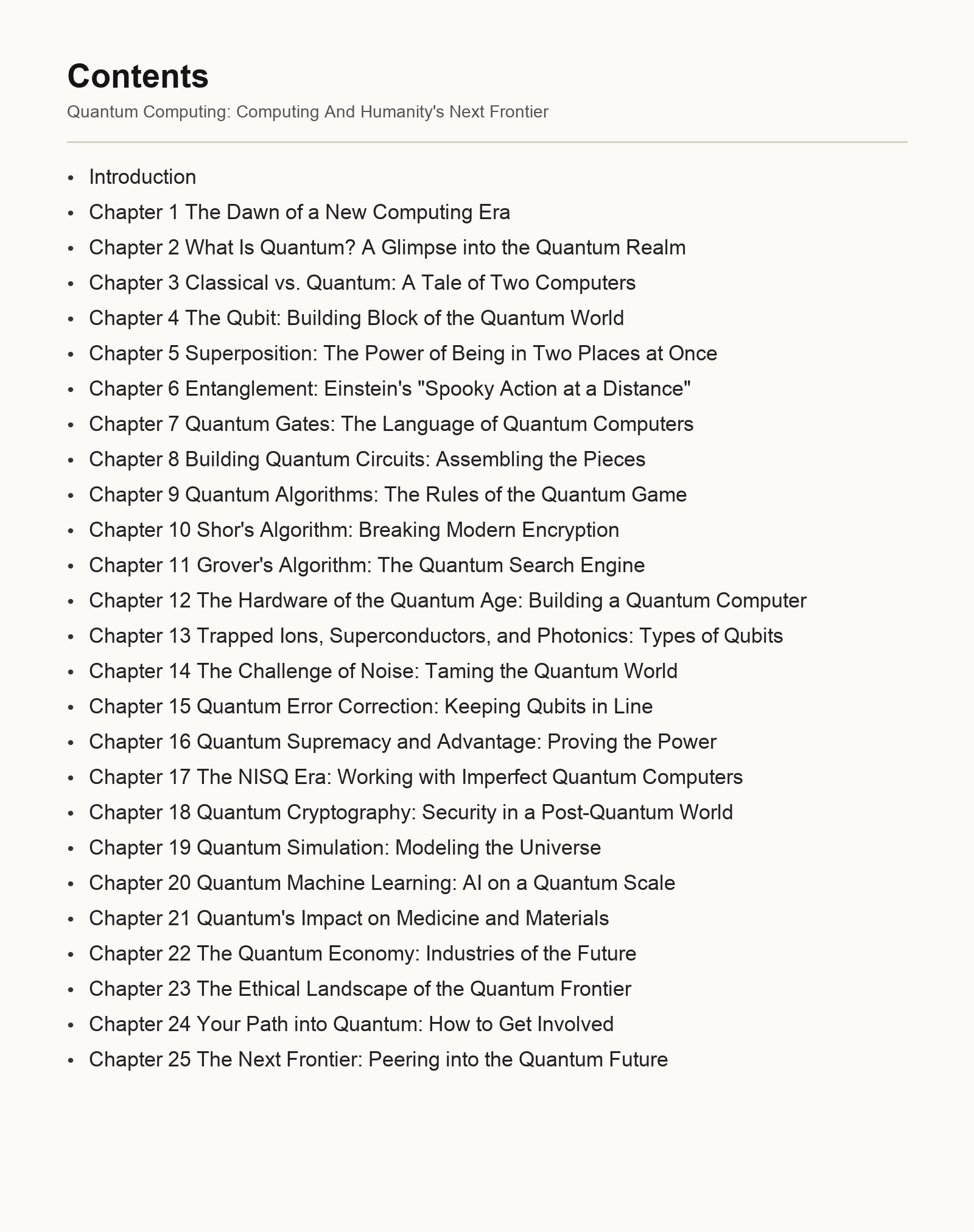
Table of Contents:
- Introduction Free
- Chapter 1 The Dawn of a New Computing Era Free
- Chapter 2 What Is Quantum? A Glimpse into the Quantum Realm
- Chapter 3 Classical vs. Quantum: A Tale of Two Computers
- Chapter 4 The Qubit: Building Block of the Quantum World
- Chapter 5 Superposition: The Power of Being in Two Places at Once
- Chapter 6 Entanglement: Einstein's "Spooky Action at a Distance"
- Chapter 7 Quantum Gates: The Language of Quantum Computers
- Chapter 8 Building Quantum Circuits: Assembling the Pieces
- Chapter 9 Quantum Algorithms: The Rules of the Quantum Game
- Chapter 10 Shor's Algorithm: Breaking Modern Encryption
- Chapter 11 Grover's Algorithm: The Quantum Search Engine
- Chapter 12 The Hardware of the Quantum Age: Building a Quantum Computer
- Chapter 13 Trapped Ions, Superconductors, and Photonics: Types of Qubits
- Chapter 14 The Challenge of Noise: Taming the Quantum World
- Chapter 15 Quantum Error Correction: Keeping Qubits in Line
- Chapter 16 Quantum Supremacy and Advantage: Proving the Power
- Chapter 17 The NISQ Era: Working with Imperfect Quantum Computers
- Chapter 18 Quantum Cryptography: Security in a Post-Quantum World
- Chapter 19 Quantum Simulation: Modeling the Universe
- Chapter 20 Quantum Machine Learning: AI on a Quantum Scale
- Chapter 21 Quantum's Impact on Medicine and Materials
- Chapter 22 The Quantum Economy: Industries of the Future
- Chapter 23 The Ethical Landscape of the Quantum Frontier
- Chapter 24 Your Path into Quantum: How to Get Involved
- Chapter 25 The Next Frontier: Peering into the Quantum Future
Included when you buy the full book.
Author:
Published By:
Date Published:
May 29, 2026
Type:
Nonfiction
Language:
English
Also Available In:
German, French, Italian, Dutch
Word Count:
56,083 words
Reading Time:
3 hours 56 minutes
Sample:
Order:
Order Quantum Computing (Paperback) on MixCache.com:
Buy NowIncludes every chapter. Not sure yet? Read the opening free.
Print copy is made to order and ships worldwide. Includes the ebook free, ready to read instantly.
$5 account credit for all new MixCache.com accounts, usable toward any ebook purchase!*