Browse by Category
Fiction
- Action & Adventure
- African American
- Anthologies
- Children's Fiction
- Classics
- Comics & Graphic Novels
- Coming of Age
- Contemporary
- Cultural & Regional
- Drama
- Erotica
- Fantasy
- General
- Historical Fiction
- Horror
- Humor & Satire
- Literary Fiction
- Mystery, Thriller & Suspense
- Poetry
- Religious & Inspirational
- Romance
- Science Fiction
- Short Stories
- War & Military
- Westerns
- Women's Fiction
- Young Adult
Non-Fiction
- Antiques & Collectibles
- Arts & Photography
- Biographies & Memoirs
- Business & Money
- Children's Non-Fiction
-
Computers & Technology
- Artificial Intelligence
- Computer Science
- Cybersecurity & Cryptography
- Data Science & Analytics
- Databases & Big Data
- Game Development & Design
- General
- Hardware & DIY
- Mobile App Development
- Networking & Cloud Computing
- Operating Systems
- Programming
- Robotics
- Software
- Software Engineering
- User Experience (UX) & Design
- Web Development & Design
- Cooking, Food & Wine
- Crafts, Hobbies & Home
- Education & Teaching
- Engineering
- General
- Health, Fitness & Dieting
-
History
- African History
- African History - North Africa
- African History - Sub-Saharan Africa
- American History
- American History - 20th Century
- American History - Civil War
- American History - Colonial Period
- Ancient History
- Asian History
- Asian History - China
- Asian History - India
- Asian History - Japan
- Asian History - Southeast Asia
- European History
- European History - Ancient Greece
- European History - Ancient Rome
- European History - Medieval
- European History - Modern
- European History - Renaissance
- General
- Middle Eastern History
- Military History
- Military History - Aviation
- Military History - Naval
- Social & Cultural History
- World History
- Humor & Entertainment
- Industrial Technology
- Language Learning
- Law
- LGBTQ+ Non-Fiction
- Literary Criticism
- Medical Books
- Parenting & Relationships
- Philosophy
- Politics & Social Sciences
- Reference
- Religion & Spirituality
-
Science & Math
- Agricultural Sciences
- Astronomy & Space Science
- Behavioral Sciences
- Biological Sciences
- Botany & Plant Science
- Chemistry
- Earth Sciences
- Engineering - Chemical
- Engineering - Civil
- Engineering - Electrical
- Engineering - Mechanical
- Environment
- General
- Geology
- Mathematics
- Nature & Ecology
- Oceanography
- Paleontology
- Physics
- Statistics
- Self-Help
- Sports & Outdoors
- Study Aids
- Sustainability & Green Living
- Textbooks
- Transportation
- Travel
- True Crime
- Urban Planning & Development
- Veterinary Medicine
- Writing & Publishing
Jump to Section
MixCache.com Total Access
Unlimited reading and audiobooks for every book published by MixCache.com.
Included titles carry the MTA badge.
Learn more →
Refrigeration and Air Conditioning
A History of Artificial Cooling
About this book:
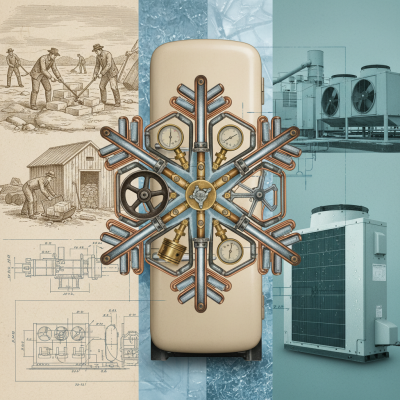
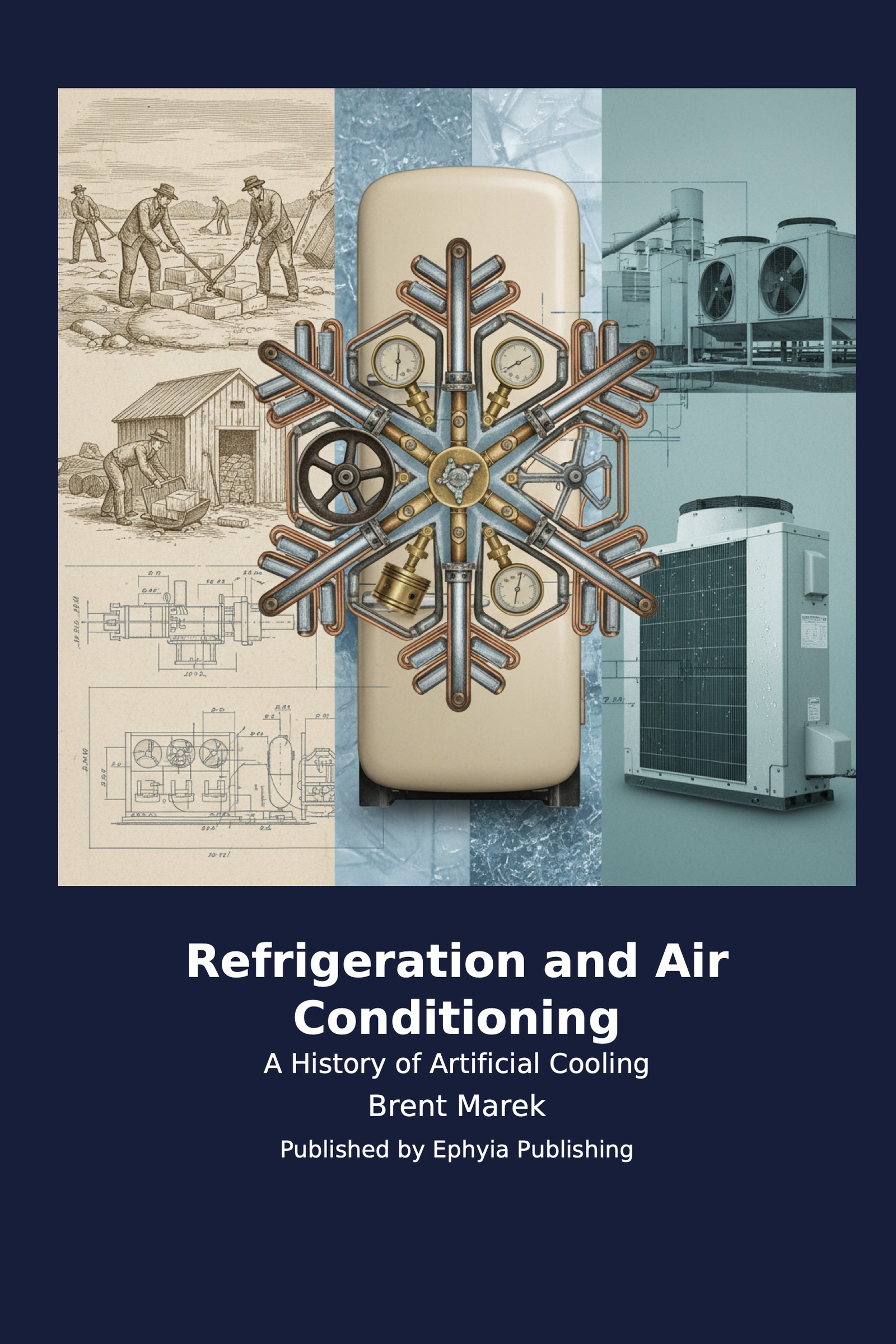
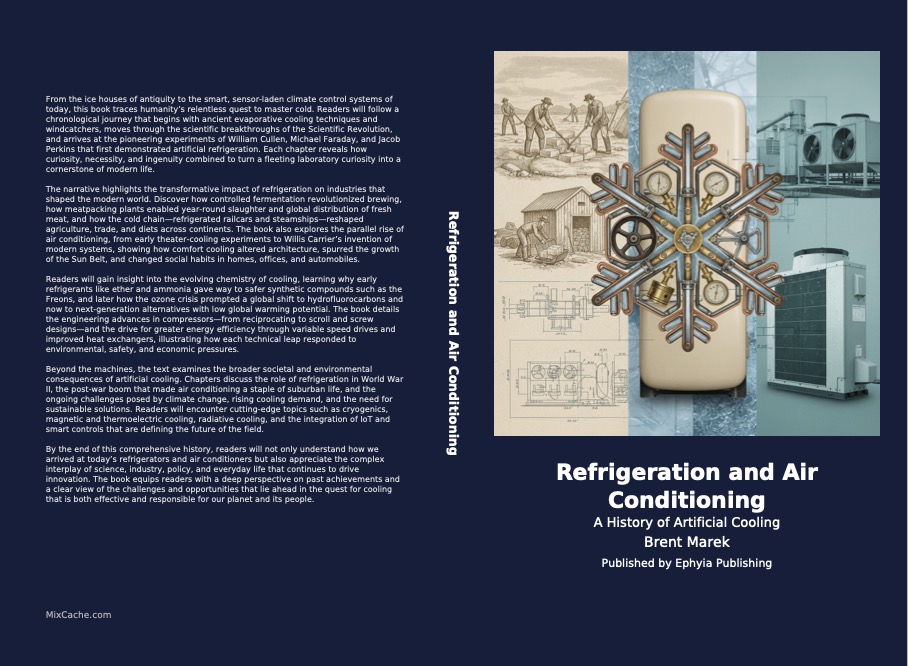
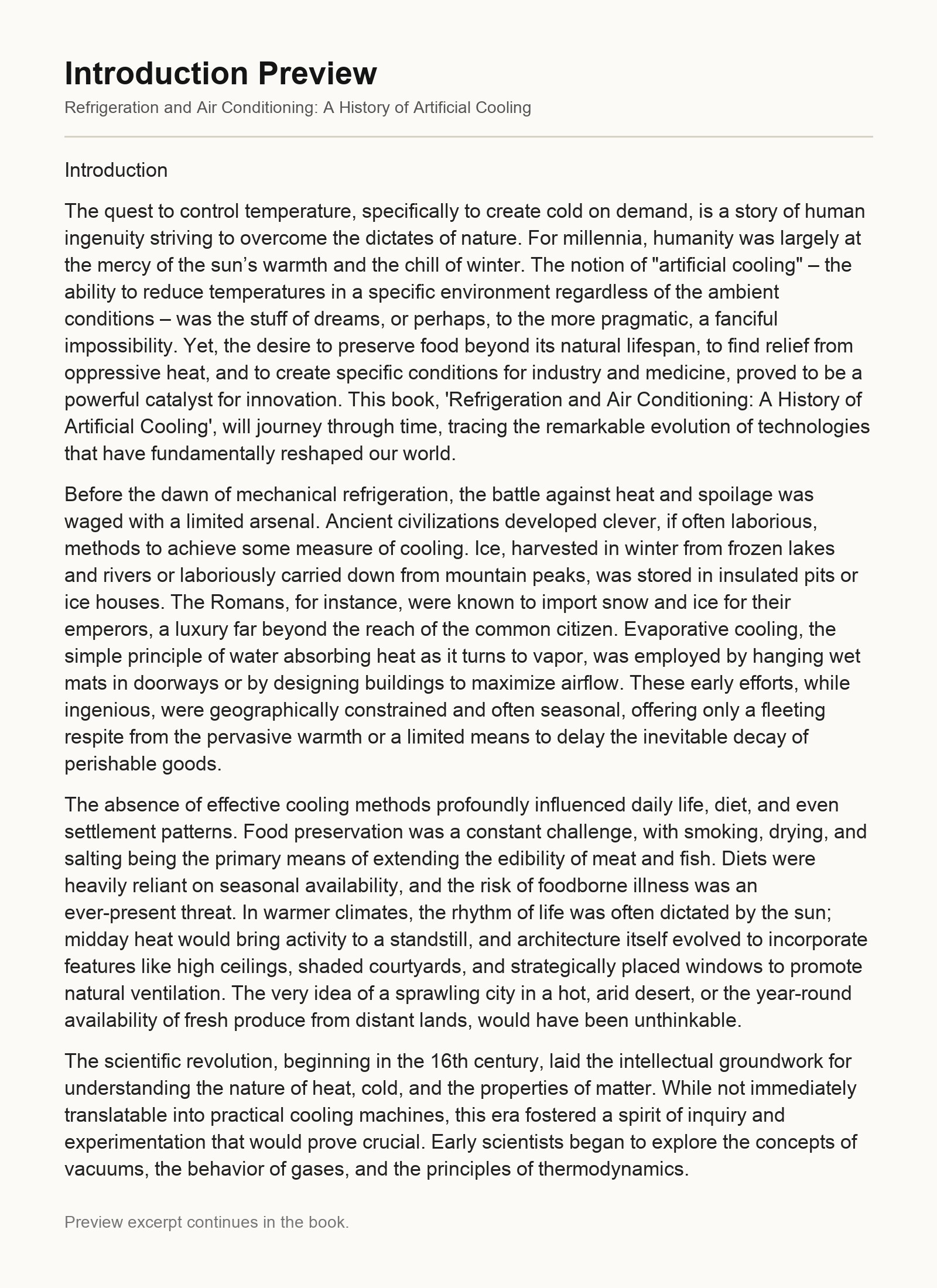
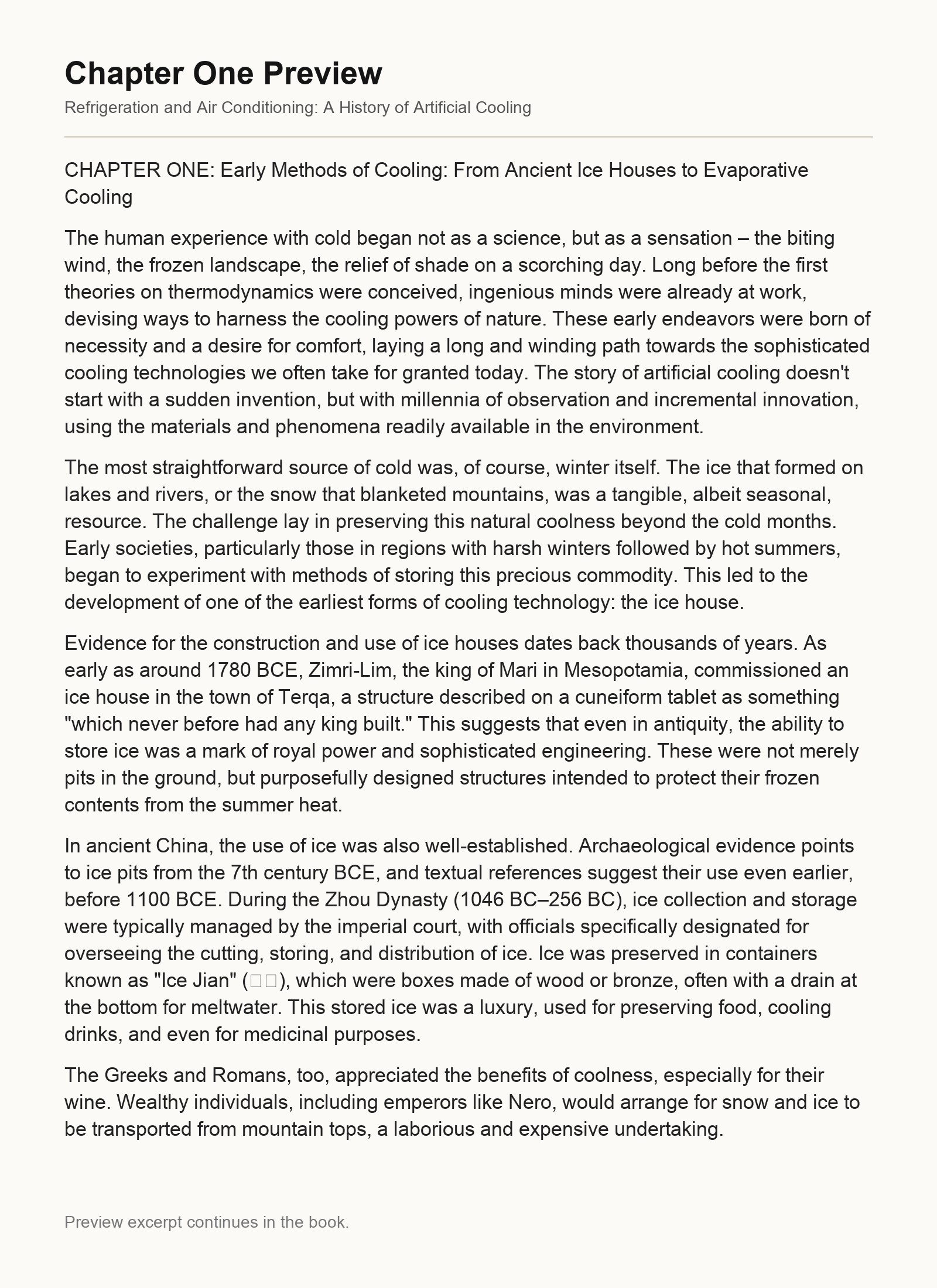
From the ice houses of antiquity to the smart, sensor‑laden climate control systems of today, this book traces humanity’s relentless quest to master cold. Readers will follow a chronological journey that begins with ancient evaporative cooling techniques and windcatchers, moves through the scientific breakthroughs of the Scientific Revolution, and arrives at the pioneering experiments of William Cullen, Michael Faraday, and Jacob Perkins that first demonstrated artificial refrigeration. Each chapter reveals how curiosity, necessity, and ingenuity combined to turn a fleeting laboratory curiosity into a cornerstone of modern life.
The narrative highlights the transformative impact of refrigeration on industries that shaped the modern world. Discover how controlled fermentation revolutionized brewing, how meatpacking plants enabled year‑round slaughter and global distribution of fresh meat, and how the cold chain—refrigerated railcars and steamships—reshaped agriculture, trade, and diets across continents. The book also explores the parallel rise of air conditioning, from early theater‑cooling experiments to Willis Carrier’s invention of modern systems, showing how comfort cooling altered architecture, spurred the growth of the Sun Belt, and changed social habits in homes, offices, and automobiles.
Readers will gain insight into the evolving chemistry of cooling, learning why early refrigerants like ether and ammonia gave way to safer synthetic compounds such as the Freons, and later how the ozone crisis prompted a global shift to hydrofluorocarbons and now to next‑generation alternatives with low global warming potential. The book details the engineering advances in compressors—from reciprocating to scroll and screw designs—and the drive for greater energy efficiency through variable speed drives and improved heat exchangers, illustrating how each technical leap responded to environmental, safety, and economic pressures.
Beyond the machines, the text examines the broader societal and environmental consequences of artificial cooling. Chapters discuss the role of refrigeration in World War II, the post‑war boom that made air conditioning a staple of suburban life, and the ongoing challenges posed by climate change, rising cooling demand, and the need for sustainable solutions. Readers will encounter cutting‑edge topics such as cryogenics, magnetic and thermoelectric cooling, radiative cooling, and the integration of IoT and smart controls that are defining the future of the field.
By the end of this comprehensive history, readers will not only understand how we arrived at today’s refrigerators and air conditioners but also appreciate the complex interplay of science, industry, policy, and everyday life that continues to drive innovation. The book equips readers with a deep perspective on past achievements and a clear view of the challenges and opportunities that lie ahead in the quest for cooling that is both effective and responsible for our planet and its people.
What You'll Find Inside:
- The evolution of cooling from ancient ice houses and evaporative techniques to modern vapor-compression systems, highlighting key inventors like Perkins, Gorrie, Carrier, and Linde
- How refrigeration revolutionized industries including brewing, meatpacking, and pharmaceuticals by enabling year-round production and global distribution of perishable goods
- The development of the global cold chain through refrigerated transport by rail and sea, transforming food security and international trade patterns
- The environmental journey of refrigerants from toxic/flammable substances to CFCs/HCFCs and now to HFOs and natural alternatives due to ozone and climate concerns
- Emerging trends in sustainable cooling including smart technologies, IoT integration, passive cooling designs, and non-vapor compression systems for future climate resilience
Who's It For:
This book is ideal for engineering students, HVAC professionals, and technology historians seeking a comprehensive understanding of how artificial cooling evolved from ancient practices to modern smart systems. Environmental scientists and policymakers will find valuable insights into the refrigerant evolution and sustainability challenges, while general readers interested in how technology shapes daily life will appreciate the societal impacts detailed throughout the narrative.
Table of Contents:
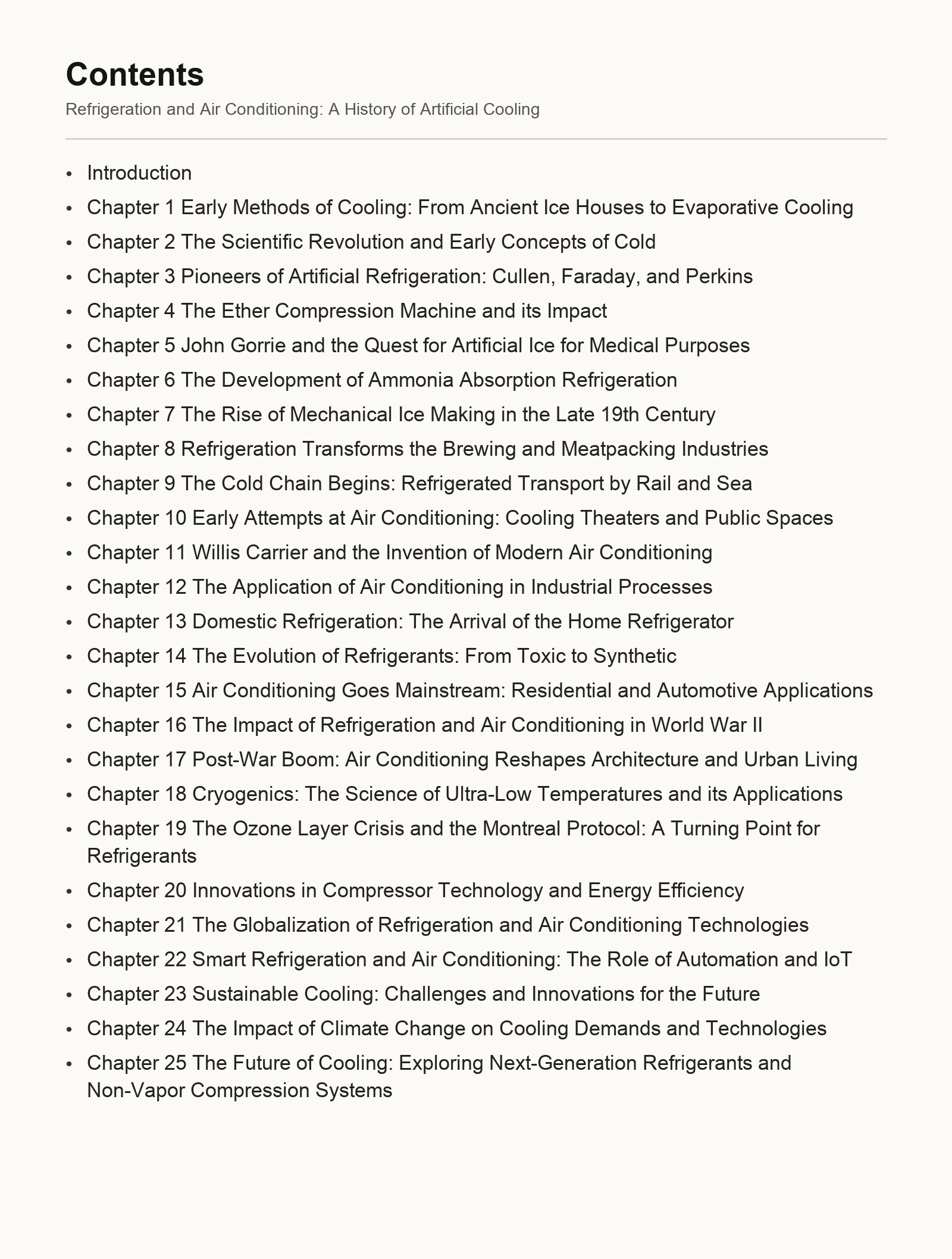
- Introduction
- Chapter 1 Early Methods of Cooling: From Ancient Ice Houses to Evaporative Cooling
- Chapter 2 The Scientific Revolution and Early Concepts of Cold
- Chapter 3 Pioneers of Artificial Refrigeration: Cullen, Faraday, and Perkins
- Chapter 4 The Ether Compression Machine and its Impact
- Chapter 5 John Gorrie and the Quest for Artificial Ice for Medical Purposes
- Chapter 6 The Development of Ammonia Absorption Refrigeration
- Chapter 7 The Rise of Mechanical Ice Making in the Late 19th Century
- Chapter 8 Refrigeration Transforms the Brewing and Meatpacking Industries
- Chapter 9 The Cold Chain Begins: Refrigerated Transport by Rail and Sea
- Chapter 10 Early Attempts at Air Conditioning: Cooling Theaters and Public Spaces
- Chapter 11 Willis Carrier and the Invention of Modern Air Conditioning
- Chapter 12 The Application of Air Conditioning in Industrial Processes
- Chapter 13 Domestic Refrigeration: The Arrival of the Home Refrigerator
- Chapter 14 The Evolution of Refrigerants: From Toxic to Synthetic
- Chapter 15 Air Conditioning Goes Mainstream: Residential and Automotive Applications
- Chapter 16 The Impact of Refrigeration and Air Conditioning in World War II
- Chapter 17 Post-War Boom: Air Conditioning Reshapes Architecture and Urban Living
- Chapter 18 Cryogenics: The Science of Ultra-Low Temperatures and its Applications
- Chapter 19 The Ozone Layer Crisis and the Montreal Protocol: A Turning Point for Refrigerants
- Chapter 20 Innovations in Compressor Technology and Energy Efficiency
- Chapter 21 The Globalization of Refrigeration and Air Conditioning Technologies
- Chapter 22 Smart Refrigeration and Air Conditioning: The Role of Automation and IoT
- Chapter 23 Sustainable Cooling: Challenges and Innovations for the Future
- Chapter 24 The Impact of Climate Change on Cooling Demands and Technologies
- Chapter 25 The Future of Cooling: Exploring Next-Generation Refrigerants and Non-Vapor Compression Systems
Author:
Published By:
Date Published:
May 16, 2026
Type:
Nonfiction
Language:
English
Also Available In:
Spanish, French, Dutch, Portuguese
Word Count:
53,878 words
Reading Time:
3 hours 46 minutes
Sample:
Order:
Order Refrigeration and Air Conditioning (Paperback) on MixCache.com:
Buy NowPrint copy is made to order and ships worldwide. Includes the ebook free, ready to read instantly.
$5 account credit for all new MixCache.com accounts, usable toward any ebook purchase!*