Browse by Category
Fiction
- Action & Adventure
- African American
- Anthologies
- Children's Fiction
- Classics
- Comics & Graphic Novels
- Coming of Age
- Contemporary
- Cultural & Regional
- Drama
- Erotica
- Fantasy
- General
- Historical Fiction
- Horror
- Humor & Satire
- Literary Fiction
- Mystery, Thriller & Suspense
- Poetry
- Religious & Inspirational
- Romance
- Science Fiction
- Short Stories
- War & Military
- Westerns
- Women's Fiction
- Young Adult
Non-Fiction
- Antiques & Collectibles
- Arts & Photography
- Biographies & Memoirs
- Business & Money
- Children's Non-Fiction
-
Computers & Technology
- Artificial Intelligence
- Computer Science
- Cybersecurity & Cryptography
- Data Science & Analytics
- Databases & Big Data
- Game Development & Design
- General
- Hardware & DIY
- Mobile App Development
- Networking & Cloud Computing
- Operating Systems
- Programming
- Robotics
- Software
- Software Engineering
- User Experience (UX) & Design
- Web Development & Design
- Cooking, Food & Wine
- Crafts, Hobbies & Home
- Education & Teaching
- Engineering
- General
- Health, Fitness & Dieting
-
History
- African History
- African History - North Africa
- African History - Sub-Saharan Africa
- American History
- American History - 20th Century
- American History - Civil War
- American History - Colonial Period
- Ancient History
- Asian History
- Asian History - China
- Asian History - India
- Asian History - Japan
- Asian History - Southeast Asia
- European History
- European History - Ancient Greece
- European History - Ancient Rome
- European History - Medieval
- European History - Modern
- European History - Renaissance
- General
- Middle Eastern History
- Military History
- Military History - Aviation
- Military History - Naval
- Social & Cultural History
- World History
- Humor & Entertainment
- Industrial Technology
- Language Learning
- Law
- LGBTQ+ Non-Fiction
- Literary Criticism
- Medical Books
- Parenting & Relationships
- Philosophy
- Politics & Social Sciences
- Reference
- Religion & Spirituality
-
Science & Math
- Agricultural Sciences
- Astronomy & Space Science
- Behavioral Sciences
- Biological Sciences
- Botany & Plant Science
- Chemistry
- Earth Sciences
- Engineering - Chemical
- Engineering - Civil
- Engineering - Electrical
- Engineering - Mechanical
- Environment
- General
- Geology
- Mathematics
- Nature & Ecology
- Oceanography
- Paleontology
- Physics
- Statistics
- Self-Help
- Sports & Outdoors
- Study Aids
- Sustainability & Green Living
- Textbooks
- Transportation
- Travel
- True Crime
- Urban Planning & Development
- Veterinary Medicine
- Writing & Publishing
Jump to Section
MixCache.com Total Access
Unlimited reading and audiobooks for every book published by MixCache.com.
Included titles carry the MTA badge.
Learn more →
From Stretcher to Surgeon: The Evolution of Military Medicine and Battlefield Care
MTA
Medical innovation, trauma care, and disease control from ancient to modern war
About this book:
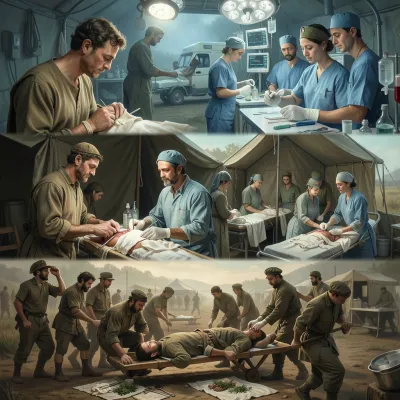
*From Stretcher to Surgeon* explores the centuries-long evolution of military medicine, tracing how the desperate pressures of the battlefield have served as a primary catalyst for global medical innovation. The narrative begins with the pragmatic healers of the Bronze and Iron Ages and moves through the foundational codes of the classical world, the monastic infirmaries of the Middle Ages, and the surgical revolutions of the Renaissance. Central to this history is the persistent struggle against the "invisible enemy" of disease and infection, which historically claimed more lives than combat, leading to transformative breakthroughs in sanitation, hygiene, and public health that eventually reshaped civilian life.
The book highlights pivotal figures and conflicts that introduced modern medical concepts. It details Ambroise Paré’s rejection of cautery in favor of ligatures, Dominique-Jean Larrey’s invention of "flying ambulances" and triage during the Napoleonic Wars, and Florence Nightingale’s systematic approach to hospital sanitation in the Crimea. The American Civil War and the World Wars further accelerated these shifts, institutionalizing anesthesia, blood transfusion, and the widespread use of antibiotics like penicillin. These eras marked the transition from ad hoc field care to sophisticated trauma systems capable of managing industrial-scale casualties through tiered evacuation and specialized surgery.
In the modern era, the focus shifts to the technological and logistical refinements of the 20th and 21st centuries. The narrative examines the impact of helicopter MEDEVAC in Korea and Vietnam, the refinement of Tactical Combat Casualty Care (TCCC) in Iraq and Afghanistan, and the development of advanced prosthetics and mental health protocols to address the "invisible wounds" of war. The book illustrates how military medicine has moved toward a model of precision logistics, where rapid intervention and data-driven protocols maximize survival rates for even the most complex blast and ballistic traumas.
Looking toward the future, the book envisions a digital battlefield defined by robotics, telemedicine, and genomics. It explores how artificial intelligence, unmanned systems, and personalized medicine are poised to transform care in austere and contested environments. Ultimately, the book serves as a testament to the symbiotic relationship between military and civilian medicine, demonstrating that the tools and techniques developed to save lives under fire—from the basic tourniquet to complex trauma systems—continue to form the backbone of emergency care and public health worldwide.
What You'll Find Inside:
- Battlefield innovations like triage, anesthesia, and antisepsis emerged from wartime necessities and later revolutionized civilian medical care
- Sanitation and disease prevention have consistently saved more soldiers' lives than weapons throughout military history
- Medical evacuation systems evolved from ancient stretcher bearers to modern helicopter MEDEVAC, dramatically improving survival rates
- Military medicine has continually adapted to new challenges including CBRN warfare, traumatic brain injury, and psychological trauma
- The book demonstrates the continuous two-way exchange of knowledge between military and civilian medicine
Who's It For:
This book is ideal for medical professionals, military historians, and veterans interested in understanding how warfare has driven medical innovation. It will particularly benefit trauma surgeons, public health officials, and medical students seeking insights into the historical development of battlefield care and its civilian applications. Anyone fascinated by the intersection of medicine, technology, and conflict will find valuable lessons in this comprehensive chronicle.
Table of Contents:
- Introduction
- Chapter 1: Healers Before the Line: Medicine in the Bronze and Iron Ages
- Chapter 2: Classical Codes and Battlefield Care: From Hippocrates to Galen
- Chapter 3: Steel and Sanctuaries: Medieval Barber‑Surgeons and Monastic Infirmaries
- Chapter 4: Gunpowder and the Birth of Ballistic Surgery
- Chapter 5: Ambroise Paré and the Gentle Revolution: Ligatures Over Cautery
- Chapter 6: Camps, Latrines, and Lifelines: The Sanitation Imperative
- Chapter 7: The Soldier and Smallpox: From Variolation to Vaccination
- Chapter 8: Larrey’s Flying Ambulances: Inventing Triage in the Napoleonic Wars
- Chapter 9: Nightingale’s Lessons: The Crimean War and Sanitary Reform
- Chapter 10: The American Civil War: Anesthesia, Amputation, and the Hospital System
- Chapter 11: Germs Unmasked: Antisepsis and Asepsis in Uniform
- Chapter 12: The Great War: X‑Rays, Blood Transfusion, and the Shock of Industrial Wounds
- Chapter 13: The Other Enemy: Pandemic Influenza and the Military
- Chapter 14: World War II: Sulfa, Penicillin, and the Rise of Aviation Medicine
- Chapter 15: Korea: MASH Units and the Helicopter Advantage
- Chapter 16: Vietnam: MEDEVAC, Vascular Repair, and the Birth of Modern Trauma Systems
- Chapter 17: Preparing for the Unthinkable: CBRN Medicine in the Cold War
- Chapter 18: Rules of Care: Ethics, Law, and the Protection of the Wounded
- Chapter 19: Expanding the Ranks: Women, Diversity, and the Changing Medical Corps
- Chapter 20: Desert Medicine: The Persian Gulf War and Precision Logistics
- Chapter 21: Iraq and Afghanistan: TCCC, Tourniquets, and Damage Control Surgery
- Chapter 22: Beyond Survival: Rehabilitation, Prosthetics, TBI, and the Invisible Wounds of War
- Chapter 23: Digital Battlefields: Data, Simulation, Telemedicine, and Unmanned Systems
- Chapter 24: From War to Ward: How Military Innovations Transformed Civilian Care
- Chapter 25: Tomorrow’s Care Under Fire: Robotics, Genomics, and Surgery in Austere Environments
Author:
Published By:
Date Published:
May 6, 2026
Type:
Nonfiction
Language:
English
Word Count:
61,096 words
Reading Time:
4 hours 17 minutes
Sample:
Order:
Order From Stretcher to Surgeon: The Evolution of Military Medicine and Battlefield Care (Paperback) on MixCache.com:
Buy NowPrint copy is made to order and ships worldwide. Includes the ebook free, ready to read instantly.
$5 account credit for all new MixCache.com accounts, usable toward any ebook purchase!*