
Browse by Category
Fiction
- Action & Adventure
- African American
- Anthologies
- Children's Fiction
- Classics
- Comics & Graphic Novels
- Coming of Age
- Contemporary
- Cultural & Regional
- Drama
- Erotica
- Fantasy
- General
- Historical Fiction
- Horror
- Humor & Satire
- Literary Fiction
- Mystery, Thriller & Suspense
- Poetry
- Religious & Inspirational
- Romance
- Science Fiction
- Short Stories
- War & Military
- Westerns
- Women's Fiction
- Young Adult
Non-Fiction
- Antiques & Collectibles
- Arts & Photography
- Biographies & Memoirs
- Business & Money
- Children's Non-Fiction
-
Computers & Technology
- Artificial Intelligence
- Computer Science
- Cybersecurity & Cryptography
- Data Science & Analytics
- Databases & Big Data
- Game Development & Design
- General
- Hardware & DIY
- Mobile App Development
- Networking & Cloud Computing
- Operating Systems
- Programming
- Robotics
- Software
- Software Engineering
- User Experience (UX) & Design
- Web Development & Design
- Cooking, Food & Wine
- Crafts, Hobbies & Home
- Education & Teaching
- Engineering
- General
- Health, Fitness & Dieting
-
History
- African History
- African History - North Africa
- African History - Sub-Saharan Africa
- American History
- American History - 20th Century
- American History - Civil War
- American History - Colonial Period
- Ancient History
- Asian History
- Asian History - China
- Asian History - India
- Asian History - Japan
- Asian History - Southeast Asia
- European History
- European History - Ancient Greece
- European History - Ancient Rome
- European History - Medieval
- European History - Modern
- European History - Renaissance
- General
- Middle Eastern History
- Military History
- Military History - Aviation
- Military History - Naval
- Social & Cultural History
- World History
- Humor & Entertainment
- Industrial Technology
- Language Learning
- Law
- LGBTQ+ Non-Fiction
- Literary Criticism
- Medical Books
- Parenting & Relationships
- Philosophy
- Politics & Social Sciences
- Reference
- Religion & Spirituality
-
Science & Math
- Agricultural Sciences
- Astronomy & Space Science
- Behavioral Sciences
- Biological Sciences
- Botany & Plant Science
- Chemistry
- Earth Sciences
- Engineering - Chemical
- Engineering - Civil
- Engineering - Electrical
- Engineering - Mechanical
- Environment
- General
- Geology
- Mathematics
- Nature & Ecology
- Oceanography
- Paleontology
- Physics
- Statistics
- Self-Help
- Sports & Outdoors
- Study Aids
- Sustainability & Green Living
- Textbooks
- Transportation
- Travel
- True Crime
- Urban Planning & Development
- Veterinary Medicine
- Writing & Publishing
Jump to Section
MixCache.com Total Access
Unlimited reading and audiobooks for every book published by MixCache.com.
Included titles carry the MTA badge.
Learn more →
Australian Fire-Adapted Flora
MTA
Ecology, propagation, and restoration of native plants adapted to fire-prone environments
About this book:
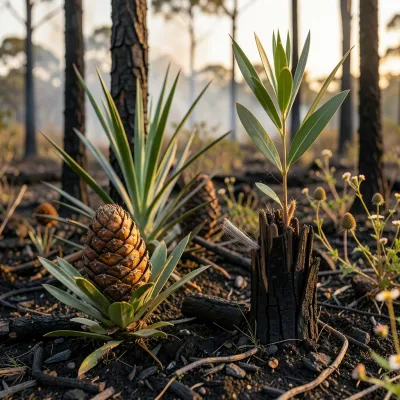
"Australian Fire-Adapted Flora" provides a comprehensive guide to the ecology, propagation, and restoration of native plants in Australia's fire-prone environments. The book begins by establishing fire as an intrinsic and evolutionary force in the Australian landscape, detailing its historical patterns shaped by natural ignitions and, significantly, by millennia of Indigenous cultural burning practices. It explains how these fire regimes have driven the evolution of unique plant adaptations, such as resprouting from lignotubers and epicormic buds, and reseeding from serotinous cones or soil seed banks. The intricate physiological mechanisms behind fire-stimulated germination, including the roles of heat, smoke (karrikinolide), and char, are also thoroughly explored as key drivers of post-fire regeneration.
The book delves into the diverse fire regimes across Australia's major biomes—savannas, shrublands, forests, and heaths—highlighting how varying frequencies, intensities, seasons, and spatial patterns dictate plant life-history strategies (resprouters vs. reseeders). It emphasizes the critical role of post-fire faunal interactions, particularly myrmecochory (ant-mediated seed dispersal), and the impact of pollinators, herbivores, and seed predators on ecosystem recovery. A significant focus is placed on pyrodiversity, advocating for mosaic burn designs that create heterogeneous landscapes to maximize biodiversity and resilience, drawing inspiration from Indigenous fire stewardship and its ecological benefits.
Practical aspects of restoration are extensively covered, from the ethical considerations and meticulous processes of collecting, processing, and storing native seeds to advanced propagation techniques like smoke water and heat treatments in nurseries. The importance of rigorous nursery production standards and quality control is stressed to ensure robust planting stock. The book then guides readers through the stages of post-fire site assessment and restoration planning, emphasizing the need for adaptive management and measurable success metrics. Specific challenges such as erosion control, soil rehabilitation, and weed management in burned landscapes are addressed, with case studies illustrating successful and problematic scenarios in eucalypt forests, banksia woodlands, and coastal heaths.
Finally, the book addresses future directions, particularly the profound impacts of climate change on fire regimes and the consequent challenges for restoration. It calls for a shift towards climate-informed policies, deeper integration of Indigenous knowledge, and innovative restoration pathways that prioritize adaptive capacity and ecosystem resilience over rigid adherence to historical baselines. The overarching message is that successful restoration in Australia requires a holistic understanding of fire as an ecological partner, blending scientific knowledge, practical skills, and ethical stewardship to foster diverse and self-sustaining landscapes in a rapidly changing world.
What You'll Find Inside:
- Fire regimes across Australian biomes (savannas, shrublands, forests, heaths) and how frequency, intensity, season, and spatial pattern shape plant adaptations and community dynamics
- Germination cues and physiological mechanisms including heat, smoke (karrikinolide), and char that trigger seed dormancy breakage in fire-adapted flora, with practical propagation techniques
- Life-history strategies of resprouters ( lignotubers, epicormic buds) versus reseeders (soil seed banks, serotiny) and how fire regime influences the balance between persistence and recruitment
- Practical restoration guidance covering seed collection, processing, storage, smoke/heat treatments, nursery production standards, site assessment, and choosing between direct seeding vs. planting
- Case studies from eucalypt forests/woodlands and banksia woodlands/coastal heath illustrating post-fire recovery pathways, Indigenous cultural burning practices, and adaptive management approaches
Who's It For:
This book is written for restoration practitioners, land managers, ecologists, nursery professionals, and conservation workers who need both theoretical understanding and field-applicable guidance for working with Australia's fire-adapted flora. It will be most beneficial for those involved in post-bushfire recovery efforts, seed collection and propagation, site rehabilitation, and designing restoration projects that align with ecological processes. Readers seeking to integrate Indigenous fire stewardship principles with contemporary restoration practices while addressing climate change challenges will find particular value in the integrated approach presented throughout the text.
Table of Contents:
- Introduction
- Chapter 1 Fire in the Australian Landscape: Patterns and Drivers
- Chapter 2 Evolutionary Origins of Fire‑Adapted Traits
- Chapter 3 Fire Regimes Across Biomes: Savannas, Shrublands, Forests, and Heaths
- Chapter 4 Heat, Smoke, and Char: Germination Cues and Physiological Mechanisms
- Chapter 5 Soil Seed Banks and Canopy Seed Storage (Serotiny)
- Chapter 6 Resprouters vs. Reseeders: Life‑History Strategies
- Chapter 7 Post‑Fire Seed Dispersal and Myrmecochory
- Chapter 8 Pyrodiversity and Biodiversity: Designing Mosaic Burns
- Chapter 9 Indigenous Fire Stewardship and Cultural Burning
- Chapter 10 Post‑Fire Succession and Community Assembly
- Chapter 11 Fire Effects on Soils, Nutrients, and Microbiomes
- Chapter 12 Faunal Interactions After Fire: Pollinators, Herbivores, and Seed Predators
- Chapter 13 Invasion Risk and Weed Management in Burned Landscapes
- Chapter 14 Collecting, Processing, and Storing Native Seed
- Chapter 15 Smoke Water, Heat Treatments, and Other Propagation Techniques
- Chapter 16 Nursery Production of Fire‑Adapted Natives: Standards and Quality Control
- Chapter 17 Site Assessment and Restoration Planning After Bushfires
- Chapter 18 Erosion Control, Mulching, and Soil Rehabilitation
- Chapter 19 Direct Seeding vs. Planting: Methods, Timing, and Equipment
- Chapter 20 Establishment Phase: Irrigation, Protection, and Monitoring
- Chapter 21 Genetic Diversity, Provenancing, and Seed Sourcing Ethics
- Chapter 22 Monitoring, Adaptive Management, and Success Metrics
- Chapter 23 Case Studies: Eucalypt Forests and Woodlands
- Chapter 24 Case Studies: Banksia Woodlands and Coastal Heath
- Chapter 25 Future Directions: Climate Change, Policy, and Restoration Pathways
Author:
Published By:
Date Published:
May 4, 2026
Type:
Nonfiction
Language:
English
Word Count:
59,947 words
Reading Time:
4 hours 12 minutes
Sample:
Order:
Order Australian Fire-Adapted Flora (Paperback) on MixCache.com:
Buy NowPrint copy is made to order and ships worldwide. Includes the ebook free, ready to read instantly.
$5 account credit for all new MixCache.com accounts, usable toward any ebook purchase!*


