
Browse by Category
Fiction
- Action & Adventure
- African American
- Anthologies
- Children's Fiction
- Classics
- Comics & Graphic Novels
- Coming of Age
- Contemporary
- Cultural & Regional
- Drama
- Erotica
- Fantasy
- General
- Historical Fiction
- Horror
- Humor & Satire
- Literary Fiction
- Mystery, Thriller & Suspense
- Poetry
- Religious & Inspirational
- Romance
- Science Fiction
- Short Stories
- War & Military
- Westerns
- Women's Fiction
- Young Adult
Non-Fiction
- Antiques & Collectibles
- Arts & Photography
- Biographies & Memoirs
- Business & Money
- Children's Non-Fiction
-
Computers & Technology
- Artificial Intelligence
- Computer Science
- Cybersecurity & Cryptography
- Data Science & Analytics
- Databases & Big Data
- Game Development & Design
- General
- Hardware & DIY
- Mobile App Development
- Networking & Cloud Computing
- Operating Systems
- Programming
- Robotics
- Software
- Software Engineering
- User Experience (UX) & Design
- Web Development & Design
- Cooking, Food & Wine
- Crafts, Hobbies & Home
- Education & Teaching
- Engineering
- General
- Health, Fitness & Dieting
-
History
- African History
- African History - North Africa
- African History - Sub-Saharan Africa
- American History
- American History - 20th Century
- American History - Civil War
- American History - Colonial Period
- Ancient History
- Asian History
- Asian History - China
- Asian History - India
- Asian History - Japan
- Asian History - Southeast Asia
- European History
- European History - Ancient Greece
- European History - Ancient Rome
- European History - Medieval
- European History - Modern
- European History - Renaissance
- General
- Middle Eastern History
- Military History
- Military History - Aviation
- Military History - Naval
- Social & Cultural History
- World History
- Humor & Entertainment
- Industrial Technology
- Language Learning
- Law
- LGBTQ+ Non-Fiction
- Literary Criticism
- Medical Books
- Parenting & Relationships
- Philosophy
- Politics & Social Sciences
- Reference
- Religion & Spirituality
-
Science & Math
- Agricultural Sciences
- Astronomy & Space Science
- Behavioral Sciences
- Biological Sciences
- Botany & Plant Science
- Chemistry
- Earth Sciences
- Engineering - Chemical
- Engineering - Civil
- Engineering - Electrical
- Engineering - Mechanical
- Environment
- General
- Geology
- Mathematics
- Nature & Ecology
- Oceanography
- Paleontology
- Physics
- Statistics
- Self-Help
- Sports & Outdoors
- Study Aids
- Sustainability & Green Living
- Textbooks
- Transportation
- Travel
- True Crime
- Urban Planning & Development
- Veterinary Medicine
- Writing & Publishing
Jump to Section
MixCache.com Total Access
Unlimited reading and audiobooks for every book published by MixCache.com.
Included titles carry the MTA badge.
Learn more →
South African Fynbos: Plants, Pollinators, and Practice
MTA
An in-depth guide to cultivating, conserving, and understanding fynbos biome natives
About this book:
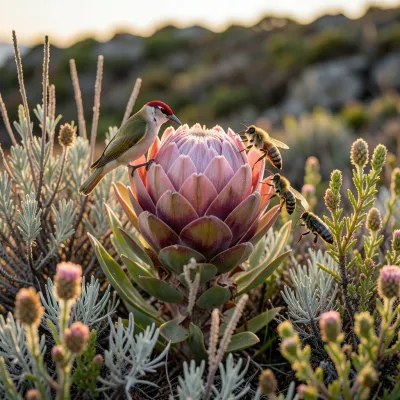
*South African Fynbos: Plants, Pollinators, and Practice* is a comprehensive guide to the ecology, cultivation, and restoration of the Cape Floristic Region. The book establishes that fynbos is a biome defined by paradox: it thrives in nutrient-poor, acidic soils and harsh Mediterranean climates through specialized adaptations. Key plant families like Proteaceae, Ericaceae, and Restionaceae are analyzed for their unique survival strategies, including sclerophylly (leathery leaves), specialized root systems for phosphorus acquisition, and serotiny (fire-activated seed release). The text emphasizes that fire is not a catastrophe but a fundamental ecological architect that resets competition and triggers germination.
The book details the intricate pollination syndromes that sustain this biodiversity, moving beyond birds like sunbirds and sugarbirds to include insects, small mammals, and even wind. These evolutionary partnerships dictate the physical form of the flora, creating a complex "ecological theater" where plant morphology is precisely calibrated to the anatomy and behavior of its pollinators. This biological logic is then translated into practical horticultural principles, advising gardeners and land stewards to avoid traditional pampering—such as rich fertilizers and frequent irrigation—in favor of lean media, sharp drainage, and seasonal rhythms that mimic the wild.
A significant portion of the work is dedicated to the technical aspects of fynbos management, covering propagation through smoke-treated seeds and cuttings, as well as the prevention of pathogens like *Phytophthora*. The book advocates for "adaptive management," a process of constant monitoring and adjustment to combat threats like invasive species and climate change. By integrating scientific research with nursery practices and landscape design, the text provides a toolkit for creating resilient, water-wise gardens that serve as functional nodes in a larger conservation network.
Finally, the book looks toward the future through restoration planning and real-world case studies. It highlights successful projects across various terrains, from urban fragments to mountain plantations and drained wetlands, emphasizing that restoration is a long-term commitment to process rather than a one-time planting. The core message is one of ecological literacy and stewardship: by understanding the deep logic of the fynbos biome—its reliance on fire, its thrift with nutrients, and its partnership with wildlife—people can effectively cultivate and conserve one of the world's most extraordinary botanical heritages.
What You'll Find Inside:
- The fynbos biome's unique adaptations to nutrient-poor soils, seasonal drought, and recurrent fire
- Detailed ecology of key plant families: Proteaceae, Ericaceae, and Restionaceae
- Specialized pollination syndromes involving birds, insects, mammals, lizards, and wind
- Fire ecology principles including germination cues, seedbanks, and landscape management
- Practical guidance for fynbos cultivation, propagation, nursery practices, garden design, and restoration
Who's It For:
This book is ideal for gardeners, horticulturists, land managers, conservationists, and students seeking to understand and work with the fynbos biome. It provides both ecological foundations and practical techniques for cultivating fynbos gardens, restoring degraded landscapes, and supporting native pollinators. Readers will gain the knowledge needed to align their practices with fynbos ecology rather than working against it, whether they're managing a small garden or large-scale restoration project.
Table of Contents:
- Introduction
- Chapter 1 The Fynbos Biome: Scope and Significance
- Chapter 2 Geology, Climate, and Soils of the Cape Floristic Region
- Chapter 3 Plant Form and Function: Adaptations to Nutrient-Poor Landscapes
- Chapter 4 Proteaceae of the Fynbos: Diversity and Ecology
- Chapter 5 Ericaceae in Fynbos: Heaths, Habitats, and Hybrids
- Chapter 6 Restios and Restionaceae: Architecture of the Heathlands
- Chapter 7 Bulbs and Geophytes: Hidden Engines of Seasonal Color
- Chapter 8 Pollination Syndromes I: Birds—Sunbirds and Sugarbirds
- Chapter 9 Pollination Syndromes II: Insects—Bees, Beetles, and Butterflies
- Chapter 10 Pollination Syndromes III: Mammals, Lizards, and Wind
- Chapter 11 Fire Ecology: Return Intervals, Intensity, and Mosaic Landscapes
- Chapter 12 Smoke, Heat, and Seed: Germination Cues and Seedbanks
- Chapter 13 Nutrient Cycling and Mycorrhizae: Life on Low Phosphorus
- Chapter 14 Water Relations: Drought Tolerance and Fog Harvesting
- Chapter 15 Horticultural Principles for Fynbos Gardens
- Chapter 16 Propagation Techniques: Seed, Cuttings, and Tissue Culture
- Chapter 17 Nursery Practices: Media, Containers, and Disease Management
- Chapter 18 Garden Design: Planting Plans, Companions, and Aesthetics
- Chapter 19 Irrigation, Mulch, and Soil Management for Success
- Chapter 20 Pests, Pathogens, and Phytophthora: Prevention and Response
- Chapter 21 Invasive Species and Weeds: Threats and Control Strategies
- Chapter 22 Restoration Planning: Site Assessment and Goal Setting
- Chapter 23 Implementation: Sourcing, Planting, and Early Stewardship
- Chapter 24 Monitoring, Adaptive Management, and Citizen Science
- Chapter 25 Case Studies: Successful Restoration Across the Cape and Beyond
Author:
Published By:
Date Published:
May 4, 2026
Type:
Nonfiction
Language:
English
Word Count:
65,181 words
Reading Time:
4 hours 34 minutes
Sample:
Order:
Order South African Fynbos: Plants, Pollinators, and Practice (Paperback) on MixCache.com:
Buy NowPrint copy is made to order and ships worldwide. Includes the ebook free, ready to read instantly.
$5 account credit for all new MixCache.com accounts, usable toward any ebook purchase!*


