Browse by Category
Fiction
- Action & Adventure
- African American
- Anthologies
- Children's Fiction
- Classics
- Comics & Graphic Novels
- Coming of Age
- Contemporary
- Cultural & Regional
- Drama
- Erotica
- Fantasy
- General
- Historical Fiction
- Horror
- Humor & Satire
- Literary Fiction
- Mystery, Thriller & Suspense
- Poetry
- Religious & Inspirational
- Romance
- Science Fiction
- Short Stories
- War & Military
- Westerns
- Women's Fiction
- Young Adult
Non-Fiction
- Antiques & Collectibles
- Arts & Photography
- Biographies & Memoirs
- Business & Money
- Children's Non-Fiction
-
Computers & Technology
- Artificial Intelligence
- Computer Science
- Cybersecurity & Cryptography
- Data Science & Analytics
- Databases & Big Data
- Game Development & Design
- General
- Hardware & DIY
- Mobile App Development
- Networking & Cloud Computing
- Operating Systems
- Programming
- Robotics
- Software
- Software Engineering
- User Experience (UX) & Design
- Web Development & Design
- Cooking, Food & Wine
- Crafts, Hobbies & Home
- Education & Teaching
- Engineering
- General
- Health, Fitness & Dieting
-
History
- African History
- African History - North Africa
- African History - Sub-Saharan Africa
- American History
- American History - 20th Century
- American History - Civil War
- American History - Colonial Period
- Ancient History
- Asian History
- Asian History - China
- Asian History - India
- Asian History - Japan
- Asian History - Southeast Asia
- European History
- European History - Ancient Greece
- European History - Ancient Rome
- European History - Medieval
- European History - Modern
- European History - Renaissance
- General
- Middle Eastern History
- Military History
- Military History - Aviation
- Military History - Naval
- Social & Cultural History
- World History
- Humor & Entertainment
- Industrial Technology
- Language Learning
- Law
- LGBTQ+ Non-Fiction
- Literary Criticism
- Medical Books
- Parenting & Relationships
- Philosophy
- Politics & Social Sciences
- Reference
- Religion & Spirituality
-
Science & Math
- Agricultural Sciences
- Astronomy & Space Science
- Behavioral Sciences
- Biological Sciences
- Botany & Plant Science
- Chemistry
- Earth Sciences
- Engineering - Chemical
- Engineering - Civil
- Engineering - Electrical
- Engineering - Mechanical
- Environment
- General
- Geology
- Mathematics
- Nature & Ecology
- Oceanography
- Paleontology
- Physics
- Statistics
- Self-Help
- Sports & Outdoors
- Study Aids
- Sustainability & Green Living
- Textbooks
- Transportation
- Travel
- True Crime
- Urban Planning & Development
- Veterinary Medicine
- Writing & Publishing
Jump to Section
MixCache.com Total Access
Unlimited reading and audiobooks for every book published by MixCache.com.
Included titles carry the MTA badge.
Learn more →
The Kremlin's Secret Police
MTA
KGB Operations, International Espionage, and Domestic Surveillance Tactics
About this book:
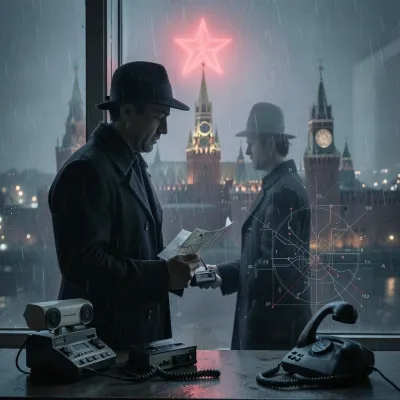
"The Kremlin's Secret Police" provides a comprehensive overview of the KGB, tracing its evolution from the Cheka in 1917 to its post-Soviet successors like the FSB and SVR. The book demystifies the organization, explaining its structure, mandates, and operational methods across decades of the 20th century. It emphasizes the KGB's fundamental subservience to the Communist Party and the Politburo, framing it as the Party's "sword and shield"—protecting the state internally and projecting its influence globally. The text details the rigorous training of Soviet intelligence officers, their recruitment of diverse human sources (agents, assets, and agents of influence), and the pervasive domestic surveillance and social control mechanisms, including extensive informant networks, censorship, and the repression of dissidents and "refuseniks" through methods like forced psychiatric treatment.
The book delves into the KGB's foreign intelligence operations, describing the architecture of the First Chief Directorate, the creation of "illegals" operating under deep cover, and the establishment of legal "rezidenturas" within embassies and trade missions. It highlights the crucial role of technical collection, encompassing signals intelligence, cryptography, and the systematic acquisition of Western science and technology (Line X) to close strategic gaps. Global case studies anchor the analysis, illustrating the KGB's penetration of Western governments (e.g., the Cambridge Five), its intense activities in postwar spy cities like Berlin and Vienna, and its intelligence warning failures and successes during critical events like the Cuban Missile Crisis. The book also covers the extensive "active measures" campaigns, utilizing front organizations and cultural diplomacy to shape international perceptions and sow discord, and its operations in the Global South to support allied regimes and revolutionary movements.
A significant portion of the book examines the KGB's complex relationships with allied security services within the Eastern Bloc, such as the East German Stasi and Romanian Securitate, highlighting both cooperation and inherent tensions. It documents the organization's struggles with managing dissent within the Soviet Union and its deep involvement in the War in Afghanistan, revealing the limits of its power when confronted with popular resistance and flawed strategic decisions. The final chapters detail the KGB's crisis during Perestroika and the 1991 coup attempt, leading to its formal dissolution and fragmentation into successor agencies. The book concludes by exploring the lasting legacies of the KGB—its influence on post-Soviet security states, the ethical and legal challenges posed by its historical methods, and the enduring relevance of its practices in contemporary surveillance and information warfare, underscoring the persistent tension between state security and individual freedom.
What You'll Find Inside:
- The KGB's evolution from revolutionary Cheka to Cold War security apparatus, tracing its organizational development and ideological foundations.
- The dual mandate of the KGB as 'sword and shield' - balancing foreign intelligence operations with domestic surveillance and social control.
- Tradecraft and recruitment methods used by KGB officers, including agent handling, technical collection, and illegal rezidenturas.
- Active measures and influence operations abroad, covering propaganda, disinformation campaigns, and front organizations.
- The KGB's global impact through case studies like the Cambridge Five, Afghan War, and operations in the Global South, plus its legacy in post-Soviet security services.
Who's It For:
This book is ideal for students, researchers, and professionals in history, political science, international relations, and security studies who seek a comprehensive understanding of Soviet intelligence operations during the Cold War. It will particularly benefit those interested in the organizational structure of intelligence agencies, the tradecraft of espionage, and the lasting impact of KGB methods on contemporary security practices and surveillance states.
Table of Contents:
- Introduction
- Chapter 1 From Cheka to KGB: The Making of a Security Apparatus
- Chapter 2 Organization and Mandate: How the KGB Was Built to Rule
- Chapter 3 Party Control: The Politburo, Ideology, and the “Sword and Shield”
- Chapter 4 Schools of Tradecraft: Training the Soviet Intelligence Officer
- Chapter 5 Recruitment and Sources: Agents, Assets, and Influence
- Chapter 6 Watching the Homeland: Domestic Surveillance and Social Control
- Chapter 7 Censorship, Propaganda, and Active Measures
- Chapter 8 Counterintelligence at Home: From SMERSH to the Second Chief Directorate
- Chapter 9 The First Chief Directorate: Architecture of Foreign Intelligence
- Chapter 10 Illegals and Deep Cover: Life Without a Legend
- Chapter 11 Rezidenturas: Embassies, Trade Missions, and Legal Cover
- Chapter 12 Technical Collection: Bugs, Codes, and Signals Intelligence
- Chapter 13 Science, Technology, and Space: The Strategic Edge
- Chapter 14 Penetrating the West: Moles, Double Agents, and Defections
- Chapter 15 Case Study: The Cambridge Five and the British Establishment
- Chapter 16 Case Study: Berlin and Vienna—Postwar Cities of Spies
- Chapter 17 Case Study: The Cuban Missile Crisis and Intelligence Warning
- Chapter 18 Active Measures Abroad: Front Organizations and Cultural Diplomacy
- Chapter 19 The Global South: Operations in Africa, Asia, and Latin America
- Chapter 20 The Bloc Within the Bloc: Stasi, Securitate, and Allied Services
- Chapter 21 Managing Dissent: Dissidents, Refuseniks, and Internal Repression
- Chapter 22 War in Afghanistan: Intelligence, Insurgency, and Covert Action
- Chapter 23 Reform, Crisis, and Collapse: Perestroika and the 1991 Coup
- Chapter 24 Afterlives of an Institution: FSB, SVR, and Post-Soviet Security States
- Chapter 25 Legacies and Lessons: Ethics, Law, and the Future of Surveillance
Author:
Published By:
Date Published:
May 2, 2026
Type:
Nonfiction
Language:
English
Word Count:
74,825 words
Reading Time:
5 hours 14 minutes
Sample:
Order:
Order The Kremlin's Secret Police (Paperback) on MixCache.com:
Buy NowPrint copy is made to order and ships worldwide. Includes the ebook free, ready to read instantly.
$5 account credit for all new MixCache.com accounts, usable toward any ebook purchase!*