Browse by Category
Fiction
- Action & Adventure
- African American
- Anthologies
- Children's Fiction
- Classics
- Comics & Graphic Novels
- Coming of Age
- Contemporary
- Cultural & Regional
- Drama
- Erotica
- Fantasy
- General
- Historical Fiction
- Horror
- Humor & Satire
- Literary Fiction
- Mystery, Thriller & Suspense
- Poetry
- Religious & Inspirational
- Romance
- Science Fiction
- Short Stories
- War & Military
- Westerns
- Women's Fiction
- Young Adult
Non-Fiction
- Antiques & Collectibles
- Arts & Photography
- Biographies & Memoirs
- Business & Money
- Children's Non-Fiction
-
Computers & Technology
- Artificial Intelligence
- Computer Science
- Cybersecurity & Cryptography
- Data Science & Analytics
- Databases & Big Data
- Game Development & Design
- General
- Hardware & DIY
- Mobile App Development
- Networking & Cloud Computing
- Operating Systems
- Programming
- Robotics
- Software
- Software Engineering
- User Experience (UX) & Design
- Web Development & Design
- Cooking, Food & Wine
- Crafts, Hobbies & Home
- Education & Teaching
- Engineering
- General
- Health, Fitness & Dieting
-
History
- African History
- African History - North Africa
- African History - Sub-Saharan Africa
- American History
- American History - 20th Century
- American History - Civil War
- American History - Colonial Period
- Ancient History
- Asian History
- Asian History - China
- Asian History - India
- Asian History - Japan
- Asian History - Southeast Asia
- European History
- European History - Ancient Greece
- European History - Ancient Rome
- European History - Medieval
- European History - Modern
- European History - Renaissance
- General
- Middle Eastern History
- Military History
- Military History - Aviation
- Military History - Naval
- Social & Cultural History
- World History
- Humor & Entertainment
- Industrial Technology
- Language Learning
- Law
- LGBTQ+ Non-Fiction
- Literary Criticism
- Medical Books
- Parenting & Relationships
- Philosophy
- Politics & Social Sciences
- Reference
- Religion & Spirituality
-
Science & Math
- Agricultural Sciences
- Astronomy & Space Science
- Behavioral Sciences
- Biological Sciences
- Botany & Plant Science
- Chemistry
- Earth Sciences
- Engineering - Chemical
- Engineering - Civil
- Engineering - Electrical
- Engineering - Mechanical
- Environment
- General
- Geology
- Mathematics
- Nature & Ecology
- Oceanography
- Paleontology
- Physics
- Statistics
- Self-Help
- Sports & Outdoors
- Study Aids
- Sustainability & Green Living
- Textbooks
- Transportation
- Travel
- True Crime
- Urban Planning & Development
- Veterinary Medicine
- Writing & Publishing
Jump to Section
MixCache.com Total Access
Unlimited reading and audiobooks for every book published by MixCache.com.
Included titles carry the MTA badge.
Learn more →
A History of Paccar
MTA
The Story of an S&P 500 Company
About this book:
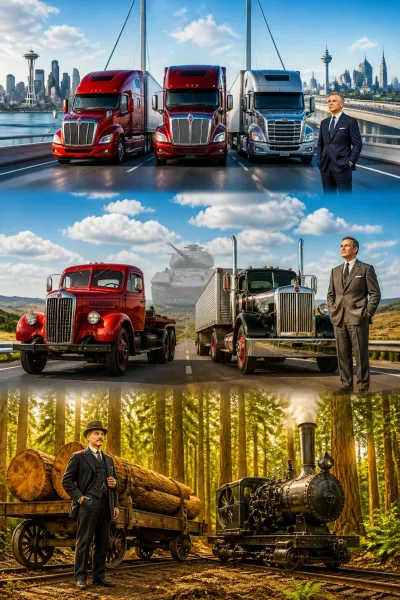
Paccar's evolution from a modest 1905 Seattle railway and logging equipment manufacturer into a global S&P 500 heavy-duty truck leader is a story of strategic vision, financial prudence, and decentralized brand management. Founded by William Pigott Sr. as Seattle Car Manufacturing Company, the firm survived the Great Depression through a family-led buyback and wartime production of Sherman tanks. The pivotal 1945 acquisition of Kenworth, followed by Peterbilt in 1958, shifted the company's identity toward premium, custom-engineered trucks. Under Paul Pigott and subsequent leaders—including his son Charles and grandson Mark—Paccar cultivated a culture of conservative debt management, operational efficiency, and long-term investment in R&D, allowing it to weather economic cycles while maintaining product quality. The 1996 acquisition of DAF Trucks in the Netherlands, followed by Leyland Trucks, transformed Paccar into a truly multinational corporation with dominant positions in both North American and European markets.
Technological innovation has been a constant driver of Paccar’s competitive advantage. The company transitioned from integrating third-party engines to developing its proprietary MX powertrain, leveraging DAF’s European engineering expertise to meet stringent global emissions standards while optimizing fuel efficiency. Investments in aerodynamics, advanced materials, driver-centric cab designs, and digital telematics have consistently reduced total cost of ownership for customers. Paccar’s vertical integration strategy extended to a comprehensive global parts and service network (Paccar Parts) and a captive finance arm (Paccar Financial), creating a resilient ecosystem that supports customers throughout the vehicle lifecycle and stabilizes revenue during cyclical downturns. Manufacturing excellence, characterized by lean principles, automation, and a skilled workforce, underpins the quality reputation of the Kenworth, Peterbilt, and DAF brands.
Environmental stewardship and regulatory adaptation have shaped modern product development. Paccar has proactively addressed increasingly strict emissions regulations through advanced diesel aftertreatment systems and is now aggressively pursuing zero-emission solutions, including battery-electric and hydrogen fuel cell platforms for urban and regional haul applications. The company integrates advanced driver-assistance systems (ADAS) and connectivity features to enhance safety and fleet efficiency, laying groundwork for future autonomous capabilities. Throughout these transitions, Paccar maintains its decentralized philosophy, empowering its distinct brands to serve specific market niches while sharing core technologies and financial strength.
As Paccar navigates the 21st century, its enduring legacy rests on a foundation of financial fortitude, customer intimacy, and engineering leadership. The company faces a future defined by decarbonization, digitalization, and automation, requiring massive capital investment and supply chain resilience. By adhering to its century-old principles—prudent capital allocation, premium product positioning, and a workforce culture of craftsmanship—Paccar aims to remain the standard-bearer for the global commercial vehicle industry, evolving from a builder of trucks into a comprehensive mobility solutions partner.
What You'll Find Inside:
- The century-long evolution of Paccar from a Pacific Northwest railway and logging equipment manufacturer into a global S&P 500 leader in premium heavy-duty trucks (Kenworth, Peterbilt, DAF).
- A distinctive decentralized brand strategy that preserves the unique identities and engineering philosophies of acquired companies while leveraging shared R&D, manufacturing, and financial strength.
- Unwavering financial fortitude characterized by conservative debt management, strong cash flow, and counter-cyclical investment that ensures resilience through economic downturns.
- Vertical integration and technological sovereignty demonstrated by the development of proprietary MX engines, integrated powertrains, and advanced digital/telematics ecosystems.
- A comprehensive customer-centric ecosystem encompassing custom vehicle specification, a global parts and service network (Paccar Parts), and captive financing (Paccar Financial) to minimize total cost of ownership.
Who's It For:
This book is ideal for business strategists, corporate historians, and supply chain professionals seeking a deep case study in sustainable industrial growth. It will particularly benefit executives in manufacturing and transportation industries interested in long-term brand management, acquisition integration, and navigating regulatory and technological disruption. Investors and analysts tracking S&P 500 industrial conglomerates will also find valuable insights into Paccar's financial discipline and competitive moat.
Table of Contents:
- Introduction: Paccar - A Legacy of Innovation and Growth
- Chapter 1: The Early Years - Founding and First Ventures
- Chapter 2: Diversification and Expansion - Broadening Horizons
- Chapter 3: The Kenworth Era Begins - Forging a New Identity
- Chapter 4: Peterbilt's Genesis - Crafting an Icon
- Chapter 5: International Growth - Expanding Beyond North America
- Chapter 6: Technological Advancements in Truck Manufacturing
- Chapter 7: Navigating Economic Downturns and Triumphs
- Chapter 8: Leadership and Visionaries - Shaping Paccar's Destiny
- Chapter 9: Acquisitions and Mergers - Strategic Growth
- Chapter 10: Engines of Progress - Paccar's Powertrain Development
- Chapter 11: The DAF Story - European Market Dominance
- Chapter 12: Financial Fortitude - A Prudent Approach to Business
- Chapter 13: Global Manufacturing and Supply Chains
- Chapter 14: Innovation in Design - Aesthetics and Aerodynamics
- Chapter 15: Environmental Stewardship and Sustainable Practices
- Chapter 16: Customer Focus - Building Lasting Relationships
- Chapter 17: Paccar Parts - A Comprehensive Support Network
- Chapter 18: Information Technology and the Digital Transformation
- Chapter 19: Paccar Financial - Enabling Customer Success
- Chapter 20: The Workforce - People Behind the Products
- Chapter 21: Philanthropy and Community Engagement
- Chapter 22: Adapting to Changing Regulations and Market Demands
- Chapter 23: Research and Development - Shaping the Future of Transport
- Chapter 24: Paccar in the 21st Century - Modern Challenges and Opportunities
- Chapter 25: The Road Ahead - Paccar's Enduring Legacy
Author:
Published By:
Date Published:
November 5, 2026
Type:
Nonfiction
Language:
English
Word Count:
42,906 words
Reading Time:
3 hours
Sample:
Order:
Order A History of Paccar (Hardcover) on MixCache.com:
Buy NowPrint copy is made to order and ships worldwide. Includes the ebook free, ready to read instantly.
$5 account credit for all new MixCache.com accounts, usable toward any ebook purchase!*