
Browse by Category
Fiction
- Action & Adventure
- African American
- Anthologies
- Children's Fiction
- Classics
- Comics & Graphic Novels
- Coming of Age
- Contemporary
- Cultural & Regional
- Drama
- Erotica
- Fantasy
- General
- Historical Fiction
- Horror
- Humor & Satire
- Literary Fiction
- Mystery, Thriller & Suspense
- Poetry
- Religious & Inspirational
- Romance
- Science Fiction
- Short Stories
- War & Military
- Westerns
- Women's Fiction
- Young Adult
Non-Fiction
- Antiques & Collectibles
- Arts & Photography
- Biographies & Memoirs
- Business & Money
- Children's Non-Fiction
-
Computers & Technology
- Artificial Intelligence
- Computer Science
- Cybersecurity & Cryptography
- Data Science & Analytics
- Databases & Big Data
- Game Development & Design
- General
- Hardware & DIY
- Mobile App Development
- Networking & Cloud Computing
- Operating Systems
- Programming
- Robotics
- Software
- Software Engineering
- User Experience (UX) & Design
- Web Development & Design
- Cooking, Food & Wine
- Crafts, Hobbies & Home
- Education & Teaching
- Engineering
- General
- Health, Fitness & Dieting
-
History
- African History
- African History - North Africa
- African History - Sub-Saharan Africa
- American History
- American History - 20th Century
- American History - Civil War
- American History - Colonial Period
- Ancient History
- Asian History
- Asian History - China
- Asian History - India
- Asian History - Japan
- Asian History - Southeast Asia
- European History
- European History - Ancient Greece
- European History - Ancient Rome
- European History - Medieval
- European History - Modern
- European History - Renaissance
- General
- Middle Eastern History
- Military History
- Military History - Aviation
- Military History - Naval
- Social & Cultural History
- World History
- Humor & Entertainment
- Industrial Technology
- Language Learning
- Law
- LGBTQ+ Non-Fiction
- Literary Criticism
- Medical Books
- Parenting & Relationships
- Philosophy
- Politics & Social Sciences
- Reference
- Religion & Spirituality
-
Science & Math
- Agricultural Sciences
- Astronomy & Space Science
- Behavioral Sciences
- Biological Sciences
- Botany & Plant Science
- Chemistry
- Earth Sciences
- Engineering - Chemical
- Engineering - Civil
- Engineering - Electrical
- Engineering - Mechanical
- Environment
- General
- Geology
- Mathematics
- Nature & Ecology
- Oceanography
- Paleontology
- Physics
- Statistics
- Self-Help
- Sports & Outdoors
- Study Aids
- Sustainability & Green Living
- Textbooks
- Transportation
- Travel
- True Crime
- Urban Planning & Development
- Veterinary Medicine
- Writing & Publishing
Jump to Section

Want unlimited access to all books published by MixCache.com (plus their audiobooks)? Try MixCache.com Total Access. Look for the MTA badge on book covers to identify included titles.
Access to infinite ebooks: Don't see the book you want? Suggest it and we'll create it (free!) for you from scratch with our powerful AI book writer. Then read it with MTA - besides profiting from any sales it makes!
A History of McDonald's
MTA
The Story of an S&P 500 Company
About this book:
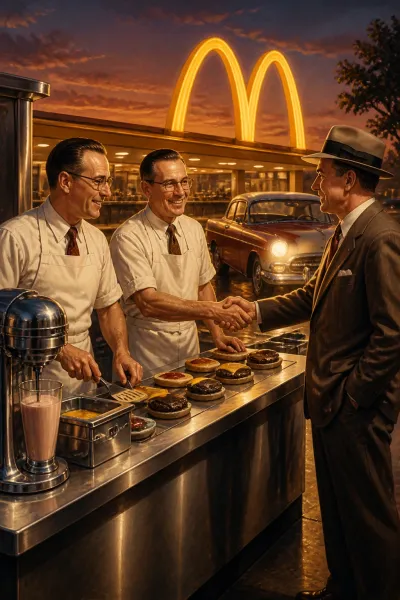
McDonald's began as a single drive-in restaurant in San Bernardino, California, where brothers Richard and Maurice McDonald revolutionized food service in 1948 with their "Speedee Service System"—an assembly-line approach emphasizing speed, consistency, and a limited menu. Milkshake machine salesman Ray Kroc recognized the model's scalability and, after becoming their franchising agent in 1954, opened the first franchised location in Des Plaines, Illinois, in 1955. Kroc's aggressive expansion strategy, bolstered by Harry Sonneborn's innovative real estate model of owning land and leasing to franchisees, fueled rapid national growth. The company went public in 1965, cementing its financial foundation, while iconic menu additions like the Filet-O-Fish, Big Mac, and the revolutionary Egg McMuffin breakfast line diversified offerings and captured new dayparts. Marketing genius, epitomized by Ronald McDonald and the Happy Meal, embedded the brand deeply into family culture, and the drive-thru window redefined convenience for a mobile society.
As McDonald's saturated the U.S. market, it embarked on global expansion starting with Canada and Puerto Rico in the late 1960s, adapting its model through local partnerships and menu localization in diverse markets like Japan and Europe. This international growth transformed the Golden Arches into a symbol of globalization and "McDonaldization," representing both American cultural export and modern convenience. However, the company's immense scale invited intense scrutiny regarding nutrition, labor practices, and environmental impact. McDonald's responded by phasing out Styrofoam packaging, introducing healthier options and nutritional transparency, committing to sustainable sourcing for beef and coffee, and navigating complex labor debates across its vast global workforce. The Ronald McDonald House Charities, founded in 1974, became a cornerstone of its corporate social responsibility, providing vital support for families with hospitalized children.
Entering the 21st century, McDonald's faced slowing growth and fierce competition from fast-casual chains, prompting a comprehensive modernization strategy under leaders like Jim Skinner and Steve Easterbrook. The "Experience of the Future" initiative overhauled restaurant designs with modern aesthetics, self-ordering kiosks, table service, and enhanced drive-thru technology. The McCafé line, originating in Australia, was scaled globally to compete in the premium coffee market, while digital transformation—mobile ordering, delivery partnerships, and AI-driven personalization—redefined the customer journey. Menu innovations addressed plant-based trends and "clean label" demands, and the company set science-based targets for climate action and packaging waste reduction.
Throughout its history, McDonald's endurance has relied on a unique three-legged stool partnership between the corporation, franchisees, and suppliers, governed by rigorous operational standards from Hamburger University. Leadership succession, largely promoted from within, maintained cultural continuity while adapting strategy to each era's challenges. Today, as a stalwart of the S&P 500, McDonald's stands as more than a restaurant chain; it is a global institution that has shaped architecture, language, employment, and supply chain logistics. Its legacy is defined by the ability to scale a simple idea—consistent, affordable, quick food—into a complex, adaptive empire that continuously reinvents itself to remain relevant in a rapidly changing world.
What You'll Find Inside:
- The revolutionary Speedee Service System created by the McDonald brothers that established the blueprint for modern fast food through assembly-line efficiency, standardized menus, and speed-focused operations.
- Ray Kroc's transformative franchising strategy and innovative real estate model (Franchise Realty Corporation) that turned McDonald's into a property-owning empire with franchisees as tenants, creating financial stability and operational control.
- The company's mastery of global expansion through cultural adaptation—balancing standardized core offerings with localized menus—exemplified by the 'McDonaldization' phenomenon and strategic entries into diverse markets like Japan, Europe, and India.
- Continuous reinvention across decades: from breakfast innovation (Egg McMuffin) and drive-thru adoption to McCafé's coffee market entry, digital transformation (kiosks, mobile ordering, AI), and plant-based menu development.
- Navigation of major controversies (health/nutrition criticism, labor practices, environmental impact) while maintaining S&P 500 status through corporate social responsibility initiatives like Ronald McDonald House Charities and sustainability commitments.
Who's It For:
This book is ideal for business students, entrepreneurs, and corporate strategists seeking a comprehensive case study in scaling a franchise model, global brand management, and sustained S&P 500 performance. Investors and financial analysts will appreciate the detailed examination of McDonald's real estate strategy, supply chain excellence, and shareholder value creation. Additionally, marketing professionals and cultural historians will find value in the analysis of iconic branding campaigns, the 'McDonaldization' sociological impact, and the company's navigation of public scrutiny across health, labor, and environmental issues.
Author:
Published By:
Date Published:
September 9, 2026
Type:
Nonfiction
Language:
English
Word Count:
36,724 words
Reading Time:
2 hours 34 minutes
Sample:
Order:
Order A History of McDonald's (Hardcover) on MixCache.com:
Buy NowPrint copy is made to order and ships worldwide. Includes the ebook free, ready to read instantly.
$5 account credit for all new MixCache.com accounts, usable toward any ebook purchase!*


