
Browse by Category
Fiction
- Action & Adventure
- African American
- Anthologies
- Children's Fiction
- Classics
- Comics & Graphic Novels
- Coming of Age
- Contemporary
- Cultural & Regional
- Drama
- Erotica
- Fantasy
- General
- Historical Fiction
- Horror
- Humor & Satire
- Literary Fiction
- Mystery, Thriller & Suspense
- Poetry
- Religious & Inspirational
- Romance
- Science Fiction
- Short Stories
- War & Military
- Westerns
- Women's Fiction
- Young Adult
Non-Fiction
- Antiques & Collectibles
- Arts & Photography
- Biographies & Memoirs
- Business & Money
- Children's Non-Fiction
-
Computers & Technology
- Artificial Intelligence
- Computer Science
- Cybersecurity & Cryptography
- Data Science & Analytics
- Databases & Big Data
- Game Development & Design
- General
- Hardware & DIY
- Mobile App Development
- Networking & Cloud Computing
- Operating Systems
- Programming
- Robotics
- Software
- Software Engineering
- User Experience (UX) & Design
- Web Development & Design
- Cooking, Food & Wine
- Crafts, Hobbies & Home
- Education & Teaching
- Engineering
- General
- Health, Fitness & Dieting
-
History
- African History
- African History - North Africa
- African History - Sub-Saharan Africa
- American History
- American History - 20th Century
- American History - Civil War
- American History - Colonial Period
- Ancient History
- Asian History
- Asian History - China
- Asian History - India
- Asian History - Japan
- Asian History - Southeast Asia
- European History
- European History - Ancient Greece
- European History - Ancient Rome
- European History - Medieval
- European History - Modern
- European History - Renaissance
- General
- Middle Eastern History
- Military History
- Military History - Aviation
- Military History - Naval
- Social & Cultural History
- World History
- Humor & Entertainment
- Industrial Technology
- Language Learning
- Law
- LGBTQ+ Non-Fiction
- Literary Criticism
- Medical Books
- Parenting & Relationships
- Philosophy
- Politics & Social Sciences
- Reference
- Religion & Spirituality
-
Science & Math
- Agricultural Sciences
- Astronomy & Space Science
- Behavioral Sciences
- Biological Sciences
- Botany & Plant Science
- Chemistry
- Earth Sciences
- Engineering - Chemical
- Engineering - Civil
- Engineering - Electrical
- Engineering - Mechanical
- Environment
- General
- Geology
- Mathematics
- Nature & Ecology
- Oceanography
- Paleontology
- Physics
- Statistics
- Self-Help
- Sports & Outdoors
- Study Aids
- Sustainability & Green Living
- Textbooks
- Transportation
- Travel
- True Crime
- Urban Planning & Development
- Veterinary Medicine
- Writing & Publishing
Jump to Section
MixCache.com Total Access
Unlimited reading and audiobooks for every book published by MixCache.com.
Included titles carry the MTA badge.
Learn more →
The Hidden Life of Octopuses
MTA
What They Teach Us About Intelligence
About this book:
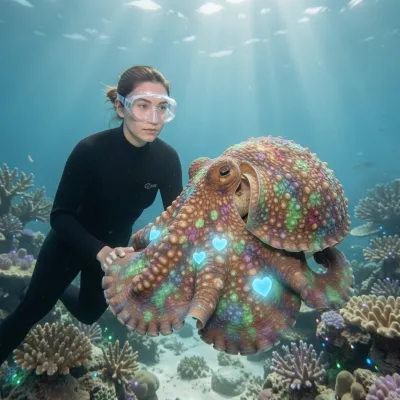
The Hidden Life of Octopuses explores the extraordinary biology and cognition of these marine invertebrates, beginning with their unparalleled camouflage—rapid, skin‑based changes in color, pattern, and texture driven by chromatophores, iridophores, leucophores, and papillae—and their unique physiology, including three hearts, copper‑based blue blood, and a body plan built from muscular hydrostats that allows boneless flexibility. Central to their intelligence is a distributed nervous system: while a large central brain handles strategic functions, two‑thirds of an octopus’s neurons reside in its arms, granting each limb a degree of autonomy for sensing, moving, and making local decisions. This architecture underpins their acute, multimodal perception—sharp vision sensitive to polarized light, chemosensory suckers that “taste” the environment, and sophisticated proprioception—enabling them to navigate, hunt, and interact with their surroundings in ways that differ fundamentally from vertebrate cognition.
Behaviorally, octopuses demonstrate sophisticated problem‑solving and tool use, from unscrewing jars and carrying coconut shells as mobile shelters to manipulating objects to block den entrances or extract prey. Their curiosity and play—repeated, seemingly purposeless interactions with objects—reflect an intrinsic drive for exploration that enhances learning and memory, which they exhibit through classical and operant conditioning, spatial mazes, and observational learning. These cognitive feats are coupled with dramatic life‑history traits: rapid growth, a brief, intense reproductive cycle marked by semelparity, and elaborate, self‑sacrificial brooding by females. As solitary hunters they employ ambush, active foraging, deception, and mimicry—most famously the mimic octopus’s dynamic impersonation of venomous sea snakes, lionfish, and flatfish—to both avoid predators and capture prey. Communication occurs through rapid, visual displays of color, pattern, and texture, conveying aggression, submission, courtship, and territorial status without sound.
The book situates these abilities within an evolutionary framework, emphasizing that cephalopod intelligence arose independently of vertebrates over half a billion years ago, offering a terrestrial model of “alien” cognition that challenges anthropocentric views of mind and consciousness. Evidence of individual personalities, play, curiosity, and responses to pain and pleasure supports arguments for octopus sentience, informing ethical considerations regarding research, captivity, and the emerging octopus farming industry. Conservation threats—overfishing, habitat destruction, pollution, climate change, and bycatch—are outlined alongside mitigation strategies. Cultural depictions ranging from the Kraken to modern documentaries illustrate shifting human perceptions, while prospects for future research include genomics, neuroscience, advanced tracking, and biomimicry. Ultimately, the synthesis reveals octopuses as living laboratories for understanding the diverse forms intelligence can take, their potential to illuminate extraterrestrial cognition, and the profound responsibility humans bear to protect these remarkable, sentient beings.
What You'll Find Inside:
- Octopuses have a distributed nervous system where two-thirds of their neurons reside in the arms, enabling remarkable dexterity, independent problem-solving, and parallel processing of sensory information.
- Their skin contains chromatophores, iridophores, leucophores, and papillae, allowing instantaneous changes in color, pattern, and texture for sophisticated camouflage, mimicry, and visual communication.
- Octopuses demonstrate advanced cognition through tool use (e.g., carrying coconut shells as mobile shelters), observational learning, maze navigation, and flexible hunting strategies that reveal foresight and planning.
- Despite a short, semelparous life span of 1–5 years, they exhibit rapid learning, long-term memory, curiosity, play, and individual personalities, suggesting a rich inner life and potential sentience.
- The book addresses conservation threats, ethical responsibilities toward sentient invertebrates, and explores what octopus intelligence reveals about alternative forms of cognition and the search for extraterrestrial intelligence.
Who's It For:
This book is ideal for readers fascinated by marine biology, animal behavior, and the science of intelligence—including students, educators, researchers, and informed general audiences. It will especially appeal to those interested in cephalopod biology, neuroscience, evolution, and the ethical considerations surrounding sentient invertebrates. Conservationists and anyone curious about how studying alien-like minds on Earth can inform our understanding of cognition beyond our species will also find the content highly relevant.
Table of Contents:
- Introduction
- Chapter 1: Masters of Disguise: The Art of Camouflage
- Chapter 2: Architects of the Deep: Octopus Homes and Habitats
- Chapter 3: Three Hearts, Blue Blood: The Unique Octopus Physiology
- Chapter 4: Beyond the Brain: Distributed Intelligence
- Chapter 5: Tools of the Trade: Octopuses as Problem Solvers
- Chapter 6: Minds in Motion: Play and Curiosity
- Chapter 7: The Great Escape: Octopuses and Their Ingenuity
- Chapter 8: Mimicry and Deception: When Octopuses Impersonate
- Chapter 9: Sensory Worlds: How Octopuses Perceive Their Environment
- Chapter 10: From Egg to Adult: The Octopus Life Cycle
- Chapter 11: Courtship and Reproduction: A Brief, Intense Affair
- Chapter 12: The Solitary Hunter: Foraging Strategies
- Chapter 13: Octopus vs. Prey: A Battle of Wits
- Chapter 14: Learning and Memory: Evidence of Octopus Cognition
- Chapter 15: Sentience in the Cephalopod: Exploring Consciousness
- Chapter 16: Communication Beneath the Waves: Body Language and Color Changes
- Chapter 17: Alien Among Us: The Evolutionary Divergence of Cephalopods
- Chapter 18: Conservation Challenges: Protecting Our Eight-Armed Friends
- Chapter 19: Octopuses in Culture and Myth: From Monsters to Muses
- Chapter 20: The Future of Octopus Research: New Discoveries on the Horizon
- Chapter 21: Ethical Considerations: Our Responsibility to Intelligent Invertebrates
- Chapter 22: Beyond Earth: What Octopuses Teach Us About Extraterrestrial Intelligence
- Chapter 23: The Octopus Garden: Observing Octopuses in Aquariums
- Chapter 24: Unraveling the Genome: Genetic Insights into Octopus Intelligence
- Chapter 25: The Hidden Life Revealed: A Synthesis of Octopus Intelligence
Author:
Published By:
Date Published:
August 13, 2026
Type:
Nonfiction
Language:
English
Word Count:
39,468 words
Reading Time:
2 hours 46 minutes
Sample:
Order:
Order The Hidden Life of Octopuses (Hardcover) on MixCache.com:
Buy NowPrint copy is made to order and ships worldwide. Includes the ebook free, ready to read instantly.
$5 account credit for all new MixCache.com accounts, usable toward any ebook purchase!*


