Browse by Category
Fiction
- Action & Adventure
- African American
- Anthologies
- Children's Fiction
- Classics
- Comics & Graphic Novels
- Coming of Age
- Contemporary
- Cultural & Regional
- Drama
- Erotica
- Fantasy
- General
- Historical Fiction
- Horror
- Humor & Satire
- Literary Fiction
- Mystery, Thriller & Suspense
- Poetry
- Religious & Inspirational
- Romance
- Science Fiction
- Short Stories
- War & Military
- Westerns
- Women's Fiction
- Young Adult
Non-Fiction
- Antiques & Collectibles
- Arts & Photography
- Biographies & Memoirs
- Business & Money
- Children's Non-Fiction
-
Computers & Technology
- Artificial Intelligence
- Computer Science
- Cybersecurity & Cryptography
- Data Science & Analytics
- Databases & Big Data
- Game Development & Design
- General
- Hardware & DIY
- Mobile App Development
- Networking & Cloud Computing
- Operating Systems
- Programming
- Robotics
- Software
- Software Engineering
- User Experience (UX) & Design
- Web Development & Design
- Cooking, Food & Wine
- Crafts, Hobbies & Home
- Education & Teaching
- Engineering
- General
- Health, Fitness & Dieting
-
History
- African History
- African History - North Africa
- African History - Sub-Saharan Africa
- American History
- American History - 20th Century
- American History - Civil War
- American History - Colonial Period
- Ancient History
- Asian History
- Asian History - China
- Asian History - India
- Asian History - Japan
- Asian History - Southeast Asia
- European History
- European History - Ancient Greece
- European History - Ancient Rome
- European History - Medieval
- European History - Modern
- European History - Renaissance
- General
- Middle Eastern History
- Military History
- Military History - Aviation
- Military History - Naval
- Social & Cultural History
- World History
- Humor & Entertainment
- Industrial Technology
- Language Learning
- Law
- LGBTQ+ Non-Fiction
- Literary Criticism
- Medical Books
- Parenting & Relationships
- Philosophy
- Politics & Social Sciences
- Reference
- Religion & Spirituality
-
Science & Math
- Agricultural Sciences
- Astronomy & Space Science
- Behavioral Sciences
- Biological Sciences
- Botany & Plant Science
- Chemistry
- Earth Sciences
- Engineering - Chemical
- Engineering - Civil
- Engineering - Electrical
- Engineering - Mechanical
- Environment
- General
- Geology
- Mathematics
- Nature & Ecology
- Oceanography
- Paleontology
- Physics
- Statistics
- Self-Help
- Sports & Outdoors
- Study Aids
- Sustainability & Green Living
- Textbooks
- Transportation
- Travel
- True Crime
- Urban Planning & Development
- Veterinary Medicine
- Writing & Publishing
Jump to Section

Want unlimited access to all books published by MixCache.com (plus their audiobooks)? Try MixCache.com Total Access. Look for the MTA badge on book covers to identify included titles.
Access to infinite ebooks: Don't see the book you want? Suggest it and we'll create it (free!) for you from scratch with our powerful AI book writer. Then read it with MTA - besides profiting from any sales it makes!
Italy's Medieval City States
MTA
Commerce Art and Conflict in the Renaissance Era
About this book:
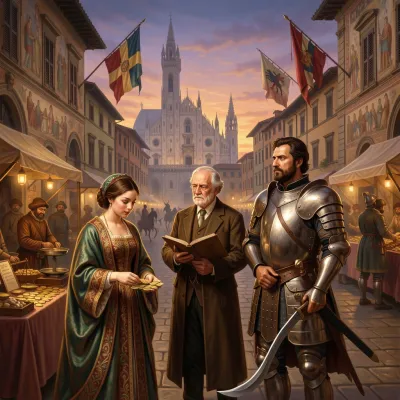
The book traces the emergence of Italy’s medieval city‑states from the fragmented aftermath of the Roman Empire, showing how geography, revived trade, and a desire for self‑rule led to the formation of communes that asserted autonomy over bishops and feudal lords. Early consular and podestà governments gave way to more complex councils, while fierce local patriotism and factionalism—epitomized by the Guelph–Ghibelline divide—shaped internal politics. Cities such as Florence, Venice, and Milan followed distinct paths: Florence retained a republican (though often oligarchic) structure dominated by merchant guilds and banking families; Venice developed a highly stable aristocratic republic with a ceremonially powerful Doge checked by elaborate councils; Milan evolved from a tumultuous commune into a hereditary duchy under the Visconti and later Sforza dynasties, prioritizing centralized military authority.
Economic dynamism lay at the heart of these urban centers. Innovative banking practices—including bills of exchange, double‑entry bookkeeping, and the decentralized Medici Bank—created financial instruments that facilitated long‑distance commerce. The gold florin of Florence and the ducat of Venice became trusted international currencies, while powerful guilds regulated production quality and wielded political influence. Vast trade networks linking the Mediterranean with Northern Europe and the East brought wealth that fueled public works, patronage of the arts, and the rise of a moneyed elite. This prosperity underwrote an intellectual and artistic revolution: humanist scholars revived classical texts, artists such as Giotto, Brunelleschi, Donatello, Leonardo, and Michelangelo pioneered perspective, naturalism, and monumental architecture, and a vibrant urban life flourished amid festivals, markets, and religious devotion.
Constant competition among the city‑states bred both diplomatic sophistication and endemic warfare. Resident ambassadors, intricate treaty networks, and strategic marriages were tools of inter‑city relations, yet shifting alliances and betrayals were common. Military reliance evolved from citizen militias to professional condottieri companies, whose contracts and shifting loyalties influenced the balance of power. External threats culminated in the Italian Wars (1494‑1559), when French, Spanish, and Imperial armies exploited Italy’s fragmentation, ending the era of independent republican and ducal rule and incorporating the peninsula into a nascent European order dominated by centralized monarchies. Despite this political decline, the city‑states’ legacy endured: they pioneered modern capitalism, republican governance, diplomatic practice, humanist education, and artistic standards that continued to shape Western civilization long after their banners were lowered.
What You'll Find Inside:
- The emergence of independent communes laid the foundation for urban self-governance and civic participation in medieval Italy.
- Financial innovations such as the gold florin, ducat, double-entry bookkeeping, and bills of exchange revolutionized European commerce and banking.
- Patronage by wealthy families like the Medici and Sforza fueled an artistic explosion that defined the Renaissance and Western art.
- Constant political rivalry, factionalism (Guelphs vs. Ghibellines), and the use of condottieri shaped the dynamic and often violent inter-city relations.
- The legacy of Italy's city-states includes enduring contributions to modern economic practices, republican governance, humanism, and artistic techniques that continue to influence Western civilization.
Who's It For:
This book is ideal for undergraduate and graduate students of medieval and Renaissance history, as well as scholars interested in economic, political, and cultural developments of the Italian city-states. It also appeals to general readers with a passion for art history, banking history, or the origins of modern governance who seek a comprehensive yet accessible overview of how Florence, Venice, Milan, and their contemporaries shaped the modern world.
Author:
Published By:
Date Published:
August 7, 2026
Type:
Nonfiction
Language:
English
Word Count:
39,462 words
Reading Time:
2 hours 46 minutes
Sample:
Order:
Order Italy's Medieval City States (Hardcover) on MixCache.com:
Buy NowPrint copy is made to order and ships worldwide. Includes the ebook free, ready to read instantly.
$5 account credit for all new MixCache.com accounts, usable toward any ebook purchase!*

 Includes Audiobook