Browse by Category
Fiction
- Action & Adventure
- African American
- Anthologies
- Children's Fiction
- Classics
- Comics & Graphic Novels
- Coming of Age
- Contemporary
- Cultural & Regional
- Drama
- Erotica
- Fantasy
- General
- Historical Fiction
- Horror
- Humor & Satire
- Literary Fiction
- Mystery, Thriller & Suspense
- Poetry
- Religious & Inspirational
- Romance
- Science Fiction
- Short Stories
- War & Military
- Westerns
- Women's Fiction
- Young Adult
Non-Fiction
- Antiques & Collectibles
- Arts & Photography
- Biographies & Memoirs
- Business & Money
- Children's Non-Fiction
-
Computers & Technology
- Artificial Intelligence
- Computer Science
- Cybersecurity & Cryptography
- Data Science & Analytics
- Databases & Big Data
- Game Development & Design
- General
- Hardware & DIY
- Mobile App Development
- Networking & Cloud Computing
- Operating Systems
- Programming
- Robotics
- Software
- Software Engineering
- User Experience (UX) & Design
- Web Development & Design
- Cooking, Food & Wine
- Crafts, Hobbies & Home
- Education & Teaching
- Engineering
- General
- Health, Fitness & Dieting
-
History
- African History
- African History - North Africa
- African History - Sub-Saharan Africa
- American History
- American History - 20th Century
- American History - Civil War
- American History - Colonial Period
- Ancient History
- Asian History
- Asian History - China
- Asian History - India
- Asian History - Japan
- Asian History - Southeast Asia
- European History
- European History - Ancient Greece
- European History - Ancient Rome
- European History - Medieval
- European History - Modern
- European History - Renaissance
- General
- Middle Eastern History
- Military History
- Military History - Aviation
- Military History - Naval
- Social & Cultural History
- World History
- Humor & Entertainment
- Industrial Technology
- Language Learning
- Law
- LGBTQ+ Non-Fiction
- Literary Criticism
- Medical Books
- Parenting & Relationships
- Philosophy
- Politics & Social Sciences
- Reference
- Religion & Spirituality
-
Science & Math
- Agricultural Sciences
- Astronomy & Space Science
- Behavioral Sciences
- Biological Sciences
- Botany & Plant Science
- Chemistry
- Earth Sciences
- Engineering - Chemical
- Engineering - Civil
- Engineering - Electrical
- Engineering - Mechanical
- Environment
- General
- Geology
- Mathematics
- Nature & Ecology
- Oceanography
- Paleontology
- Physics
- Statistics
- Self-Help
- Sports & Outdoors
- Study Aids
- Sustainability & Green Living
- Textbooks
- Transportation
- Travel
- True Crime
- Urban Planning & Development
- Veterinary Medicine
- Writing & Publishing
Jump to Section
MixCache.com Total Access
Unlimited reading and audiobooks for every book published by MixCache.com.
Included titles carry the MTA badge.
Learn more →The World's Greatest Banks
About this book:



This book offers a sweeping tour of the institutions that have shaped money, credit, and economic power from the Renaissance to the digital age. Readers will walk through the rise of the Medici Bank, the pioneering experiments of the Bank of Amsterdam, and the creation of the Bank of England, discovering how early innovations in bookkeeping, bill of exchange, and central banking laid the foundations for modern finance. Each chapter traces a bank’s origins, turning points, and lasting influence, showing how ambition, risk, and adaptation have defined what it means to be “great” in banking.
From the Rothschild family’s cross‑border network to the birth of the Federal Reserve, the narrative reveals how private dynasties and public authorities have wrestled for control of money and credit. Readers will learn how J.P. Morgan & Co. once acted as a de facto central bank, how Citigroup’s gamble to become a universal bank reshaped Wall Street, and how Bank of America turned a small immigrant‑focused lender into a retail banking colossus. The stories of HSBC, BNP Paribas, Deutsche Bank, Credit Suisse, and UBS illustrate the triumphs and pitfalls of global expansion, cultural clashes, and the relentless pressure to innovate while maintaining trust.
The book also shines a light on the rise of Asian banking giants, detailing how the Industrial and Commercial Bank of China, China Construction Bank, Agricultural Bank of China, and Bank of China transformed from state‑directed policy lenders into publicly traded, technology‑driven behemoths that now finance the Belt and Road Initiative and power the world’s second‑largest economy. Parallel chapters on Japan’s megabanks—Mitsubishi UFJ, Sumitomo Mitsui, and Mizuho—show how postwar crises forced consolidation, how each group carved out distinct strengths in retail, corporate, and investment banking, and how they are navigating aging populations, ultra‑low rates, and digital disruption.
Beyond the traditional banks, the final chapters examine the disruptive forces of fintech, neobanks, Big Tech, and decentralized finance. Readers will grasp how payments, lending, and wealth management are being unbundled by startups, how incumbents are responding with Banking‑as‑a‑Service and AI‑powered tools, and what the future may hold for trust, regulation, and the human role in banking. By the end, readers will not only know the histories of twenty‑five pivotal institutions but also understand the recurring themes—innovation versus hubris, the tension between private profit and public stewardship, and the enduring need for a stable financial bedrock—that continue to define the industry’s evolution.
What You'll Find Inside:
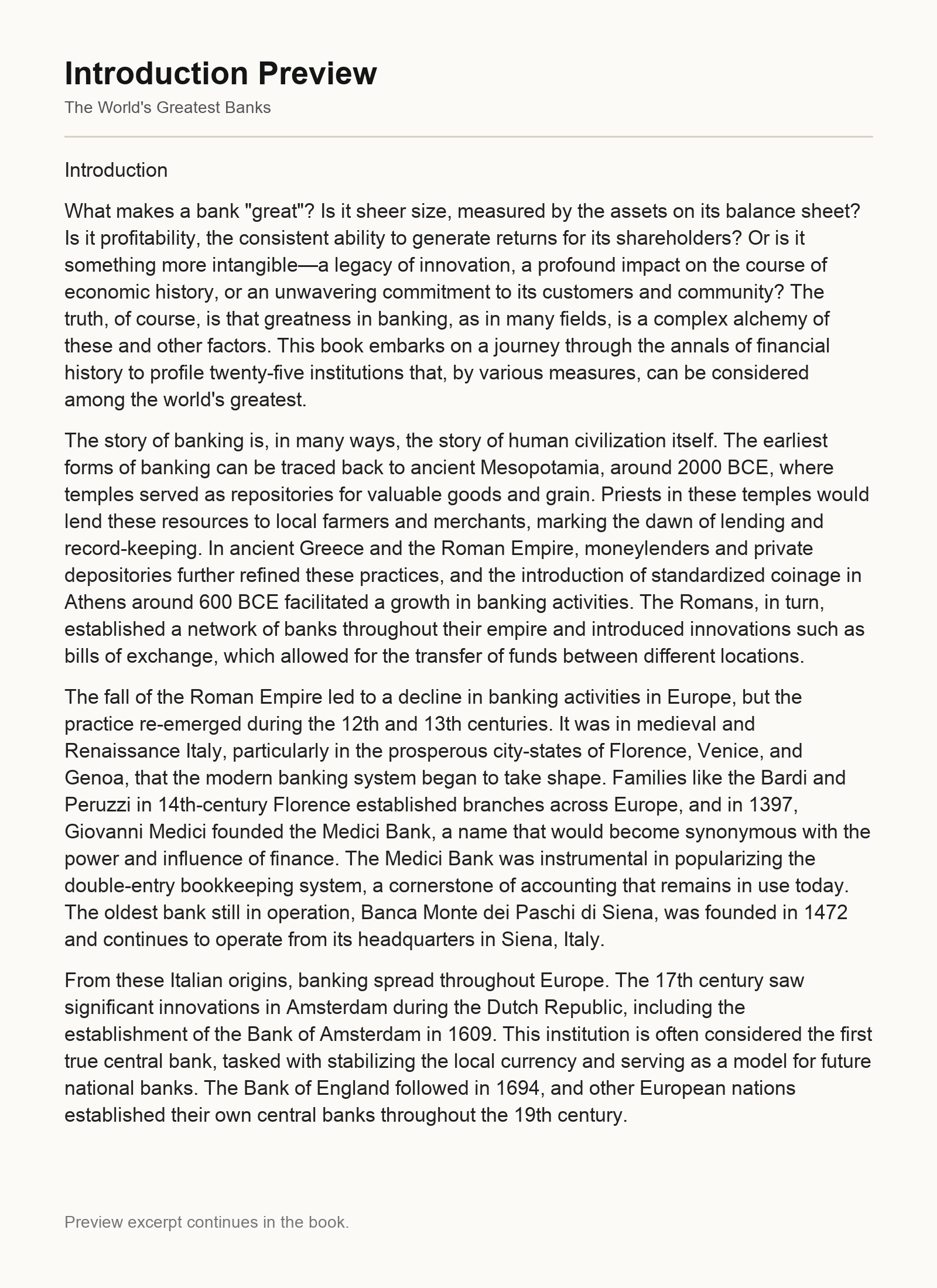
- The book traces banking's evolution from ancient Mesopotamia to modern fintech, showing how financial institutions have both reflected and shaped economic history across centuries.
- It profiles 25 historically significant banks worldwide, including the Medici Bank, Bank of England, Rothschild & Sons, JPMorgan Chase, ICBC, and HSBC, examining their origins, innovations, and lasting impacts.
- Each chapter analyzes how these institutions responded to their era's defining challenges—from financing wars and industrialization to navigating financial crises like 2008 and adapting to technological disruption.
- The book explores the recurring tension between banking innovation and risk management, illustrating how ambitious expansion (e.g., Citigroup's universal banking model) can lead to both triumph and catastrophic failure when controls are inadequate.
- It concludes with an analysis of banking's future, covering fintech disruption, digital transformation, challenges from Big Tech, and emerging concepts like decentralized finance and central bank digital currencies.
Who's It For:
This book is ideal for finance and economics students seeking historical context, banking professionals looking to understand industry evolution, and general readers interested in how financial institutions have shaped world events. It will particularly benefit those studying financial history, risk management, or the impact of technological change on traditional industries. While accessible to non-specialists, it provides sufficient depth to engage readers with some background in economics or business.
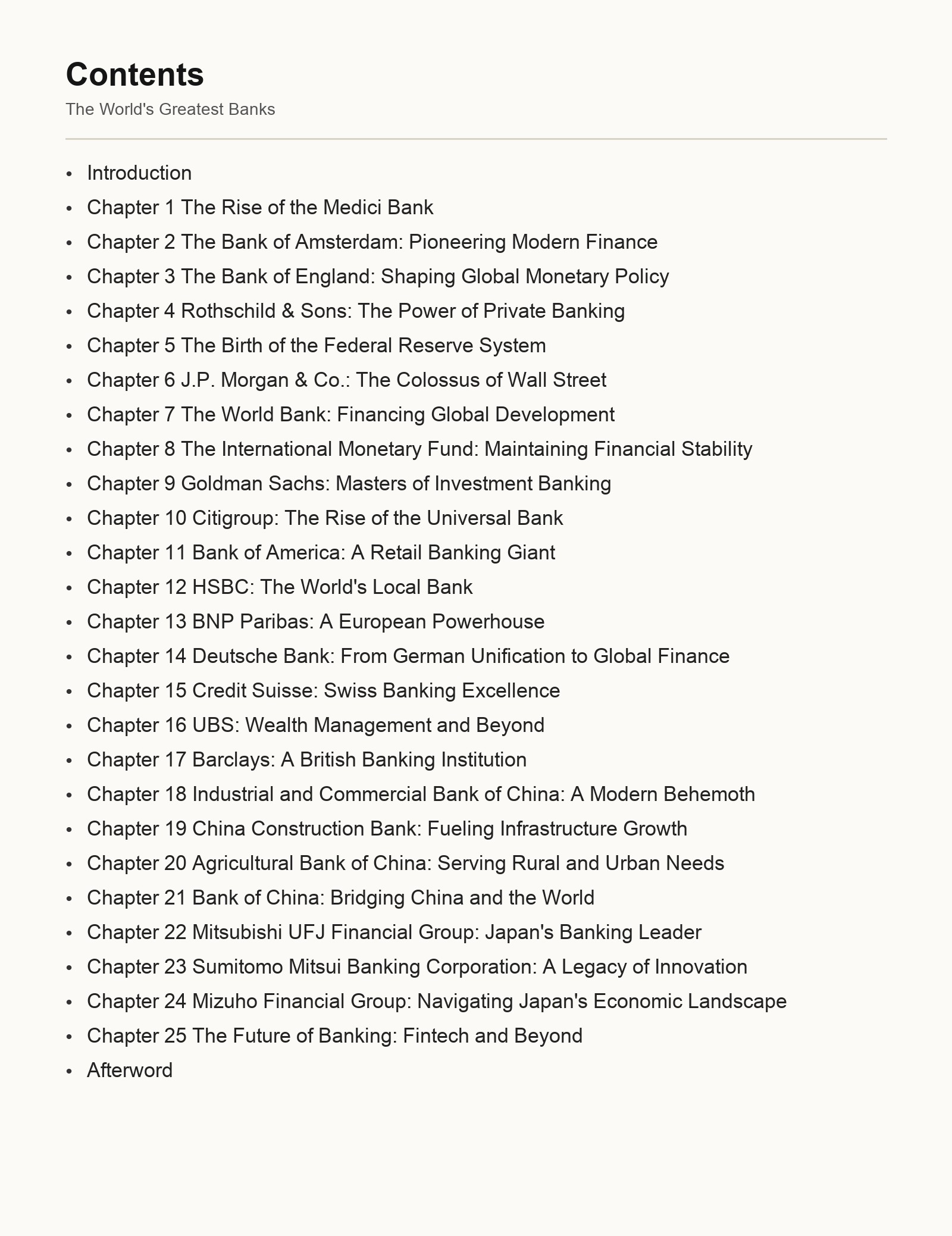
Table of Contents:
-
Introduction
-
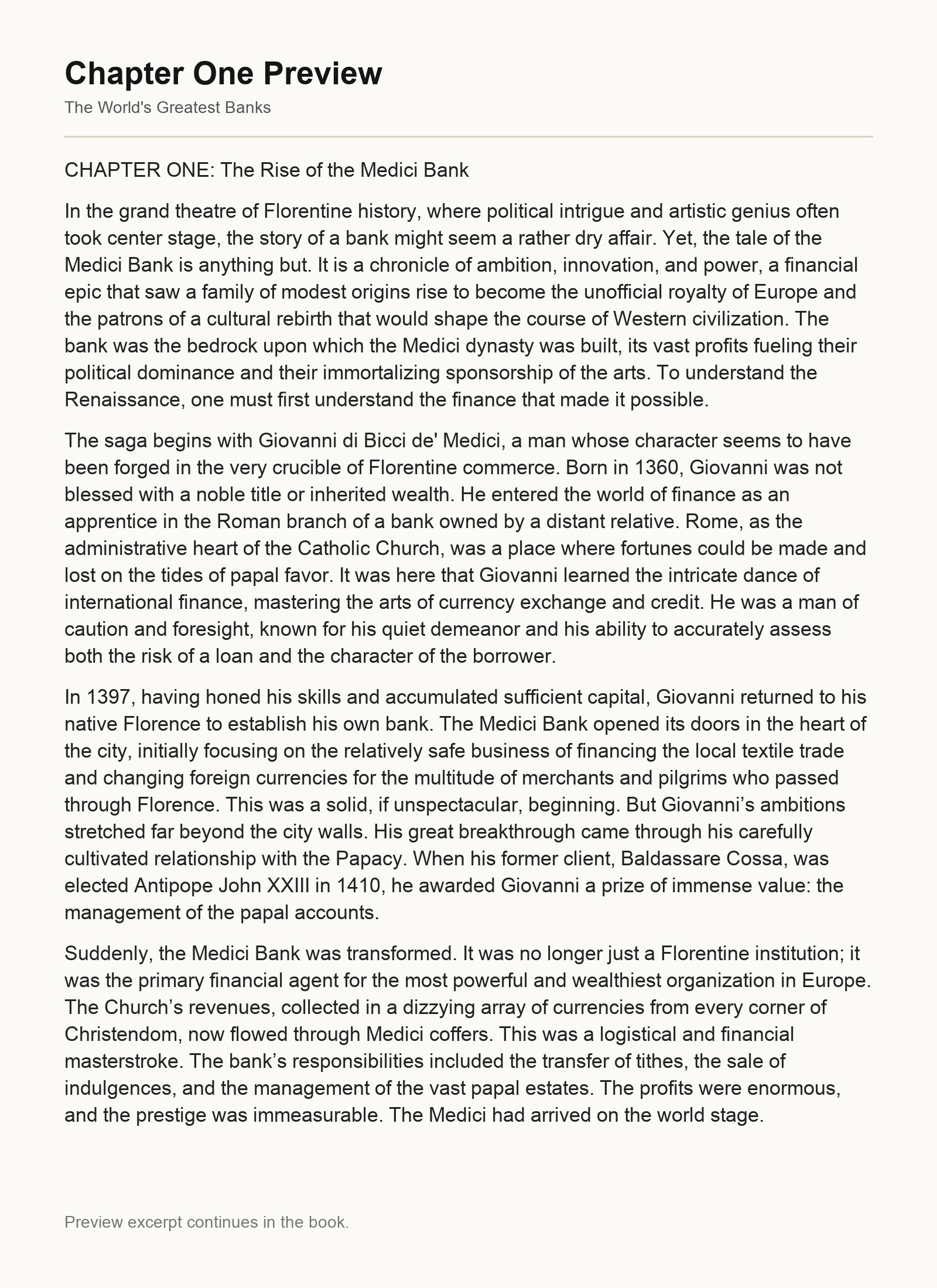
Chapter 1 The Rise of the Medici Bank
-
Chapter 2 The Bank of Amsterdam: Pioneering Modern Finance
-
Chapter 3 The Bank of England: Shaping Global Monetary Policy
-
Chapter 4 Rothschild & Sons: The Power of Private Banking
-
Chapter 5 The Birth of the Federal Reserve System
-
Chapter 6 J.P. Morgan & Co.: The Colossus of Wall Street
-
Chapter 7 The World Bank: Financing Global Development
-
Chapter 8 The International Monetary Fund: Maintaining Financial Stability
-
Chapter 9 Goldman Sachs: Masters of Investment Banking
-
Chapter 10 Citigroup: The Rise of the Universal Bank
-
Chapter 11 Bank of America: A Retail Banking Giant
-
Chapter 12 HSBC: The World's Local Bank
-
Chapter 13 BNP Paribas: A European Powerhouse
-
Chapter 14 Deutsche Bank: From German Unification to Global Finance
-
Chapter 15 Credit Suisse: Swiss Banking Excellence
-
Chapter 16 UBS: Wealth Management and Beyond
-
Chapter 17 Barclays: A British Banking Institution
-
Chapter 18 Industrial and Commercial Bank of China: A Modern Behemoth
-
Chapter 19 China Construction Bank: Fueling Infrastructure Growth
-
Chapter 20 Agricultural Bank of China: Serving Rural and Urban Needs
-
Chapter 21 Bank of China: Bridging China and the World
-
Chapter 22 Mitsubishi UFJ Financial Group: Japan's Banking Leader
-
Chapter 23 Sumitomo Mitsui Banking Corporation: A Legacy of Innovation
-
Chapter 24 Mizuho Financial Group: Navigating Japan's Economic Landscape
-
Chapter 25 The Future of Banking: Fintech and Beyond
-
Afterword
Author:
Published By:
Date Published:
May 29, 2026
Type:
Nonfiction
Language:
English
Word Count:
53,705 words
Reading Time:
3 hours 46 minutes
Sample:
Order:
Order The World's Greatest Banks (Hardcover) on MixCache.com:
Buy NowPrint copy is made to order and ships worldwide. Includes the ebook free, ready to read instantly.
$5 account credit for all new MixCache.com accounts, usable toward any ebook purchase!*