
Browse by Category
Fiction
- Action & Adventure
- African American
- Anthologies
- Children's Fiction
- Classics
- Comics & Graphic Novels
- Coming of Age
- Contemporary
- Cultural & Regional
- Drama
- Erotica
- Fantasy
- General
- Historical Fiction
- Horror
- Humor & Satire
- Literary Fiction
- Mystery, Thriller & Suspense
- Poetry
- Religious & Inspirational
- Romance
- Science Fiction
- Short Stories
- War & Military
- Westerns
- Women's Fiction
- Young Adult
Non-Fiction
- Antiques & Collectibles
- Arts & Photography
- Biographies & Memoirs
- Business & Money
- Children's Non-Fiction
-
Computers & Technology
- Artificial Intelligence
- Computer Science
- Cybersecurity & Cryptography
- Data Science & Analytics
- Databases & Big Data
- Game Development & Design
- General
- Hardware & DIY
- Mobile App Development
- Networking & Cloud Computing
- Operating Systems
- Programming
- Robotics
- Software
- Software Engineering
- User Experience (UX) & Design
- Web Development & Design
- Cooking, Food & Wine
- Crafts, Hobbies & Home
- Education & Teaching
- Engineering
- General
- Health, Fitness & Dieting
-
History
- African History
- African History - North Africa
- African History - Sub-Saharan Africa
- American History
- American History - 20th Century
- American History - Civil War
- American History - Colonial Period
- Ancient History
- Asian History
- Asian History - China
- Asian History - India
- Asian History - Japan
- Asian History - Southeast Asia
- European History
- European History - Ancient Greece
- European History - Ancient Rome
- European History - Medieval
- European History - Modern
- European History - Renaissance
- General
- Middle Eastern History
- Military History
- Military History - Aviation
- Military History - Naval
- Social & Cultural History
- World History
- Humor & Entertainment
- Industrial Technology
- Language Learning
- Law
- LGBTQ+ Non-Fiction
- Literary Criticism
- Medical Books
- Parenting & Relationships
- Philosophy
- Politics & Social Sciences
- Reference
- Religion & Spirituality
-
Science & Math
- Agricultural Sciences
- Astronomy & Space Science
- Behavioral Sciences
- Biological Sciences
- Botany & Plant Science
- Chemistry
- Earth Sciences
- Engineering - Chemical
- Engineering - Civil
- Engineering - Electrical
- Engineering - Mechanical
- Environment
- General
- Geology
- Mathematics
- Nature & Ecology
- Oceanography
- Paleontology
- Physics
- Statistics
- Self-Help
- Sports & Outdoors
- Study Aids
- Sustainability & Green Living
- Textbooks
- Transportation
- Travel
- True Crime
- Urban Planning & Development
- Veterinary Medicine
- Writing & Publishing
Jump to Section
MixCache.com Total Access
Unlimited reading and audiobooks for every book published by MixCache.com.
Included titles carry the MTA badge.
Learn more →A History of Botswana
About this book:
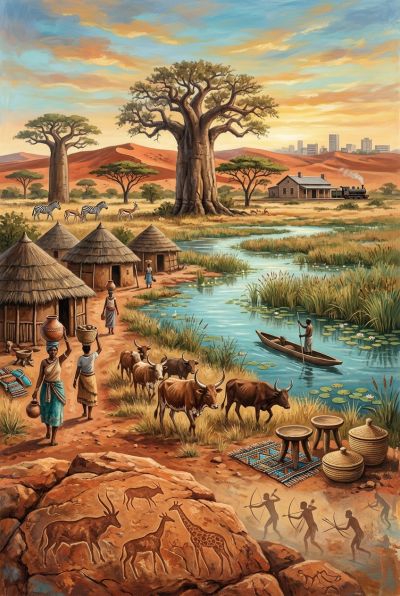
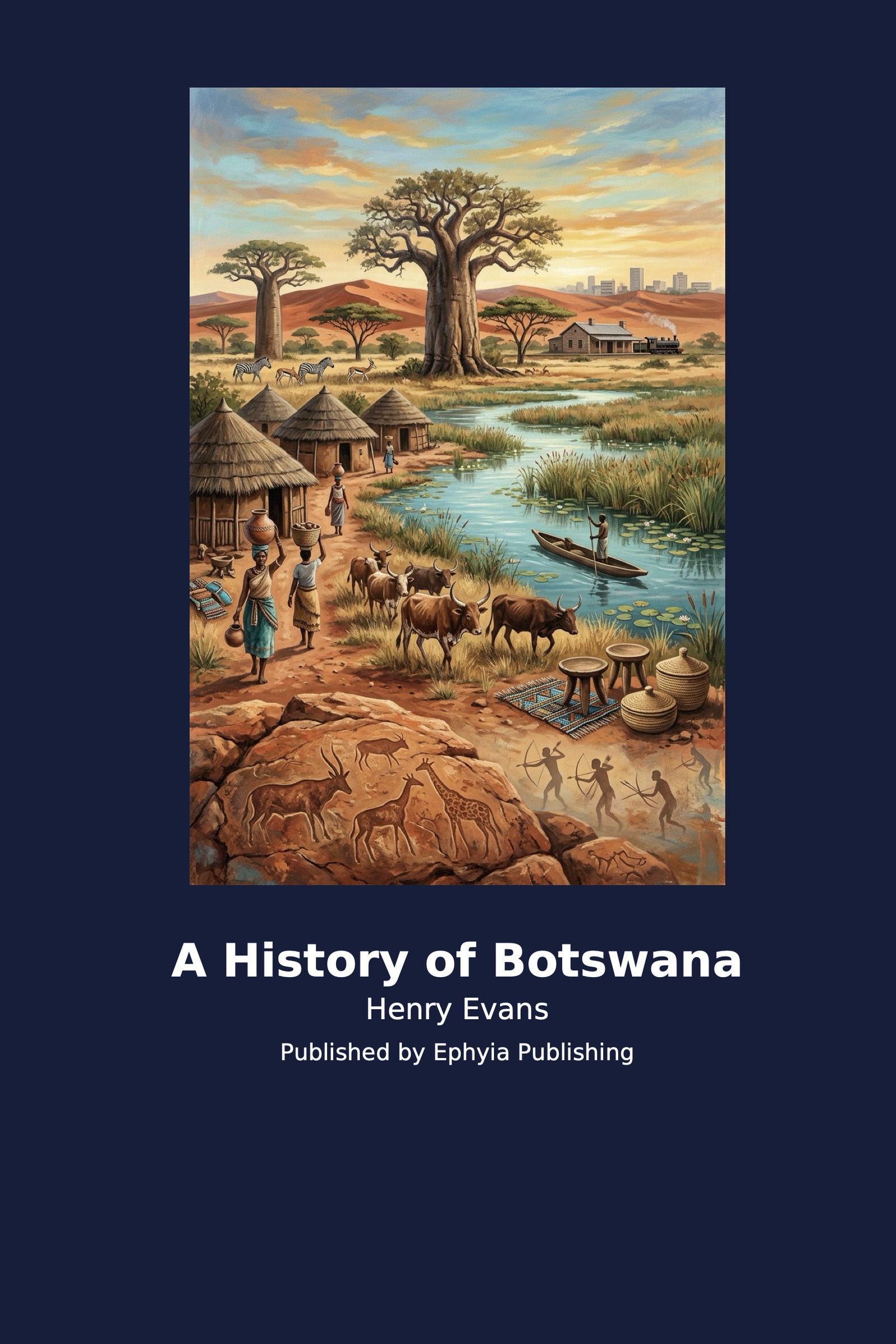
A History of Botswana invites readers on a sweeping journey through one of Africa’s most remarkable nations, from the earliest footsteps of hunter‑gatherers in the Kalahari to the modern republic celebrated for its stability and visionary leadership. The book opens with the land itself—its deserts, deltas, and ancient rock formations—showing how geography shaped survival strategies, spiritual beliefs, and the ingenuity of the San peoples who mastered life in a harsh environment long before any borders were drawn.
Readers will then follow the arrival of Bantu‑speaking farmers and ironworkers, the rise of early chiefdoms and the powerful Tswana kingdoms that built wealth on cattle, trade, and diplomatic skill. The narrative explores how these societies interacted with Khoesan groups, absorbed new ideas, and created flexible political structures that would later serve as a foundation for resilience against external pressures. Chapters on European contact, the Difaqane upheaval, and missionary influence reveal how Botswana navigated colonial encroachment while preserving core institutions such as the kgotla and traditional leadership.
The story continues through the Bechuanaland Protectorate era, illustrating how limited British investment inadvertently allowed Tswana governance to persist, and how leaders like Seretse Khama used education, diplomacy, and pragmatic reforms to steer the country toward independence. Readers will experience the transformative impact of diamond discovery, learning how mineral revenues were deliberately channeled into schools, clinics, infrastructure, and conservation rather than personal enrichment, and how Botswana’s commitment to consensus and accountability fostered a durable multi‑party democracy.
Social development, environmental stewardship, and public health challenges receive detailed attention, from early education and veterinary campaigns to the HIV/AIDS crisis and the nation’s innovative response. The final chapters bring the tale into the twenty‑first century, examining efforts to diversify the economy, balance urban growth with communal values, confront climate change, and maintain Botswana’s role as a stabilizing force in southern Africa. By the end, readers will have gained a deep appreciation for how a combination of ancient wisdom, adaptable leadership, and careful resource management enabled Botswana to turn adversity into a model of peaceful progress.
What You'll Find Inside:
- Botswana's exceptional journey to stability: How the nation avoided the coups and authoritarianism common in post-colonial Africa through consensus-building, social cohesion, and adaptive governance rooted in traditional kgotla assemblies.
- From poverty to prosperity: The transformative impact of diamond discoveries after independence, and how Botswana strategically used mineral wealth to fund education, healthcare, infrastructure, and conservation while avoiding the 'resource curse'.
- Cultural continuity and adaptation: The enduring legacy of San hunter-gatherer traditions, Bantu-speaking migrations, and Tswana statecraft that created Botswana's unique social fabric and approaches to conflict resolution, resource management, and leadership.
- Navigating colonialism and apartheid: Botswana's strategic diplomacy as a British protectorate that preserved autonomy while resisting Boer and apartheid pressures, including its principled yet pragmatic stance against racial oppression in southern Africa.
- Confronting modern challenges: Botswana's innovative public health responses to HIV/AIDS, environmental conservation efforts balancing wildlife management with community needs, and 21st-century efforts to diversify beyond diamonds while maintaining democratic traditions.
Who's It For:
This book is ideal for students, researchers, and general readers interested in African history, post-colonial development, and democratic governance. It will particularly benefit those studying Botswana as a case study of successful nation-building, resource management, and social resilience in southern Africa. Academics in fields such as history, political science, economics, and anthropology will find valuable insights into how cultural traditions can harmonize with modern statecraft to create stable, prosperous societies.
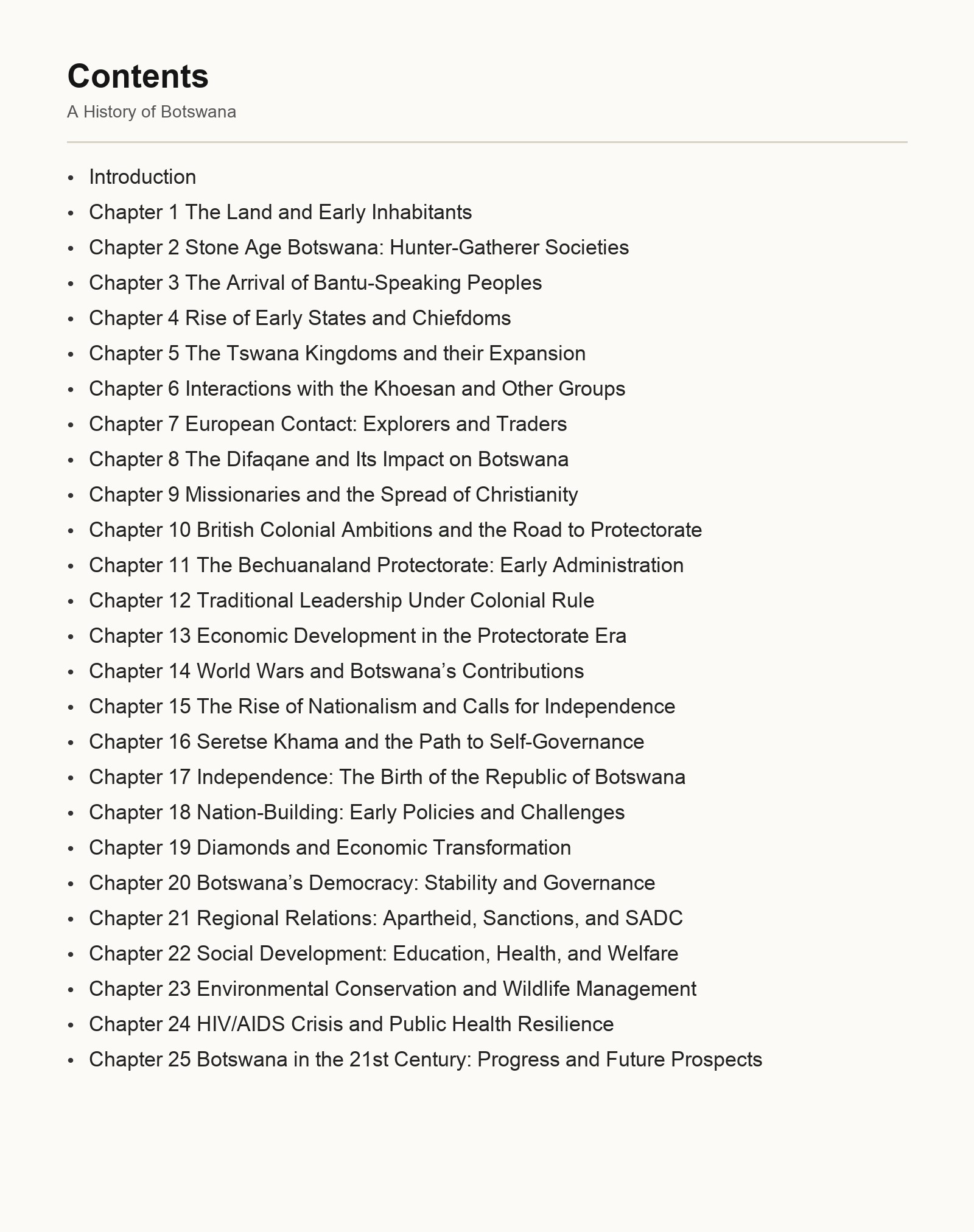
Table of Contents:
- Introduction
- Chapter 1 The Land and Early Inhabitants
- Chapter 2 Stone Age Botswana: Hunter-Gatherer Societies
- Chapter 3 The Arrival of Bantu-Speaking Peoples
- Chapter 4 Rise of Early States and Chiefdoms
- Chapter 5 The Tswana Kingdoms and their Expansion
- Chapter 6 Interactions with the Khoesan and Other Groups
- Chapter 7 European Contact: Explorers and Traders
- Chapter 8 The Difaqane and Its Impact on Botswana
- Chapter 9 Missionaries and the Spread of Christianity
- Chapter 10 British Colonial Ambitions and the Road to Protectorate
- Chapter 11 The Bechuanaland Protectorate: Early Administration
- Chapter 12 Traditional Leadership Under Colonial Rule
- Chapter 13 Economic Development in the Protectorate Era
- Chapter 14 World Wars and Botswana’s Contributions
- Chapter 15 The Rise of Nationalism and Calls for Independence
- Chapter 16 Seretse Khama and the Path to Self-Governance
- Chapter 17 Independence: The Birth of the Republic of Botswana
- Chapter 18 Nation-Building: Early Policies and Challenges
- Chapter 19 Diamonds and Economic Transformation
- Chapter 20 Botswana’s Democracy: Stability and Governance
- Chapter 21 Regional Relations: Apartheid, Sanctions, and SADC
- Chapter 22 Social Development: Education, Health, and Welfare
- Chapter 23 Environmental Conservation and Wildlife Management
- Chapter 24 HIV/AIDS Crisis and Public Health Resilience
- Chapter 25 Botswana in the 21st Century: Progress and Future Prospects
Author:
Published By:
Date Published:
May 28, 2026
Type:
Nonfiction
Language:
English
Also Available In:
Word Count:
33,871 words
Reading Time:
2 hours 22 minutes
Sample:
Order:
Order A History of Botswana (Hardcover) on MixCache.com:
Buy NowPrint copy is made to order and ships worldwide. Includes the ebook free, ready to read instantly.
$5 account credit for all new MixCache.com accounts, usable toward any ebook purchase!*


