Browse by Category
Fiction
- Action & Adventure
- African American
- Anthologies
- Children's Fiction
- Classics
- Comics & Graphic Novels
- Coming of Age
- Contemporary
- Cultural & Regional
- Drama
- Erotica
- Fantasy
- General
- Historical Fiction
- Horror
- Humor & Satire
- Literary Fiction
- Mystery, Thriller & Suspense
- Poetry
- Religious & Inspirational
- Romance
- Science Fiction
- Short Stories
- War & Military
- Westerns
- Women's Fiction
- Young Adult
Non-Fiction
- Antiques & Collectibles
- Arts & Photography
- Biographies & Memoirs
- Business & Money
- Children's Non-Fiction
-
Computers & Technology
- Artificial Intelligence
- Computer Science
- Cybersecurity & Cryptography
- Data Science & Analytics
- Databases & Big Data
- Game Development & Design
- General
- Hardware & DIY
- Mobile App Development
- Networking & Cloud Computing
- Operating Systems
- Programming
- Robotics
- Software
- Software Engineering
- User Experience (UX) & Design
- Web Development & Design
- Cooking, Food & Wine
- Crafts, Hobbies & Home
- Education & Teaching
- Engineering
- General
- Health, Fitness & Dieting
-
History
- African History
- African History - North Africa
- African History - Sub-Saharan Africa
- American History
- American History - 20th Century
- American History - Civil War
- American History - Colonial Period
- Ancient History
- Asian History
- Asian History - China
- Asian History - India
- Asian History - Japan
- Asian History - Southeast Asia
- European History
- European History - Ancient Greece
- European History - Ancient Rome
- European History - Medieval
- European History - Modern
- European History - Renaissance
- General
- Middle Eastern History
- Military History
- Military History - Aviation
- Military History - Naval
- Social & Cultural History
- World History
- Humor & Entertainment
- Industrial Technology
- Language Learning
- Law
- LGBTQ+ Non-Fiction
- Literary Criticism
- Medical Books
- Parenting & Relationships
- Philosophy
- Politics & Social Sciences
- Reference
- Religion & Spirituality
-
Science & Math
- Agricultural Sciences
- Astronomy & Space Science
- Behavioral Sciences
- Biological Sciences
- Botany & Plant Science
- Chemistry
- Earth Sciences
- Engineering - Chemical
- Engineering - Civil
- Engineering - Electrical
- Engineering - Mechanical
- Environment
- General
- Geology
- Mathematics
- Nature & Ecology
- Oceanography
- Paleontology
- Physics
- Statistics
- Self-Help
- Sports & Outdoors
- Study Aids
- Sustainability & Green Living
- Textbooks
- Transportation
- Travel
- True Crime
- Urban Planning & Development
- Veterinary Medicine
- Writing & Publishing
Jump to Section
MixCache.com Total Access
Unlimited reading and audiobooks for every book published by MixCache.com.
Included titles carry the MTA badge.
Learn more →
The History of Urban Planning
How Cities Evolved from Ancient Streets to Modern Skylines
About this book:
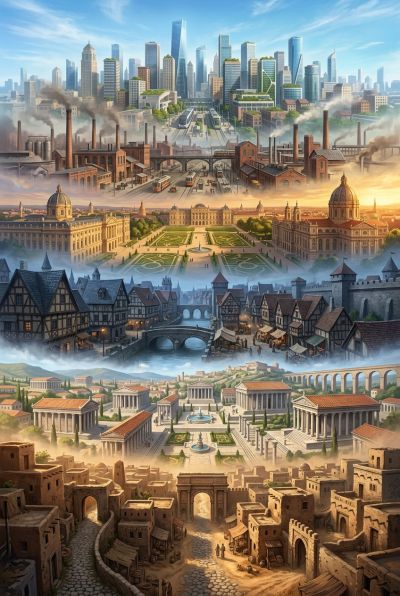
Explore the sweeping story of how human settlements have been shaped from the earliest villages of Mesopotamia and the Indus Valley to the megacities of today. This book guides you through a chronological journey that reveals the ideas, experiments, and forces behind every street, square, and skyline, showing how ancient temples, Roman forums, medieval walls, and Renaissance piazzas all emerged from deliberate choices about order, power, and daily life. You will discover how different cultures solved universal challenges—defense, water, trade, and spirituality—through unique urban forms, from the grid‑planned cities of the Harappans to the symbolic axes of Versailles and the organic alleys of Islamic medinas.
Each chapter illuminates a pivotal era, explaining not only what was built but why it mattered: the technological breakthroughs that enabled aqueducts and railways, the social reforms that introduced parks and sanitation, the visionary plans of Haussmann, the Garden City, and Modernist towers‑in‑the‑park, and the grassroots critiques of Jane Jacobs that reshaped modern thinking about human scale and community. You will see how colonialism exported European models, how postwar reconstruction gave rise to New Towns, and how contemporary movements like New Urbanism, Smart Growth, and sustainable design respond to sprawl, climate change, and equity.
By tracing these developments, you will learn to read the city as a palimpsest—layers of intention, failure, and adaptation that reveal enduring tensions between control and organic growth, between monumental grandeur and intimate street life, and between the aspirations of planners and the realities of inhabitants. The book equips you with a deep historical perspective that helps you understand today’s urban challenges—congestion, inequality, environmental stress, and technological disruption—not as isolated problems but as continuations of age‑old debates about how we shape our shared spaces.
Whether you are a student, practitioner, or curious city dweller, this narrative offers a clear, engaging, and globally grounded foundation for thinking critically about the past, present, and future of urban planning. You will finish with a richer appreciation of the forces that have built the world around you and a toolkit for imagining how those forces might be redirected toward more just, resilient, and inspiring cities.
What You'll Find Inside:
- Traces urban planning from its origins in ancient Mesopotamia and the Indus Valley through to 21st-century challenges like climate change and smart cities
- Explores diverse cultural approaches to city design, including Egyptian monumentalism, Greek agoras, Roman engineering, Islamic urbanism, and Chinese cosmological planning
- Examines major planning movements and theorists from Hippodamus and the Garden City idea to Modernism, New Urbanism, and Sustainable Urbanism
- Analyzes how societies have responded to urbanization challenges, from industrial revolution sanitary reforms to contemporary megacity growth and informality
- Addresses current frontiers in urban planning including equity, technological innovation, resilience, and future visions for 21st-century cities
Who's It For:
This book is ideal for urban planning and architecture students, professionals seeking historical context for contemporary practice, and anyone interested in how cities have been shaped across cultures and eras. It provides essential background for understanding current urban challenges by revealing the enduring patterns and lessons from millennia of human settlement design.
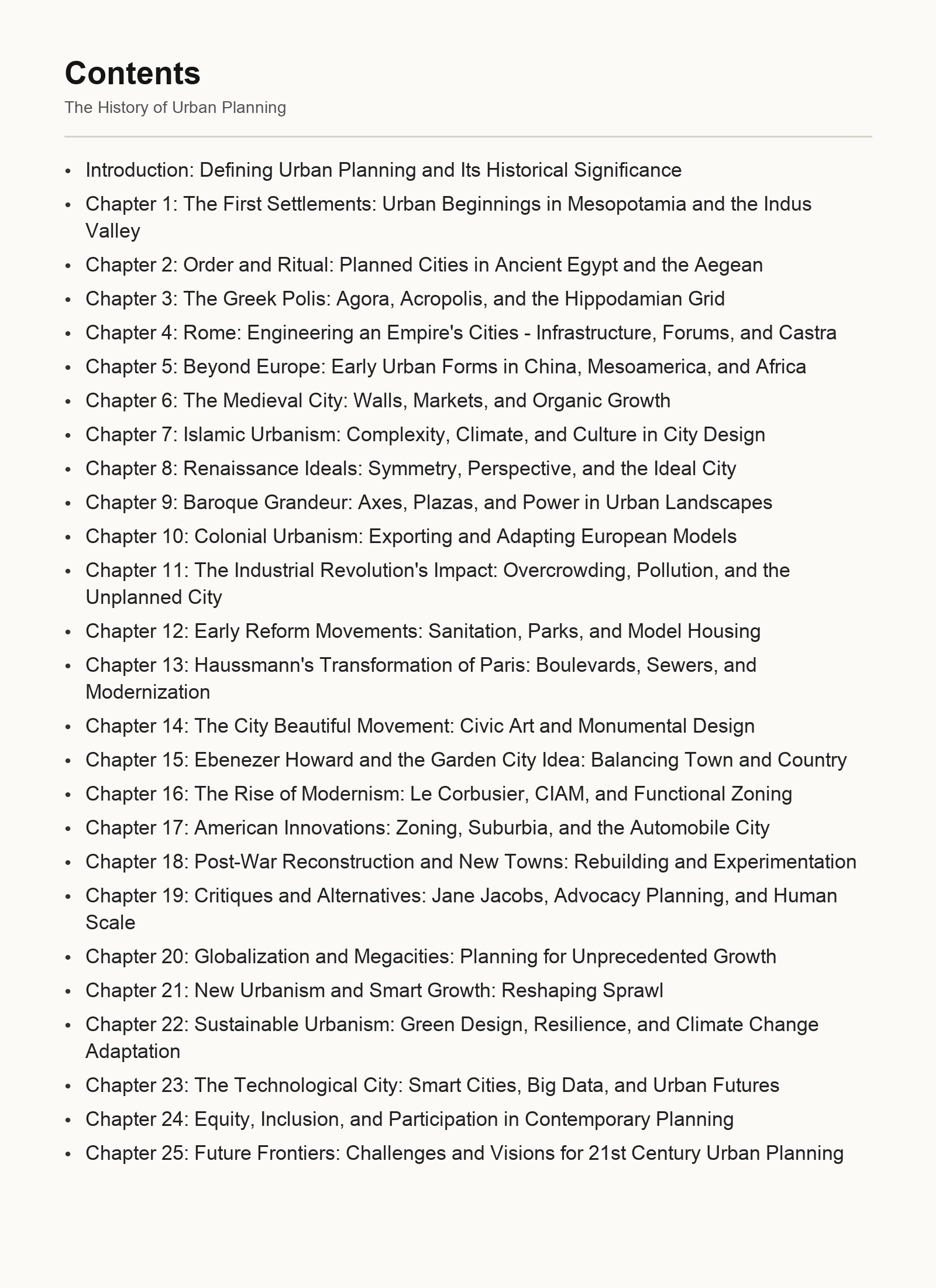
Table of Contents:
- Introduction: Defining Urban Planning and Its Historical Significance
- Chapter 1: The First Settlements: Urban Beginnings in Mesopotamia and the Indus Valley
- Chapter 2: Order and Ritual: Planned Cities in Ancient Egypt and the Aegean
- Chapter 3: The Greek Polis: Agora, Acropolis, and the Hippodamian Grid
- Chapter 4: Rome: Engineering an Empire's Cities - Infrastructure, Forums, and Castra
- Chapter 5: Beyond Europe: Early Urban Forms in China, Mesoamerica, and Africa
- Chapter 6: The Medieval City: Walls, Markets, and Organic Growth
- Chapter 7: Islamic Urbanism: Complexity, Climate, and Culture in City Design
- Chapter 8: Renaissance Ideals: Symmetry, Perspective, and the Ideal City
- Chapter 9: Baroque Grandeur: Axes, Plazas, and Power in Urban Landscapes
- Chapter 10: Colonial Urbanism: Exporting and Adapting European Models
- Chapter 11: The Industrial Revolution's Impact: Overcrowding, Pollution, and the Unplanned City
- Chapter 12: Early Reform Movements: Sanitation, Parks, and Model Housing
- Chapter 13: Haussmann's Transformation of Paris: Boulevards, Sewers, and Modernization
- Chapter 14: The City Beautiful Movement: Civic Art and Monumental Design
- Chapter 15: Ebenezer Howard and the Garden City Idea: Balancing Town and Country
- Chapter 16: The Rise of Modernism: Le Corbusier, CIAM, and Functional Zoning
- Chapter 17: American Innovations: Zoning, Suburbia, and the Automobile City
- Chapter 18: Post-War Reconstruction and New Towns: Rebuilding and Experimentation
- Chapter 19: Critiques and Alternatives: Jane Jacobs, Advocacy Planning, and Human Scale
- Chapter 20: Globalization and Megacities: Planning for Unprecedented Growth
- Chapter 21: New Urbanism and Smart Growth: Reshaping Sprawl
- Chapter 22: Sustainable Urbanism: Green Design, Resilience, and Climate Change Adaptation
- Chapter 23: The Technological City: Smart Cities, Big Data, and Urban Futures
- Chapter 24: Equity, Inclusion, and Participation in Contemporary Planning
- Chapter 25: Future Frontiers: Challenges and Visions for 21st Century Urban Planning
Author:
Published By:
Date Published:
May 27, 2026
Type:
Nonfiction
Language:
English
Also Available In:
Word Count:
55,465 words
Reading Time:
3 hours 53 minutes
Sample:
Order:
Order The History of Urban Planning (Hardcover) on MixCache.com:
Buy NowPrint copy is made to order and ships worldwide. Includes the ebook free, ready to read instantly.
$5 account credit for all new MixCache.com accounts, usable toward any ebook purchase!*