Browse by Category
Fiction
- Action & Adventure
- African American
- Anthologies
- Children's Fiction
- Classics
- Comics & Graphic Novels
- Coming of Age
- Contemporary
- Cultural & Regional
- Drama
- Erotica
- Fantasy
- General
- Historical Fiction
- Horror
- Humor & Satire
- Literary Fiction
- Mystery, Thriller & Suspense
- Poetry
- Religious & Inspirational
- Romance
- Science Fiction
- Short Stories
- War & Military
- Westerns
- Women's Fiction
- Young Adult
Non-Fiction
- Antiques & Collectibles
- Arts & Photography
- Biographies & Memoirs
- Business & Money
- Children's Non-Fiction
-
Computers & Technology
- Artificial Intelligence
- Computer Science
- Cybersecurity & Cryptography
- Data Science & Analytics
- Databases & Big Data
- Game Development & Design
- General
- Hardware & DIY
- Mobile App Development
- Networking & Cloud Computing
- Operating Systems
- Programming
- Robotics
- Software
- Software Engineering
- User Experience (UX) & Design
- Web Development & Design
- Cooking, Food & Wine
- Crafts, Hobbies & Home
- Education & Teaching
- Engineering
- General
- Health, Fitness & Dieting
-
History
- African History
- African History - North Africa
- African History - Sub-Saharan Africa
- American History
- American History - 20th Century
- American History - Civil War
- American History - Colonial Period
- Ancient History
- Asian History
- Asian History - China
- Asian History - India
- Asian History - Japan
- Asian History - Southeast Asia
- European History
- European History - Ancient Greece
- European History - Ancient Rome
- European History - Medieval
- European History - Modern
- European History - Renaissance
- General
- Middle Eastern History
- Military History
- Military History - Aviation
- Military History - Naval
- Social & Cultural History
- World History
- Humor & Entertainment
- Industrial Technology
- Language Learning
- Law
- LGBTQ+ Non-Fiction
- Literary Criticism
- Medical Books
- Parenting & Relationships
- Philosophy
- Politics & Social Sciences
- Reference
- Religion & Spirituality
-
Science & Math
- Agricultural Sciences
- Astronomy & Space Science
- Behavioral Sciences
- Biological Sciences
- Botany & Plant Science
- Chemistry
- Earth Sciences
- Engineering - Chemical
- Engineering - Civil
- Engineering - Electrical
- Engineering - Mechanical
- Environment
- General
- Geology
- Mathematics
- Nature & Ecology
- Oceanography
- Paleontology
- Physics
- Statistics
- Self-Help
- Sports & Outdoors
- Study Aids
- Sustainability & Green Living
- Textbooks
- Transportation
- Travel
- True Crime
- Urban Planning & Development
- Veterinary Medicine
- Writing & Publishing
Jump to Section
MixCache.com Total Access
Unlimited reading and audiobooks for every book published by MixCache.com.
Included titles carry the MTA badge.
Learn more →A History of Rome
About this book:
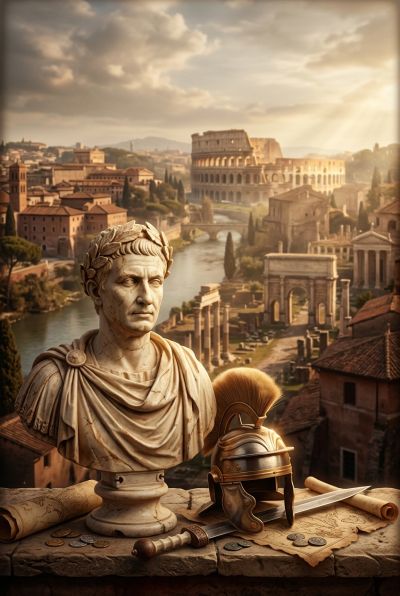
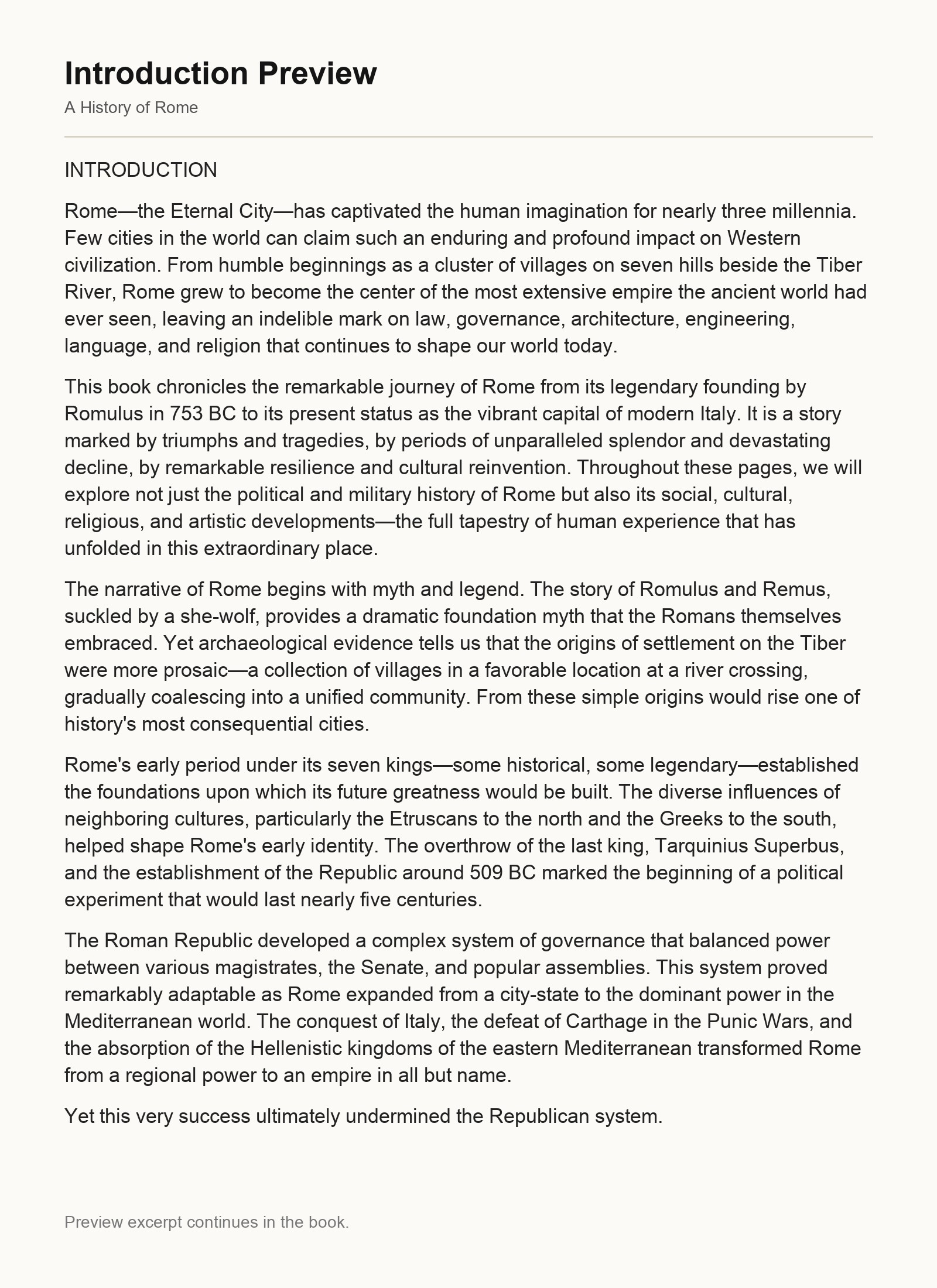
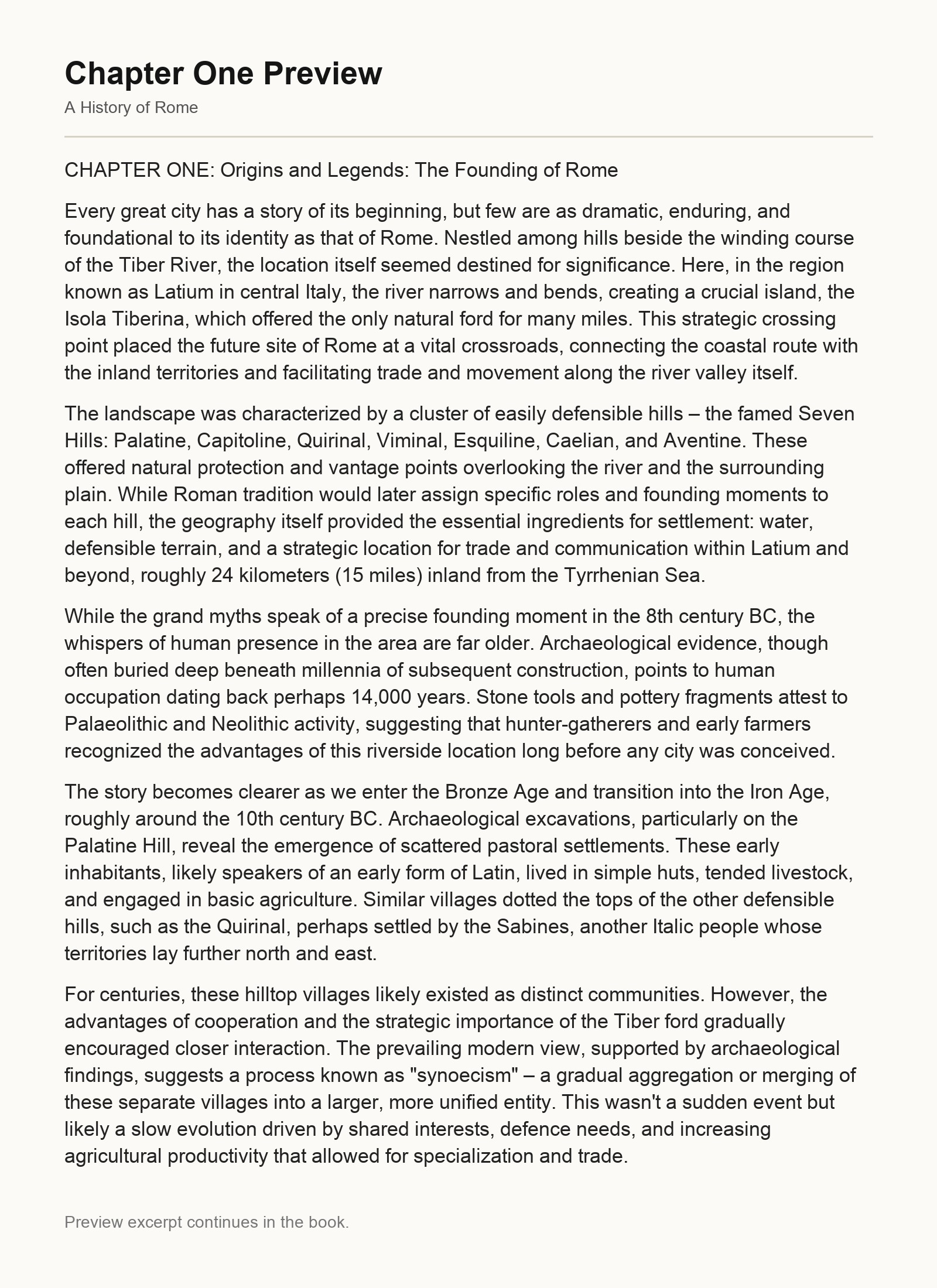
Rome's story spans nearly three millennia, evolving from a humble cluster of villages on the Tiber River to the heart of the most extensive empire the ancient world had ever seen, and finally to the vibrant capital of modern Italy. This comprehensive history traces that extraordinary journey, revealing how Rome's influence has shaped law, governance, architecture, engineering, language, and religion in ways that continue to define our world today. Readers will discover why few cities have matched Rome's enduring impact on Western civilization.
Beyond the familiar narratives of emperors, battles, and conquests, this book delves into the full tapestry of Roman life. You will explore how ordinary citizens—patricians and plebeians, slaves and immigrants—lived, worked, worshipped, and created in one of humanity's most significant urban centers. From the practical governance principles of the Republic to the universal aspirations of the Empire, from pagan polytheism to Christian monotheism, and from Renaissance humanism to modern nationalism, Rome emerges as a crucible for some of humanity's most influential ideas.
As you turn these pages, you will walk through Rome's layered streets, where ancient temples lie beneath medieval churches, Renaissance palaces incorporate Roman ruins, and Baroque façades grace older buildings. The book illuminates how the physical landscape itself tells the city's complex story—making a walk through Rome today equivalent to traversing not just space but time, encountering the tangible remnants of nearly three thousand years of urban development, from the still-intact dome of the Pantheon to the enduring presence of imperial aqueducts in the countryside.
Rome's history is one of continual reinvention while maintaining deep connections to its past. You will witness the city's remarkable resilience as it transforms from village to world empire, from imperial capital to papal city, from depopulated backwater to modern metropolis, adapting ancient spaces for new purposes and drawing inspiration from earlier achievements through every crisis and triumph. This narrative reveals how Rome has repeatedly renewed itself while preserving the memory of what came before—a pattern that offers profound insights for understanding cultural endurance and adaptation in our own time.
Whether you are new to Rome's story or seeking a deeper framework for exploration, this history provides both a comprehensive introduction and a pathway to further investigation. By understanding Rome's journey—its successes, failures, resilience, and constant rebirth—you gain essential perspective on the foundations of our modern world and the enduring legacy of Western civilization. The Eternal City's story is, in many ways, our story, and this book invites you to experience it in all its richness and complexity.
What You'll Find Inside:
- Rome's transformation from Tiber River villages to the center of the ancient world's most extensive empire, demonstrating remarkable capacity for growth and adaptation over three millennia.
- The enduring legacy of Roman innovations in law, governance, engineering, and language that continue to shape Western civilization and modern institutions worldwide.
- Rome's pattern of continuous reinvention throughout history while maintaining tangible connections to its past through layered urban landscapes, cultural traditions, and symbolic continuity.
- The cyclical nature of Rome's fortunes - periods of unparalleled splendor followed by decline and renewal - revealing remarkable resilience and adaptive capacity across changing historical circumstances.
- How Rome's physical cityscape serves as a living timeline where ancient monuments remain integral parts of a modern urban environment, creating a visible connection between past and present.
Who's It For:
This book is ideal for general readers, history students, and anyone fascinated by how ancient civilizations shape the modern world. It serves as both an accessible introduction to Rome's 3,000-year history for newcomers and a valuable framework for deeper exploration for those already familiar with specific periods. Travelers planning to visit Rome will gain rich context for understanding the city's layered historical landscape, while readers interested in Western civilization's foundations will appreciate Rome's profound influence on law, governance, language, and cultural development that continues to resonate today.
Table of Contents:
-
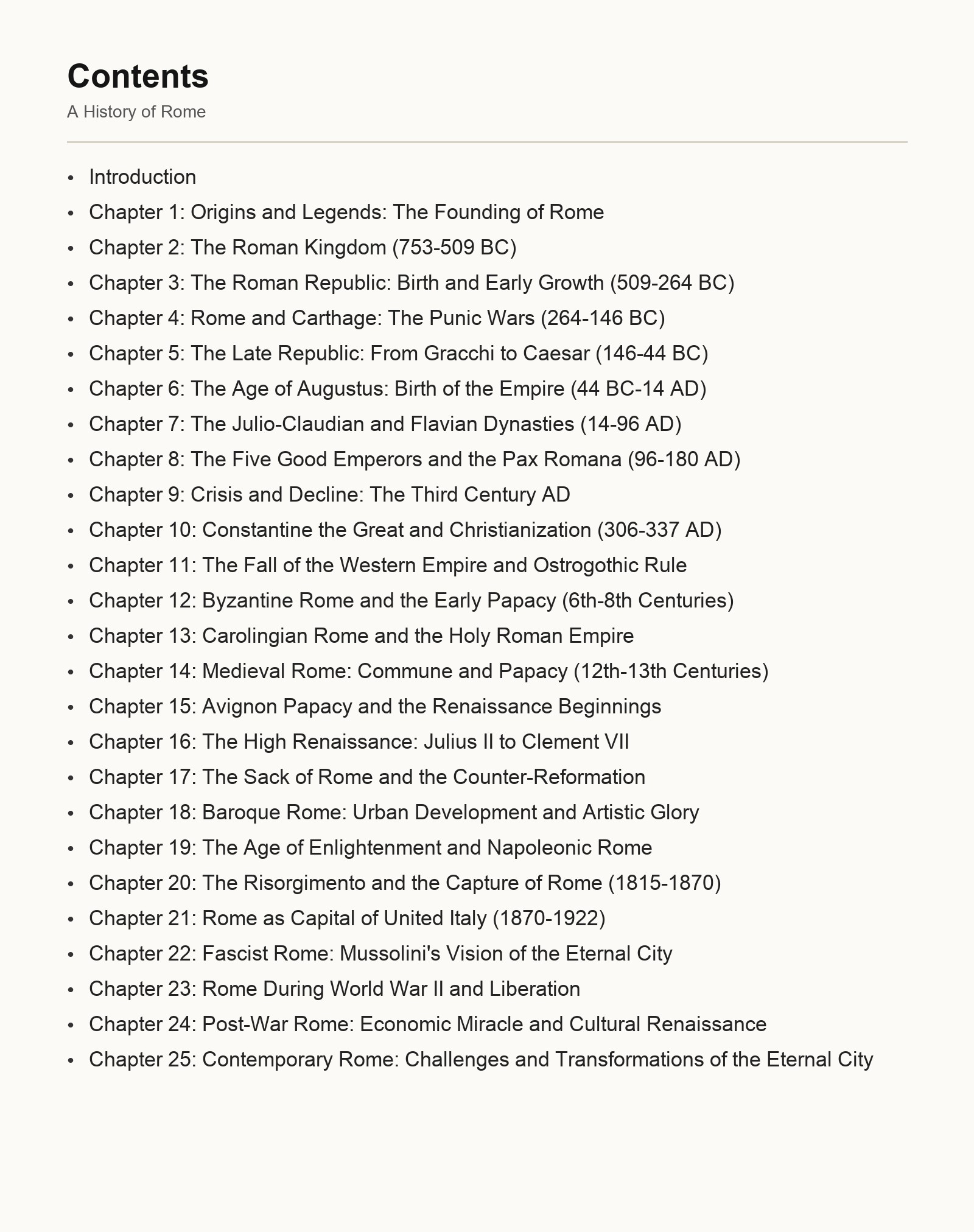
Introduction
-
Chapter 1: Origins and Legends: The Founding of Rome
-
Chapter 2: The Roman Kingdom (753-509 BC)
-
Chapter 3: The Roman Republic: Birth and Early Growth (509-264 BC)
-
Chapter 4: Rome and Carthage: The Punic Wars (264-146 BC)
-
Chapter 5: The Late Republic: From Gracchi to Caesar (146-44 BC)
-
Chapter 6: The Age of Augustus: Birth of the Empire (44 BC-14 AD)
-
Chapter 7: The Julio-Claudian and Flavian Dynasties (14-96 AD)
-
Chapter 8: The Five Good Emperors and the Pax Romana (96-180 AD)
-
Chapter 9: Crisis and Decline: The Third Century AD
-
Chapter 10: Constantine the Great and Christianization (306-337 AD)
-
Chapter 11: The Fall of the Western Empire and Ostrogothic Rule
-
Chapter 12: Byzantine Rome and the Early Papacy (6th-8th Centuries)
-
Chapter 13: Carolingian Rome and the Holy Roman Empire
-
Chapter 14: Medieval Rome: Commune and Papacy (12th-13th Centuries)
-
Chapter 15: Avignon Papacy and the Renaissance Beginnings
-
Chapter 16: The High Renaissance: Julius II to Clement VII
-
Chapter 17: The Sack of Rome and the Counter-Reformation
-
Chapter 18: Baroque Rome: Urban Development and Artistic Glory
-
Chapter 19: The Age of Enlightenment and Napoleonic Rome
-
Chapter 20: The Risorgimento and the Capture of Rome (1815-1870)
-
Chapter 21: Rome as Capital of United Italy (1870-1922)
-
Chapter 22: Fascist Rome: Mussolini's Vision of the Eternal City
-
Chapter 23: Rome During World War II and Liberation
-
Chapter 24: Post-War Rome: Economic Miracle and Cultural Renaissance
-
Chapter 25: Contemporary Rome: Challenges and Transformations of the Eternal City
Author:
Published By:
Date Published:
May 19, 2026
Type:
Nonfiction
Language:
English
Also Available In:
Word Count:
63,112 words
Reading Time:
4 hours 25 minutes
Sample:
Order:
Order A History of Rome (Hardcover) on MixCache.com:
Buy NowPrint copy is made to order and ships worldwide. Includes the ebook free, ready to read instantly.
$5 account credit for all new MixCache.com accounts, usable toward any ebook purchase!*