
Browse by Category
Fiction
- Action & Adventure
- African American
- Anthologies
- Children's Fiction
- Classics
- Comics & Graphic Novels
- Coming of Age
- Contemporary
- Cultural & Regional
- Drama
- Erotica
- Fantasy
- General
- Historical Fiction
- Horror
- Humor & Satire
- Literary Fiction
- Mystery, Thriller & Suspense
- Poetry
- Religious & Inspirational
- Romance
- Science Fiction
- Short Stories
- War & Military
- Westerns
- Women's Fiction
- Young Adult
Non-Fiction
- Antiques & Collectibles
- Arts & Photography
- Biographies & Memoirs
- Business & Money
- Children's Non-Fiction
-
Computers & Technology
- Artificial Intelligence
- Computer Science
- Cybersecurity & Cryptography
- Data Science & Analytics
- Databases & Big Data
- Game Development & Design
- General
- Hardware & DIY
- Mobile App Development
- Networking & Cloud Computing
- Operating Systems
- Programming
- Robotics
- Software
- Software Engineering
- User Experience (UX) & Design
- Web Development & Design
- Cooking, Food & Wine
- Crafts, Hobbies & Home
- Education & Teaching
- Engineering
- General
- Health, Fitness & Dieting
-
History
- African History
- African History - North Africa
- African History - Sub-Saharan Africa
- American History
- American History - 20th Century
- American History - Civil War
- American History - Colonial Period
- Ancient History
- Asian History
- Asian History - China
- Asian History - India
- Asian History - Japan
- Asian History - Southeast Asia
- European History
- European History - Ancient Greece
- European History - Ancient Rome
- European History - Medieval
- European History - Modern
- European History - Renaissance
- General
- Middle Eastern History
- Military History
- Military History - Aviation
- Military History - Naval
- Social & Cultural History
- World History
- Humor & Entertainment
- Industrial Technology
- Language Learning
- Law
- LGBTQ+ Non-Fiction
- Literary Criticism
- Medical Books
- Parenting & Relationships
- Philosophy
- Politics & Social Sciences
- Reference
- Religion & Spirituality
-
Science & Math
- Agricultural Sciences
- Astronomy & Space Science
- Behavioral Sciences
- Biological Sciences
- Botany & Plant Science
- Chemistry
- Earth Sciences
- Engineering - Chemical
- Engineering - Civil
- Engineering - Electrical
- Engineering - Mechanical
- Environment
- General
- Geology
- Mathematics
- Nature & Ecology
- Oceanography
- Paleontology
- Physics
- Statistics
- Self-Help
- Sports & Outdoors
- Study Aids
- Sustainability & Green Living
- Textbooks
- Transportation
- Travel
- True Crime
- Urban Planning & Development
- Veterinary Medicine
- Writing & Publishing
Jump to Section
MixCache.com Total Access
Unlimited reading and audiobooks for every book published by MixCache.com.
Included titles carry the MTA badge.
Learn more →Beneficial wild animals of the United States
About this book:



Discover the hidden heroes of American wildlife in this engaging guide that showcases how wild animals quietly shape the health of our landscapes. From the industrious beaver engineering wetlands that purify water and store carbon, to the night‑flying bats that devour thousands of insects and pollinate desert plants, each chapter reveals a species whose everyday actions provide essential services to ecosystems and people alike. Readers will gain a clear understanding of how these animals contribute to pollination, pest control, nutrient cycling, and habitat creation, turning abstract ecological concepts into concrete, relatable stories.
Journey through the soil with earthworms that enrich gardens and farms, meet the gentle garter snakes that keep slug populations in check, and marvel at the armored turtles that disperse seeds and indicate water quality. The book also introduces lesser‑known allies such as salamanders that signal forest health, ladybugs that annihilate aphids, and praying mantises that act as living pest traps. By exploring the biology, behavior, and challenges of each creature, readers will see how even the smallest organisms play outsized roles in maintaining balance and resilience in natural communities.
Learn about the aerial maestros that patrol our skies—hawks, owls, and woodpeckers—whose keen eyesight and silent flight control rodent and insect outbreaks, while vultures clean up carrion to prevent disease spread. The narrative extends to the waterways where salmon transport ocean nutrients upstream, sea otters guard kelp forests by eating sea urchins, and beavers’ dams create havens for countless species. Each section highlights not only the animal’s ecological importance but also the threats they face from habitat loss, pesticides, and climate change, offering a balanced view of conservation needs.
Experience the wonder of nocturnal light shows with fireflies, the vital pollination work of hummingbirds and desert bats, and the surprising benefits of opossums that gobble ticks and carrion. The book also covers the social engineers of the prairie—prairie dogs whose burrows aerate soil and shelter other wildlife—and the iconic predators like gray wolves and American alligators whose presence triggers trophic cascades that enrich entire ecosystems. Readers will finish with a deeper appreciation for the interconnected web of life and practical insights on how to support these beneficial animals in their own backyards and communities.
Whether you are a gardener, a student, a nature enthusiast, or simply curious about the wild neighbors sharing your environment, this book equips you with knowledge that fosters coexistence and stewardship. By understanding the services these animals provide, you will be inspired to protect habitats, reduce harmful practices, and celebrate the diversity that sustains healthy ecosystems across the United States. Let each page remind you that the fate of these creatures is intertwined with our own, and that safeguarding them ensures a thriving planet for future generations.
What You'll Find Inside:
- Discover how wild animals provide essential ecosystem services like pollination, pest control, and soil health that directly support American agriculture and food production.
- Learn why commonly feared animals such as snakes, spiders, bats, and opossums are actually beneficial allies that control disease vectors and pest populations.
- Understand the critical role of keystone species like beavers, bison, wolves, and sea otters in shaping landscapes and maintaining biodiversity through their natural behaviors.
- Explore the hidden world of soil engineers including earthworms, nematodes, and fungi that create fertile ground for plants through nutrient cycling and soil structuring.
- Gain practical strategies for creating wildlife-friendly habitats in your backyard, farm, or community to foster coexistence and support beneficial animal populations.
Who's It For:
This book is ideal for gardeners, homeowners, farmers, and landowners seeking ecological approaches to pest control and land management. It will also benefit conservation professionals, environmental educators, and students of ecology or wildlife biology who want to understand the tangible benefits of native species. Anyone interested in sustainable living, biodiversity, or improving their local ecosystem's health will find actionable insights and a renewed appreciation for the wild animals sharing their landscape.
Table of Contents:
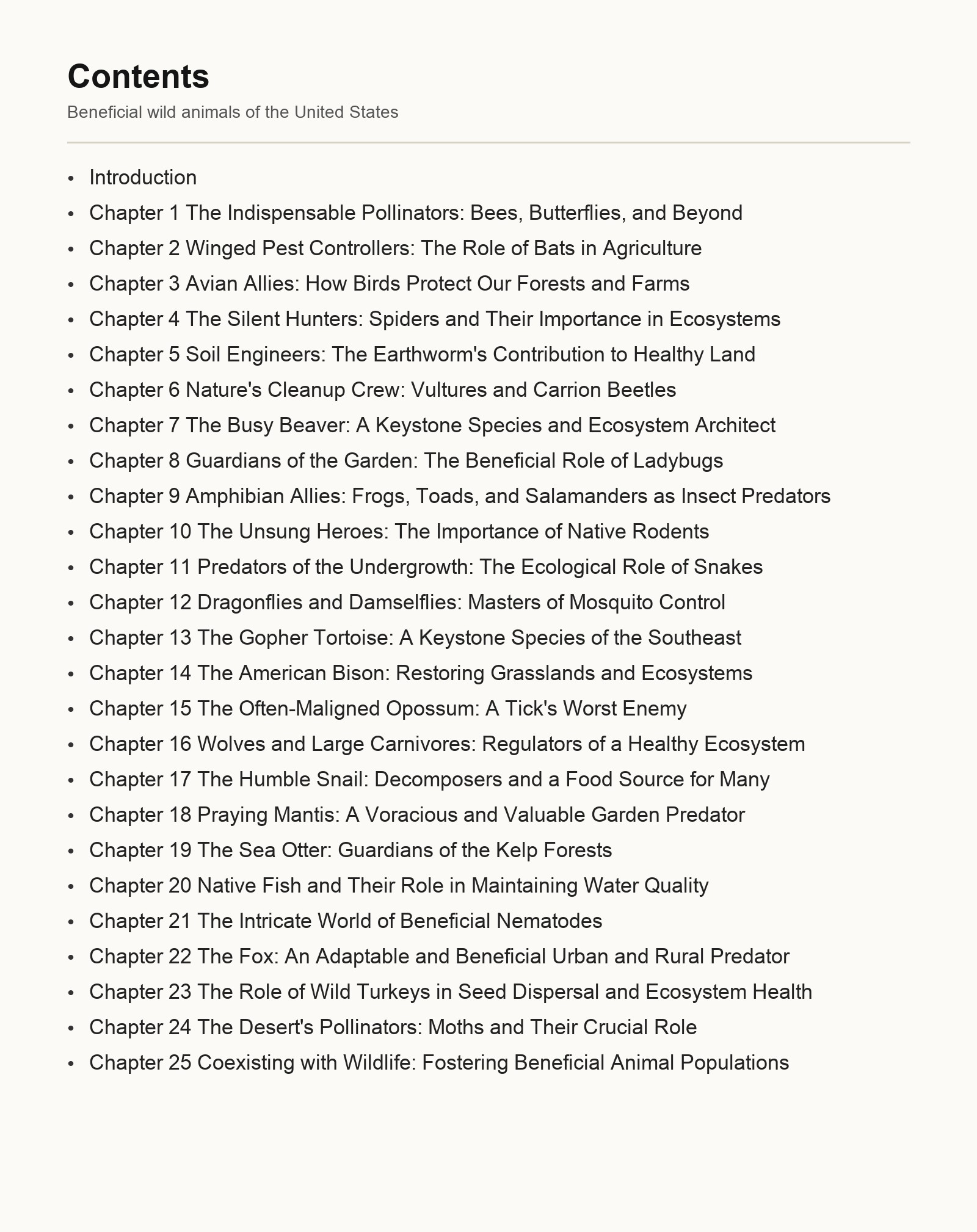
- Introduction
- Chapter 1 The Indispensable Pollinators: Bees, Butterflies, and Beyond
- Chapter 2 Winged Pest Controllers: The Role of Bats in Agriculture
- Chapter 3 Avian Allies: How Birds Protect Our Forests and Farms
- Chapter 4 The Silent Hunters: Spiders and Their Importance in Ecosystems
- Chapter 5 Soil Engineers: The Earthworm's Contribution to Healthy Land
- Chapter 6 Nature's Cleanup Crew: Vultures and Carrion Beetles
- Chapter 7 The Busy Beaver: A Keystone Species and Ecosystem Architect
- Chapter 8 Guardians of the Garden: The Beneficial Role of Ladybugs
- Chapter 9 Amphibian Allies: Frogs, Toads, and Salamanders as Insect Predators
- Chapter 10 The Unsung Heroes: The Importance of Native Rodents
- Chapter 11 Predators of the Undergrowth: The Ecological Role of Snakes
- Chapter 12 Dragonflies and Damselflies: Masters of Mosquito Control
- Chapter 13 The Gopher Tortoise: A Keystone Species of the Southeast
- Chapter 14 The American Bison: Restoring Grasslands and Ecosystems
- Chapter 15 The Often-Maligned Opossum: A Tick's Worst Enemy
- Chapter 16 Wolves and Large Carnivores: Regulators of a Healthy Ecosystem
- Chapter 17 The Humble Snail: Decomposers and a Food Source for Many
- Chapter 18 Praying Mantis: A Voracious and Valuable Garden Predator
- Chapter 19 The Sea Otter: Guardians of the Kelp Forests
- Chapter 20 Native Fish and Their Role in Maintaining Water Quality
- Chapter 21 The Intricate World of Beneficial Nematodes
- Chapter 22 The Fox: An Adaptable and Beneficial Urban and Rural Predator
- Chapter 23 The Role of Wild Turkeys in Seed Dispersal and Ecosystem Health
- Chapter 24 The Desert's Pollinators: Moths and Their Crucial Role
- Chapter 25 Coexisting with Wildlife: Fostering Beneficial Animal Populations
Author:
Published By:
Date Published:
May 17, 2026
Type:
Nonfiction
Language:
English
Also Available In:
Word Count:
33,890 words
Reading Time:
2 hours 22 minutes
Sample:
Order:
Order Beneficial wild animals of the United States (Hardcover) on MixCache.com:
Buy NowPrint copy is made to order and ships worldwide. Includes the ebook free, ready to read instantly.
$5 account credit for all new MixCache.com accounts, usable toward any ebook purchase!*


