Browse by Category
Fiction
- Action & Adventure
- African American
- Anthologies
- Children's Fiction
- Classics
- Comics & Graphic Novels
- Coming of Age
- Contemporary
- Cultural & Regional
- Drama
- Erotica
- Fantasy
- General
- Historical Fiction
- Horror
- Humor & Satire
- Literary Fiction
- Mystery, Thriller & Suspense
- Poetry
- Religious & Inspirational
- Romance
- Science Fiction
- Short Stories
- War & Military
- Westerns
- Women's Fiction
- Young Adult
Non-Fiction
- Antiques & Collectibles
- Arts & Photography
- Biographies & Memoirs
- Business & Money
- Children's Non-Fiction
-
Computers & Technology
- Artificial Intelligence
- Computer Science
- Cybersecurity & Cryptography
- Data Science & Analytics
- Databases & Big Data
- Game Development & Design
- General
- Hardware & DIY
- Mobile App Development
- Networking & Cloud Computing
- Operating Systems
- Programming
- Robotics
- Software
- Software Engineering
- User Experience (UX) & Design
- Web Development & Design
- Cooking, Food & Wine
- Crafts, Hobbies & Home
- Education & Teaching
- Engineering
- General
- Health, Fitness & Dieting
-
History
- African History
- African History - North Africa
- African History - Sub-Saharan Africa
- American History
- American History - 20th Century
- American History - Civil War
- American History - Colonial Period
- Ancient History
- Asian History
- Asian History - China
- Asian History - India
- Asian History - Japan
- Asian History - Southeast Asia
- European History
- European History - Ancient Greece
- European History - Ancient Rome
- European History - Medieval
- European History - Modern
- European History - Renaissance
- General
- Middle Eastern History
- Military History
- Military History - Aviation
- Military History - Naval
- Social & Cultural History
- World History
- Humor & Entertainment
- Industrial Technology
- Language Learning
- Law
- LGBTQ+ Non-Fiction
- Literary Criticism
- Medical Books
- Parenting & Relationships
- Philosophy
- Politics & Social Sciences
- Reference
- Religion & Spirituality
-
Science & Math
- Agricultural Sciences
- Astronomy & Space Science
- Behavioral Sciences
- Biological Sciences
- Botany & Plant Science
- Chemistry
- Earth Sciences
- Engineering - Chemical
- Engineering - Civil
- Engineering - Electrical
- Engineering - Mechanical
- Environment
- General
- Geology
- Mathematics
- Nature & Ecology
- Oceanography
- Paleontology
- Physics
- Statistics
- Self-Help
- Sports & Outdoors
- Study Aids
- Sustainability & Green Living
- Textbooks
- Transportation
- Travel
- True Crime
- Urban Planning & Development
- Veterinary Medicine
- Writing & Publishing
Jump to Section
MixCache.com Total Access
Unlimited reading and audiobooks for every book published by MixCache.com.
Included titles carry the MTA badge.
Learn more →
From Cacao to Copper: Commodities, Global Markets, and African Economic Transformations
MTA
Resource Booms, Labor, and the Politics of Extraction
About this book:
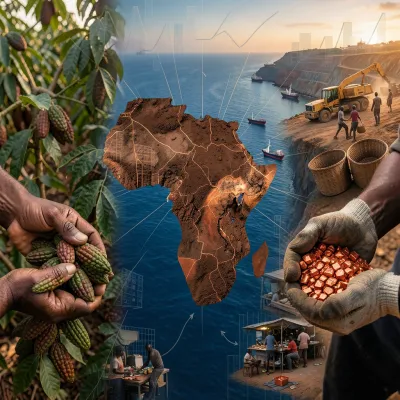
*From Cacao to Copper: Commodities, Global Markets, and African Economic Transformations* provides a comprehensive analysis of how primary resources like gold, cocoa, copper, and oil have shaped the political, social, and economic landscapes of Africa from the colonial era to the modern day. The book argues that while these commodities have driven global booms and financed state-building, they have also left deep ecological scars and created structural dependencies. It traces the history of "extractive corridors"—infrastructure like railways and ports originally designed by colonial powers to channel wealth outward—and explores how these inherited geographies continue to influence contemporary trade patterns and regional integration efforts.
The text delves into the "commodity trap," examining the macroeconomic challenges of resource dependence, such as Dutch Disease and extreme price volatility. Through comparative case studies, the book illustrates different models of extraction: from the capital-intensive, company-ruled "modernity" of the Central African Copperbelt and the enclave economies of offshore oil, to the labor-intensive smallholder structures of West African cocoa. It highlights the social costs of these industries, emphasizing the physical toll on workers, the gendered burdens of care and labor, and the frequent displacement of communities as states and corporations contest the ownership of the subsoil.
Moving into the 21st century, the book analyzes the "new demand shock" sparked by the rise of China and India, which has provided African states with new diplomatic and financial leverage but also introduced new forms of debt and dependency. It further addresses the role of digitalization and blockchain in pursuing ethical sourcing and transparency, while noting that technological solutions often struggle to override entrenched power dynamics. The narrative concludes by looking toward the future, specifically how the global transition to green energy has ignited a new scramble for Africa’s "critical minerals" like cobalt and lithium.
Ultimately, the book advocates for a strategic rethink of African development. It suggests that while extraction is often synonymous with exploitation, it can catalyze genuine transformation if managed through robust domestic institutions, transparent fiscal policies, and a commitment to green industrialization. By shifting focus from raw exports to local value addition and regional cooperation, African states may finally be able to leverage their geological wealth to build diversified, resilient economies that outlast the finite resources beneath their soil.
What You'll Find Inside:
- Colonial infrastructure like railways and ports created extractive corridors that continue to shape Africa's economic geography and development paths
- Extraction imposes significant social costs including hazardous labor, gendered burdens, health impacts, and community displacement that often fall disproportionately on vulnerable populations
- Resource dependence creates macroeconomic vulnerabilities including Dutch Disease, boom-bust cycles, and currency appreciation that undermine economic diversification
- Governance challenges around licensing, taxation, transparency, and illicit financial flows often prevent equitable capture of resource wealth for public benefit
- Pathways beyond extraction require strategic investment in diversification, local content policies, green industrialization, and prudent management of resource windfalls
Who's It For:
This book is essential reading for policymakers, development practitioners, and scholars working on African economic development, resource governance, or extractive industries. It will particularly benefit government officials in resource-rich African countries, international development agency staff, researchers in African studies and political economy, and civil society organizations advocating for equitable resource management and community rights. Professionals in mining, commodity trading, and international finance focused on Africa will also find valuable insights into the political economy of resource extraction.
Table of Contents:
- Introduction
- Chapter 1 Mapping Africa’s Commodity Frontiers
- Chapter 2 Empire’s Arteries: Railways, Ports, and the Making of Extractive Corridors
- Chapter 3 The Gold Standard: Finance, Risk, and Power from Ashanti to Johannesburg
- Chapter 4 Cocoa Worlds: Smallholders, Cooperatives, and Price Stabilization in West Africa
- Chapter 5 Copperbelt Modernities: Labor, Urbanization, and Company Rule in Central Africa
- Chapter 6 Oil Encounters: Offshore Discoveries and Onshore Disruptions
- Chapter 7 Boom, Bust, and Dutch Disease: Macroeconomics of Resource Dependence
- Chapter 8 Work, Wages, and the Body: The Social Costs of Extraction
- Chapter 9 Land, Property, and Displacement: Who Owns the Subsoil?
- Chapter 10 Ecologies of Extraction: Water, Forests, and Carbon
- Chapter 11 States, Chiefs, and Concessions: Politics of Licensing and Rents
- Chapter 12 Global Value Chains and the Commodity Trap
- Chapter 13 China, India, and the New Demand Shock
- Chapter 14 Taxation, Transparency, and Illicit Financial Flows
- Chapter 15 Gendered Economies of Resource Booms
- Chapter 16 Conflict, Security, and the Militarization of the Mine
- Chapter 17 Communities, Resistance, and the Politics of Consent
- Chapter 18 Local Content and Industrial Policy: From Smelters to Agro-Processing
- Chapter 19 Sovereign Wealth and Public Investment: Managing the Windfall
- Chapter 20 Currency, Credit, and Commodity Exchanges: Infrastructures of Markets
- Chapter 21 Regional Integration and Cross-Border Corridors
- Chapter 22 Climate Transition, Critical Minerals, and the New Scramble
- Chapter 23 Digitalization, Traceability, and Ethical Sourcing
- Chapter 24 Beyond Extraction: Diversification Pathways and Green Industrialization
- Chapter 25 Rethinking Development: Lessons for Policy and Scholarship
Author:
Published By:
Date Published:
May 5, 2026
Type:
Nonfiction
Language:
English
Word Count:
68,744 words
Reading Time:
4 hours 49 minutes
Sample:
Order:
Order From Cacao to Copper: Commodities, Global Markets, and African Economic Transformations (Hardcover) on MixCache.com:
Buy NowPrint copy is made to order and ships worldwide. Includes the ebook free, ready to read instantly.
$5 account credit for all new MixCache.com accounts, usable toward any ebook purchase!*