
Browse by Category
Fiction
- Action & Adventure
- African American
- Anthologies
- Children's Fiction
- Classics
- Comics & Graphic Novels
- Coming of Age
- Contemporary
- Cultural & Regional
- Drama
- Erotica
- Fantasy
- General
- Historical Fiction
- Horror
- Humor & Satire
- Literary Fiction
- Mystery, Thriller & Suspense
- Poetry
- Religious & Inspirational
- Romance
- Science Fiction
- Short Stories
- War & Military
- Westerns
- Women's Fiction
- Young Adult
Non-Fiction
- Antiques & Collectibles
- Arts & Photography
- Biographies & Memoirs
- Business & Money
- Children's Non-Fiction
-
Computers & Technology
- Artificial Intelligence
- Computer Science
- Cybersecurity & Cryptography
- Data Science & Analytics
- Databases & Big Data
- Game Development & Design
- General
- Hardware & DIY
- Mobile App Development
- Networking & Cloud Computing
- Operating Systems
- Programming
- Robotics
- Software
- Software Engineering
- User Experience (UX) & Design
- Web Development & Design
- Cooking, Food & Wine
- Crafts, Hobbies & Home
- Education & Teaching
- Engineering
- General
- Health, Fitness & Dieting
-
History
- African History
- African History - North Africa
- African History - Sub-Saharan Africa
- American History
- American History - 20th Century
- American History - Civil War
- American History - Colonial Period
- Ancient History
- Asian History
- Asian History - China
- Asian History - India
- Asian History - Japan
- Asian History - Southeast Asia
- European History
- European History - Ancient Greece
- European History - Ancient Rome
- European History - Medieval
- European History - Modern
- European History - Renaissance
- General
- Middle Eastern History
- Military History
- Military History - Aviation
- Military History - Naval
- Social & Cultural History
- World History
- Humor & Entertainment
- Industrial Technology
- Language Learning
- Law
- LGBTQ+ Non-Fiction
- Literary Criticism
- Medical Books
- Parenting & Relationships
- Philosophy
- Politics & Social Sciences
- Reference
- Religion & Spirituality
-
Science & Math
- Agricultural Sciences
- Astronomy & Space Science
- Behavioral Sciences
- Biological Sciences
- Botany & Plant Science
- Chemistry
- Earth Sciences
- Engineering - Chemical
- Engineering - Civil
- Engineering - Electrical
- Engineering - Mechanical
- Environment
- General
- Geology
- Mathematics
- Nature & Ecology
- Oceanography
- Paleontology
- Physics
- Statistics
- Self-Help
- Sports & Outdoors
- Study Aids
- Sustainability & Green Living
- Textbooks
- Transportation
- Travel
- True Crime
- Urban Planning & Development
- Veterinary Medicine
- Writing & Publishing
Jump to Section

Want unlimited access to all books published by MixCache.com (plus their audiobooks)? Try MixCache.com Total Access. Look for the MTA badge on book covers to identify included titles.
The Rise of No-Till Farming
How a Quiet Revolution Changed Soil Health
About this book:
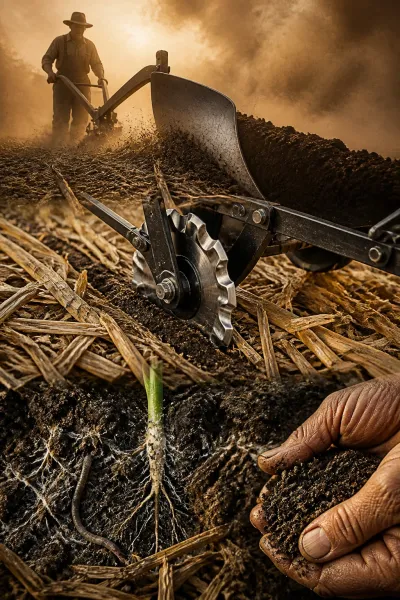 For thousands of years, the plow was the undisputed symbol of civilization—a tool that turned wilderness into wealth and defined the good farmer by the straightness of his furrows. But beneath that pristine, black earth, a slow catastrophe was unfolding. *The Rise of No-Till Farming* traces the gripping history of how agriculture’s most iconic implement stripped the land of its living architecture, setting the stage for the Dust Bowl and a crisis that forced a handful of stubborn innovators to ask a heretical question: what if we stopped turning the soil altogether?
What follows is a riveting chronicle of a quiet revolution, from the blacksmith’s shed where John Deere’s steel plow broke the prairie, to the midwestern fields where farmers risked ridicule to plant into the stubble of last year’s crop. You’ll witness the collision of steel and biology, the chemical breakthroughs that made weed control possible without a moldboard, and the engineering ingenuity that built machines capable of slicing through residue instead of burying it. This is a story of scientific detective work—revealing the unseen universe of fungi, earthworms, and aggregates that make soil a sponge, not a dust bowl—and the cultural war waged at fence lines between tradition and a radical new way of seeing the land.
Today, as climate extremes batter a hungry world, the principles born in those experimental plots have become the foundation of a global movement. From the Corn Belt to the plains of Argentina and the smallholdings of Africa, no-till has evolved into regenerative agriculture’s leading edge: a proven system that pulls carbon from the sky, holds water against drought, protects watersheds, and rebuilds the fertility that the plow spent centuries spending. *The Rise of No-Till Farming* is the definitive history of how agriculture learned to heal the ground it broke—and why the future of food depends on leaving the soil alone.
Table of Contents:
- Introduction
- Chapter 1 The Moldboard Legacy: A History of Tillage
- Chapter 2 Lessons from the Dust Bowl
- Chapter 3 Breaking Ground Without a Plow: The First Experiments
- Chapter 4 The Chemical Catalyst: Early Herbicides and Weed Management
- Chapter 5 Engineering the Solution: The Invention of No-Till Planters
- Chapter 6 Unseen Architecture: Understanding Soil Structure
- Chapter 7 Beneath the Surface: Microbes, Fungi, and Earthworms
- Chapter 8 Moisture in the Roots: Water Retention and Drought Resistance
- Chapter 9 Stopping the Wash: Halting Topsoil Erosion
- Chapter 10 Skepticism at the Fence Line: The Cultural Resistance to No-Till
- Chapter 11 The Pioneers of the Corn Belt
- Chapter 12 Managing Residue: Turning Trash into Treasure
- Chapter 13 The Rise of Cover Crops: Continuous Living Roots
- Chapter 14 The Midwest Shift: Widespread Adoption Across the Heartland
- Chapter 15 Fuel, Labor, and Time: The Economic Argument for No-Till
- Chapter 16 Shift in Weeds and Pests: Evolving Agronomic Challenges
- Chapter 17 Nutrient Cycling: Rethinking Fertilizer Application
- Chapter 18 Soil as a Carbon Sink: Climate and No-Till Farming
- Chapter 19 Precision Agriculture Meets No-Till Technology
- Chapter 20 Protecting the Watershed: Runoff, Rivers, and Water Quality
- Chapter 21 Policy and Programs: How Subsidies Shaped Adoption
- Chapter 22 Regenerative Agriculture and the Modern No-Till Movement
- Chapter 23 Global Echoes: No-Till Innovations Beyond the United States
- Chapter 24 Climate Extremes: Soil Resilience in an Uncertain Future
- Chapter 25 The Next Frontier of Soil Health
Author:
Published By:
Type:
Nonfiction
Sample:
Order:
Click to buy this ebook:
Buy Now