
Browse by Category
Fiction
- Action & Adventure
- African American
- Anthologies
- Children's Fiction
- Classics
- Comics & Graphic Novels
- Coming of Age
- Contemporary
- Cultural & Regional
- Drama
- Erotica
- Fantasy
- General
- Historical Fiction
- Horror
- Humor & Satire
- Literary Fiction
- Mystery, Thriller & Suspense
- Poetry
- Religious & Inspirational
- Romance
- Science Fiction
- Short Stories
- War & Military
- Westerns
- Women's Fiction
- Young Adult
Non-Fiction
- Antiques & Collectibles
- Arts & Photography
- Biographies & Memoirs
- Business & Money
- Children's Non-Fiction
-
Computers & Technology
- Artificial Intelligence
- Computer Science
- Cybersecurity & Cryptography
- Data Science & Analytics
- Databases & Big Data
- Game Development & Design
- General
- Hardware & DIY
- Mobile App Development
- Networking & Cloud Computing
- Operating Systems
- Programming
- Robotics
- Software
- Software Engineering
- User Experience (UX) & Design
- Web Development & Design
- Cooking, Food & Wine
- Crafts, Hobbies & Home
- Education & Teaching
- Engineering
- General
- Health, Fitness & Dieting
-
History
- African History
- African History - North Africa
- African History - Sub-Saharan Africa
- American History
- American History - 20th Century
- American History - Civil War
- American History - Colonial Period
- Ancient History
- Asian History
- Asian History - China
- Asian History - India
- Asian History - Japan
- Asian History - Southeast Asia
- European History
- European History - Ancient Greece
- European History - Ancient Rome
- European History - Medieval
- European History - Modern
- European History - Renaissance
- General
- Middle Eastern History
- Military History
- Military History - Aviation
- Military History - Naval
- Social & Cultural History
- World History
- Humor & Entertainment
- Industrial Technology
- Language Learning
- Law
- LGBTQ+ Non-Fiction
- Literary Criticism
- Medical Books
- Parenting & Relationships
- Philosophy
- Politics & Social Sciences
- Reference
- Religion & Spirituality
-
Science & Math
- Agricultural Sciences
- Astronomy & Space Science
- Behavioral Sciences
- Biological Sciences
- Botany & Plant Science
- Chemistry
- Earth Sciences
- Engineering - Chemical
- Engineering - Civil
- Engineering - Electrical
- Engineering - Mechanical
- Environment
- General
- Geology
- Mathematics
- Nature & Ecology
- Oceanography
- Paleontology
- Physics
- Statistics
- Self-Help
- Sports & Outdoors
- Study Aids
- Sustainability & Green Living
- Textbooks
- Transportation
- Travel
- True Crime
- Urban Planning & Development
- Veterinary Medicine
- Writing & Publishing
Jump to Section
MixCache.com Total Access
Unlimited reading and audiobooks for every book published by MixCache.com.
Included titles carry the MTA badge.
Learn more →
The Byzantine Hesychast Controversy
Mysticism, Power, and the Struggle for Orthodoxy
About this book:
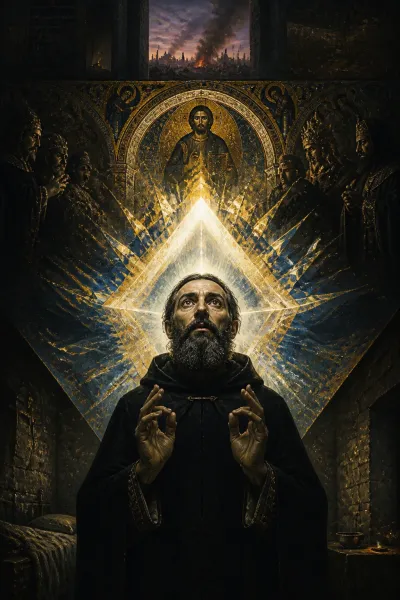 Byzantium is dying. The Ottomans tighten the noose around Constantinople, the treasury is empty, and the empire’s own mercenaries are burning the countryside. Yet in the 1330s, the Romans chose to wage their most ferocious war not for land or gold, but for the nature of God’s light. *The Byzantine Hesychast Controversy* plunges you into the heart of this paradox: a civilization collapsing into ruin while its greatest minds—aristocratic monks, humanist philosophers, and ruthless emperors—tear the state apart over a mystical vision on Mount Tabor. From the silent cells of Athos, where ascetics claimed to see the Uncreated Light through the "Jesus Prayer," to the glittering, treacherous halls of the imperial palace where theology was a weapon of civil war, this is the story of how a dispute over prayer became the fault line upon which Eastern Christianity broke from the West.
At the center stands Gregory Palamas, the brilliant aristocrat-turned-monk who dared to systematize the ineffable, arguing that while God’s essence remains forever hidden, His "energies" flood the world—allowing humans to truly *become* God. Arrayed against him is Barlaam of Calabria, the sharp-tongued emissary of Western scholasticism, who denounced the monks as "navel-gazers" mistaking biology for divinity. Their clash ignites a continent-spanning crisis: emperors are deposed, patriarchs imprisoned, and the brilliant historian Nikephoros Gregoras excommunicated for the crime of intellectual honesty. As civil war bleeds the empire dry, the controversy metastasizes into a geopolitical struggle over the soul of Byzantium—determining whether the East would embrace the rising tide of the Renaissance or seal itself behind a wall of mystical theology.
Meticulously researched and narrated with novelistic sweep, *The Byzantine Hesychast Controversy* traces the dispute from the mist-shrouded cliffs of the Holy Mountain to the Slavic courts of Serbia and Rus’, and finally to the shattered walls of 1453. It reveals how the triumph of Palamism didn't just win a debate—it forged the DNA of the modern Orthodox Church, drew the final line between Constantinople and Rome, and offered a civilization facing extinction a transfiguring vision of glory amidst the ashes. For readers of *The Name of the Rose* or *A Distant Mirror*, this is the definitive account of the moment the Middle Ages ended in the East—not with a whimper, but with a blinding flash of theological light.
Table of Contents:
- Introduction
- Chapter 1 The Fading Empire: Byzantium on the Brink in the Fourteenth Century
- Chapter 2 The Holy Mountain: Monastic Life and Stillness on Athos
- Chapter 3 The Jesus Prayer and the Psychosomatic Method
- Chapter 4 The Philosopher from Calabria: The Arrival of Barlaam
- Chapter 5 Reason and Faith: The Clash of Western Scholasticism and Eastern Apophasis
- Chapter 6 The Defender of Stillness: Gregory Palamas Enters the Arena
- Chapter 7 The Light of Mount Tabor: Vision of God or Visual Illusion?
- Chapter 8 Essence and Energies: Palamas's Radical Distinctions
- Chapter 9 The Accusation of Heresy: Barlaam’s Crusade Against the "Omphalopsychoi"
- Chapter 10 The Synod of June 1341: Barlaam’s Condemnation and Flight
- Chapter 11 Gregory Akindynos and the Shifting Battle Lines
- Chapter 12 The Empire Fractures: Civil War Between Palaiologos and Kantakouzenos
- Chapter 13 Orthodoxy Politicized: The Hesychasts in the Crosshairs
- Chapter 14 The Patriarch of Constantinople Strikes: The Imprisonment of Palamas
- Chapter 15 The Empress Anna and the Zealous Radicals
- Chapter 16 The Turn of the Tide: John Kantakouzenos Claims the Imperial Throne
- Chapter 17 The Triumph of Palamism: The Council of 1351
- Chapter 18 Nikephoros Gregoras: The Intellectual Rebellion Against Mysticism
- Chapter 19 Excommunication and Anathema: Purging the Anti-Palamites
- Chapter 20 Captive of the Turks: Palamas’s Odyssey Beyond the Imperial Borders
- Chapter 21 The Synodal Tome: Institutionalizing Hesychasm in Imperial Law
- Chapter 22 The Monastic International: Hesychasm’s Spread to Serbia, Bulgaria, and Rus'
- Chapter 23 The Shadow of Rome: Hesychasm as an Obstacle to Church Union
- Chapter 24 The Fall of the City: Hesychast Identity Amidst the Ruins of 1453
- Chapter 25 The Legacy of Light: How the Fourteenth Century Defined Eastern Orthodoxy
Author:
Published By:
Type:
Nonfiction
Sample:
Order:
Click to order this paperback:
Buy Now