
Browse by Category
Fiction
- Action & Adventure
- African American
- Anthologies
- Children's Fiction
- Classics
- Comics & Graphic Novels
- Coming of Age
- Contemporary
- Cultural & Regional
- Drama
- Erotica
- Family Life
- Fantasy
- General
- Historical Fiction
- Horror
- Humor & Satire
- Literary Fiction
- Mystery, Thriller & Suspense
- Poetry
- Religious & Inspirational
- Romance
- Science Fiction
- Short Stories
- War & Military
- Westerns
- Women's Fiction
- Young Adult
Non-Fiction
- Antiques & Collectibles
- Arts & Photography
- Biographies & Memoirs
- Business & Money
- Children's Non-Fiction
-
Computers & Technology
- Artificial Intelligence
- Computer Science
- Cybersecurity & Cryptography
- Data Science & Analytics
- Databases & Big Data
- Game Development & Design
- General
- Hardware & DIY
- Mobile App Development
- Networking & Cloud Computing
- Operating Systems
- Programming
- Robotics
- Software
- Software Engineering
- User Experience (UX) & Design
- Web Development & Design
- Cooking, Food & Wine
- Crafts, Hobbies & Home
- Education & Teaching
- Engineering
- General
- Health, Fitness & Dieting
-
History
- African History
- African History - North Africa
- African History - Sub-Saharan Africa
- American History
- American History - 20th Century
- American History - Civil War
- American History - Colonial Period
- Ancient History
- Asian History
- Asian History - China
- Asian History - India
- Asian History - Japan
- Asian History - Southeast Asia
- European History
- European History - Ancient Greece
- European History - Ancient Rome
- European History - Medieval
- European History - Modern
- European History - Renaissance
- General
- Middle Eastern History
- Military History
- Military History - Aviation
- Military History - Naval
- Social & Cultural History
- World History
- Humor & Entertainment
- Industrial Technology
- Language Learning
- Law
- LGBTQ+ Non-Fiction
- Literary Criticism
- Medical Books
- Parenting & Relationships
- Philosophy
- Politics & Social Sciences
- Reference
- Religion & Spirituality
-
Science & Math
- Agricultural Sciences
- Astronomy & Space Science
- Behavioral Sciences
- Biological Sciences
- Botany & Plant Science
- Chemistry
- Earth Sciences
- Engineering - Chemical
- Engineering - Civil
- Engineering - Electrical
- Engineering - Mechanical
- Environment
- General
- Geology
- Mathematics
- Nature & Ecology
- Oceanography
- Paleontology
- Physics
- Statistics
- Self-Help
- Sports & Outdoors
- Study Aids
- Sustainability & Green Living
- Textbooks
- Transportation
- Travel
- True Crime
- Urban Planning & Development
- Veterinary Medicine
- Writing & Publishing
Jump to Section
MixCache.com Total Access
Unlimited reading and audiobooks for every book published by MixCache.com.
Included titles carry the MTA badge.
Learn more →
Teaching Entomology on the Farm
Rural Case Studies and Written Exercises in Insect Ecology
About this book:
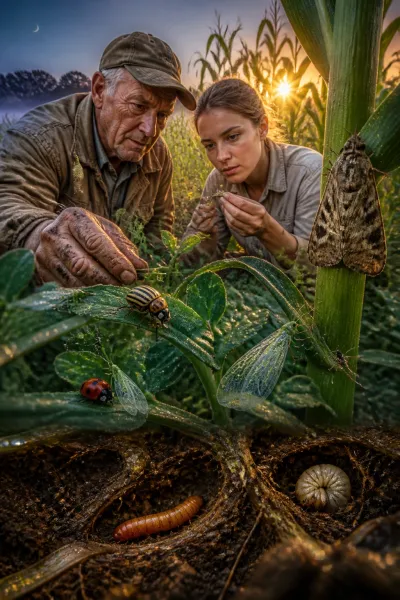 Step out of the lecture hall and into the dew-soaked alfalfa, the moonlit orchard, and the living soil beneath the corn. *Teaching Entomology on the Farm* dismantles the false divide between ecological theory and agricultural reality, offering twenty-five immersive case studies that place you knee-deep in the complex, dynamic arthropod communities driving farm productivity. From tracking the evolutionary arms race of the Colorado potato beetle to decoding the nocturnal flights of noctuid moths and the subterranean warfare of wireworms, each chapter transforms abstract concepts—predator-prey dynamics, degree-day modeling, tri-trophic cascades, pesticide resistance—into the urgent, daily decision-making of working land managers.
This is not a field guide for identification; it is a training manual for diagnostic reasoning. Through rich, narrative-driven scenarios, you will learn to read a farm as an evolving ecosystem: distinguishing a pest hotspot from a beneficial insect reservoir, calculating whether a parasitoid wasp population justifies holding off on a spray, or designing habitat complexity that turns field margins into engines of biological control. Integrated written exercises in every chapter demand active synthesis, challenging you to interpret messy field data, construct defensible management arguments, and communicate ecological logic to stakeholders—skills no multiple-choice exam can teach.
Whether you are an instructor building a capstone agroecology course, an extension agent advising growers on climate-driven range shifts, or a farm manager seeking to replace reactive chemistry with resilient biology, this text provides the analytical framework to make insects your allies. Move beyond economic thresholds as static numbers and master the art of ecological stewardship—where the sweep net, the light trap, and the soil core become instruments of intelligence, and every management decision strengthens the web of life sustaining the harvest.
Table of Contents:
- Introduction: Bridging the Gap Between Insect Ecology and Agricultural Practice
- Chapter 1: The Alfalfa Sweep — Quantitative Sampling and Population Estimation
- Chapter 2: The Aphid and the Ladybeetle — Predator-Prey Dynamics in Brassica Crops
- Chapter 3: Under the Soil — Monitoring Wireworms and Rootworms in Cornfields
- Chapter 4: Windbreaks and Hedgerows — Habitat Complexity and Beneficial Insects
- Chapter 5: The Night Patrol — Assessing Noctuid Moth Populations with Light Traps
- Chapter 6: Parasitoid Wasps and the Tomato Hornworm — Host-Parasitoid Interactions
- Chapter 7: Pollinator Networks in the Orchard — Evaluating Wild Bees and Honey Bees
- Chapter 8: The Chemical Landscape — Assessing Pesticide Resistance in the Colorado Potato Beetle
- Chapter 9: Cover Crops and Ground Beetles — Weed Seed Predation and Soil Health
- Chapter 10: The Silo Weevil — Post-Harvest Pest Ecology and Grain Storage Dynamics
- Chapter 11: Decaying Matter — Decomposers and Nutrient Cycling in Pasture Soils
- Chapter 12: Microclimates and Thrips — How Canopy Structure Affects Pest Distribution
- Chapter 13: The Invasive Lanternfly — Modeling Range Expansion and Forest-Farm Interfaces
- Chapter 14: Trap Cropping for Stink Bugs — Diversified Farming and Pest Behavior
- Chapter 15: Ant Mutualisms in the Vineyard — Honeydew Producers and Vineyard Management
- Chapter 16: Fungal Pathogens of the Grasshopper — Epizootics and Natural Microbial Control
- Chapter 17: The Squash Vine Borer — Phenology, Degree-Day Modeling, and Timing Interventions
- Chapter 18: Waterlogged Fields — Aquatic Insects as Bioindicators of Agricultural Runoff
- Chapter 19: Grazing Management and Dung Beetles — Enhancing Pasture Degradation and Fly Control
- Chapter 20: Pheromone Interruption — Mating Disruption Strategies in Apple Orchards
- Chapter 21: Plant Defenses and Spider Mites — Induced Resistance and Systemic Responses
- Chapter 22: Greenhouse Whiteflies — Biological Control and Tri-Trophic Interactions under Glass
- Chapter 23: Vectoring Disease — The Leafhopper and Phytoplasma Transmission in Berries
- Chapter 24: Climate Shifts and the Armyworm — Assessing Long-Term Range and Phenological Changes
- Chapter 25: Designing the Resilient Agroecosystem — Integrating Biodiversity and Pest Suppression
Author:
Published By:
Type:
Nonfiction
Date Published:
September 23, 2026
Sample:
Order:
Click to order this paperback:
Buy Now