
Browse by Category
Fiction
- Action & Adventure
- African American
- Anthologies
- Children's Fiction
- Classics
- Comics & Graphic Novels
- Coming of Age
- Contemporary
- Cultural & Regional
- Drama
- Erotica
- Family Life
- Fantasy
- General
- Historical Fiction
- Horror
- Humor & Satire
- Literary Fiction
- Mystery, Thriller & Suspense
- Poetry
- Religious & Inspirational
- Romance
- Science Fiction
- Short Stories
- War & Military
- Westerns
- Women's Fiction
- Young Adult
Non-Fiction
- Antiques & Collectibles
- Arts & Photography
- Biographies & Memoirs
- Business & Money
- Children's Non-Fiction
-
Computers & Technology
- Artificial Intelligence
- Computer Science
- Cybersecurity & Cryptography
- Data Science & Analytics
- Databases & Big Data
- Game Development & Design
- General
- Hardware & DIY
- Mobile App Development
- Networking & Cloud Computing
- Operating Systems
- Programming
- Robotics
- Software
- Software Engineering
- User Experience (UX) & Design
- Web Development & Design
- Cooking, Food & Wine
- Crafts, Hobbies & Home
- Education & Teaching
- Engineering
- General
- Health, Fitness & Dieting
-
History
- African History
- African History - North Africa
- African History - Sub-Saharan Africa
- American History
- American History - 20th Century
- American History - Civil War
- American History - Colonial Period
- Ancient History
- Asian History
- Asian History - China
- Asian History - India
- Asian History - Japan
- Asian History - Southeast Asia
- European History
- European History - Ancient Greece
- European History - Ancient Rome
- European History - Medieval
- European History - Modern
- European History - Renaissance
- General
- Middle Eastern History
- Military History
- Military History - Aviation
- Military History - Naval
- Social & Cultural History
- World History
- Humor & Entertainment
- Industrial Technology
- Language Learning
- Law
- LGBTQ+ Non-Fiction
- Literary Criticism
- Medical Books
- Parenting & Relationships
- Philosophy
- Politics & Social Sciences
- Reference
- Religion & Spirituality
-
Science & Math
- Agricultural Sciences
- Astronomy & Space Science
- Behavioral Sciences
- Biological Sciences
- Botany & Plant Science
- Chemistry
- Earth Sciences
- Engineering - Chemical
- Engineering - Civil
- Engineering - Electrical
- Engineering - Mechanical
- Environment
- General
- Geology
- Mathematics
- Nature & Ecology
- Oceanography
- Paleontology
- Physics
- Statistics
- Self-Help
- Sports & Outdoors
- Study Aids
- Sustainability & Green Living
- Textbooks
- Transportation
- Travel
- True Crime
- Urban Planning & Development
- Veterinary Medicine
- Writing & Publishing
Jump to Section
MixCache.com Total Access
Unlimited reading and audiobooks for every book published by MixCache.com.
Included titles carry the MTA badge.
Learn more →
Orbital Refueling: The Architecture of Starship
How In-Orbit Propellant Transfer Enables Deep Space Exploration
About this book:
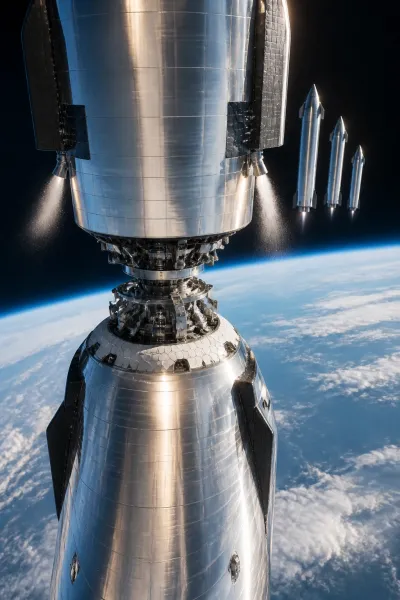 For sixty years, the rocket equation has been a prison—trapping humanity in a cycle where 99% of a launch vehicle’s mass burns up just to escape Earth’s gravity, leaving mere grams for the actual mission. *Orbital Refueling: The Architecture of Starship* reveals how SpaceX is shattering this paradigm. By decoupling launch from transit through in-orbit propellant transfer, Starship turns Low Earth Orbit into a logistics hub, allowing ships to depart for the Moon, Mars, and beyond with full tanks and unprecedented payload capacity. This is not an incremental improvement; it is the architectural key that unlocks the solar system.
Inside, you’ll find the definitive technical blueprint for this revolution. From the thermodynamics of subcooled Methalox and the nightmare of microgravity fluid dynamics—ullage settling, cryogenic boil-off, and autogenous pressurization—to the precision guidance, quick-disconnect interfaces, and high-cadence tanker fleet logistics required to move thousands of tons of propellant in zero-G. Every chapter dissects the physics and engineering systems solving problems never before attempted at scale, bridging the gap between theoretical orbital mechanics and the gritty reality of flight hardware.
Whether you are an engineer designing the next generation of space infrastructure, a policy maker drafting the rules of the orbital road, or an enthusiast demanding rigor over hype, this book delivers the master class. It connects the hardware flying today to the Artemis landing systems, the Mars transit architecture, and the economic models that will drive a multiplanetary civilization. The era of exquisite, one-shot missions is ending. The era of industrial-scale interplanetary transport has begun—start reading the manual.
Table of Contents:
- Introduction
- Chapter 1 The Tyranny of the Rocket Equation
- Chapter 2 Rethinking Space Architecture: Beyond Single-Launch Limits
- Chapter 3 Methalox: The Thermodynamics of Choice
- Chapter 4 Fluid Dynamics in Zero-G: The Challenge of Microgravity Transfer
- Chapter 5 Settling the Fuel: Ullage Maneuvers and Acceleration Control
- Chapter 6 Precision Rendezvous: Automated Proximity Operations
- Chapter 7 Docking Structural Interfaces and Quick-Disconnect Systems
- Chapter 8 Thermal Management and Managing Cryogenic Boil-Off
- Chapter 9 Autogenous Pressurization in Orbital Environments
- Chapter 10 The Tanker Variant: Optimizing Starship for Mass Payload
- Chapter 11 The Propellant Depot: Station Keeping and Storage
- Chapter 12 Guidance, Navigation, and Control during Mass Transfer
- Chapter 13 Safety Systems and Hazard Mitigation in Cryogenic Operations
- Chapter 14 High-Cadence Launch Logistics and Fleet Management
- Chapter 15 The Artemis Connection: Enabling the Human Landing System
- Chapter 16 Trans-Lunar Injection and Extended Delta-V Budgets
- Chapter 17 Mars Transit Dynamics: Carrying Mass to the Red Planet
- Chapter 18 Aerocapture, EDL, and the Mars Return Architecture
- Chapter 19 In-Situ Resource Utilization: Closing the Refueling Loop
- Chapter 20 Outer Solar System Missions: Uranus, Neptune, and Beyond
- Chapter 21 The Economics of In-Space Refueling: Cost Per Ton
- Chapter 22 Commercial Orbital Refueling Infrastructure
- Chapter 23 Policy, Regulation, and Orbital Safety Frameworks
- Chapter 24 Alternative Refueling Concepts and Historical Antecedents
- Chapter 25 The Multiplanetary Horizon: A Refueled Future
Author:
Published By:
Type:
Nonfiction
Date Published:
October 27, 2026
Sample:
Order:
Click to order this hardcover:
Buy Now