Browse by Category
Fiction
- Action & Adventure
- African American
- Anthologies
- Children's Fiction
- Classics
- Comics & Graphic Novels
- Coming of Age
- Contemporary
- Cultural & Regional
- Drama
- Erotica
- Fantasy
- General
- Historical Fiction
- Horror
- Humor & Satire
- Literary Fiction
- Mystery, Thriller & Suspense
- Poetry
- Religious & Inspirational
- Romance
- Science Fiction
- Short Stories
- War & Military
- Westerns
- Women's Fiction
- Young Adult
Non-Fiction
- Antiques & Collectibles
- Arts & Photography
- Biographies & Memoirs
- Business & Money
- Children's Non-Fiction
-
Computers & Technology
- Artificial Intelligence
- Computer Science
- Cybersecurity & Cryptography
- Data Science & Analytics
- Databases & Big Data
- Game Development & Design
- General
- Hardware & DIY
- Mobile App Development
- Networking & Cloud Computing
- Operating Systems
- Programming
- Robotics
- Software
- Software Engineering
- User Experience (UX) & Design
- Web Development & Design
- Cooking, Food & Wine
- Crafts, Hobbies & Home
- Education & Teaching
- Engineering
- General
- Health, Fitness & Dieting
-
History
- African History
- African History - North Africa
- African History - Sub-Saharan Africa
- American History
- American History - 20th Century
- American History - Civil War
- American History - Colonial Period
- Ancient History
- Asian History
- Asian History - China
- Asian History - India
- Asian History - Japan
- Asian History - Southeast Asia
- European History
- European History - Ancient Greece
- European History - Ancient Rome
- European History - Medieval
- European History - Modern
- European History - Renaissance
- General
- Middle Eastern History
- Military History
- Military History - Aviation
- Military History - Naval
- Social & Cultural History
- World History
- Humor & Entertainment
- Industrial Technology
- Language Learning
- Law
- LGBTQ+ Non-Fiction
- Literary Criticism
- Medical Books
- Parenting & Relationships
- Philosophy
- Politics & Social Sciences
- Reference
- Religion & Spirituality
-
Science & Math
- Agricultural Sciences
- Astronomy & Space Science
- Behavioral Sciences
- Biological Sciences
- Botany & Plant Science
- Chemistry
- Earth Sciences
- Engineering - Chemical
- Engineering - Civil
- Engineering - Electrical
- Engineering - Mechanical
- Environment
- General
- Geology
- Mathematics
- Nature & Ecology
- Oceanography
- Paleontology
- Physics
- Statistics
- Self-Help
- Sports & Outdoors
- Study Aids
- Sustainability & Green Living
- Textbooks
- Transportation
- Travel
- True Crime
- Urban Planning & Development
- Veterinary Medicine
- Writing & Publishing
Jump to Section
MixCache.com Total Access
Unlimited reading and audiobooks for every book published by MixCache.com.
Included titles carry the MTA badge.
Learn more →
A History of Vistra Corp.
MTA
The Story of an S&P 500 Company
About this book:
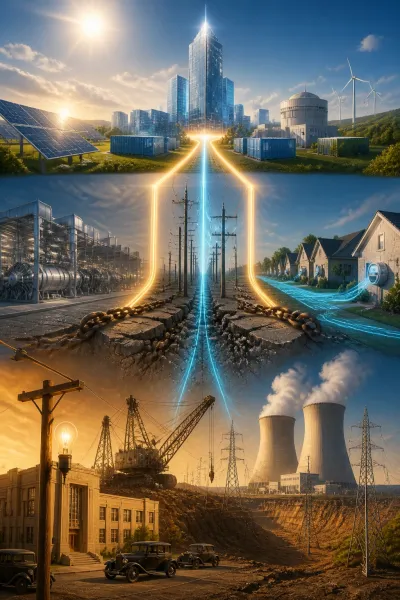
Vistra Corp. traces its origins to the earliest electric utilities in Texas, notably the Dallas Electric Lighting Company founded in 1882, and the subsequent consolidation of regional power providers into Texas Utilities Company in 1945. Over the ensuing decades the company expanded its generation capacity, embraced lignite coal and nuclear power, built an extensive transmission grid, and navigated a shifting regulatory landscape that included the creation of ERCOT and the Public Utility Commission of Texas. The deregulation era ushered in by Texas Senate Bill 7 in 1999 forced the vertically integrated monopoly to unbundle into competitive generation (Luminant) and retail (TXU Energy) arms, while transmission and distribution remained regulated.
A pivotal financial transformation occurred with the 2007 leveraged buyout of TXU Corp., which saddled the successor Energy Future Holdings with massive debt; the subsequent collapse of natural gas prices triggered a 2014 bankruptcy. Emerging from that restructuring in 2016 as Vistra Energy, the company shed legacy debt, pursued disciplined capital allocation, and executed strategic acquisitions—most notably the 2018 purchase of Dynegy Inc., which diversified its footprint across multiple U.S. deregulated markets, and the 2024 acquisition of Energy Harbor’s nuclear and retail businesses. Throughout, Vistra invested heavily in technological innovation, from advanced power‑plant controls and digital grid management to large‑scale battery storage (exemplified by the Moss Landing facility) and renewable‑energy projects, while also retiring thousands of megawatts of coal‑fired capacity under its “Vistra Zero” decarbonization initiative.
Leadership, workforce development, community engagement, and proactive policy advocacy have been central to Vistra’s resilience through crises such as Winter Storm Uri and market volatility. The company’s integrated business model—combining competitive generation with a large retail base—provides a natural hedge against price swings and enables innovative customer offerings. Financial prudence, investment‑grade credit ratings, and a focus on shareholder returns facilitated its inclusion in the S&P 500 Index in May 2024. Looking ahead, Vistra continues to prepare for a low‑carbon future by expanding nuclear, solar, wind, and storage assets, pursuing opportunities in green hydrogen and advanced modular reactors, and positioning itself to serve the growing electricity demands of data centers and hyperscalers, all while maintaining a commitment to reliability, safety, and sustainable growth.
What You'll Find Inside:
- Vistra Corp. traces its roots to the 1945 formation of Texas Utilities Company, which consolidated regional power providers into a statewide energy powerhouse.
- The deregulation era forced the unbundling of generation, transmission, and retail functions, transforming Vistra into a competitive market participant.
- Emerging from the 2014 bankruptcy of Energy Future Holdings, Vistra was reborn with a healthier balance sheet and a renewed strategic focus.
- Strategic acquisitions like Dynegy (2018) and Energy Harbor (2024) expanded Vistra's national footprint and diversified its generation portfolio.
- The 'Vistra Zero' initiative drives the company's leadership in the energy transition through investments in solar, battery storage, nuclear, and carbon-free generation.
Who's It For:
This book is ideal for energy industry professionals, investors, corporate strategists, and academic researchers seeking a detailed case study of how a major U.S. power company evolved from regional utilities to an S&P 500 leader. It will also appeal to readers interested in corporate turnarounds, market deregulation, and the ongoing transition to clean energy.
Table of Contents:
- Introduction
- Chapter 1 The Genesis of Energy: Early Forerunners and Foundations
- Chapter 2 Forging Ahead: The Birth of a Powerhouse
- Chapter 3 Navigating Regulation: Early Challenges and Triumphs
- Chapter 4 Growth and Expansion: Broadening Horizons
- Chapter 5 Innovation in Power: Technological Advancements
- Chapter 6 The Deregulation Era: A New Landscape
- Chapter 7 Mergers and Acquisitions: Strategic Consolidation
- Chapter 8 Financial Engineering: Powering Growth and Stability
- Chapter 9 Environmental Stewardship: Balancing Energy and Ecology
- Chapter 10 Crisis and Resilience: Overcoming Adversity
- Chapter 11 Market Dynamics: Adapting to Change
- Chapter 12 Leadership and Vision: Guiding the Enterprise
- Chapter 13 Community and Responsibility: Beyond the Bottom Line
- Chapter 14 The Digital Transformation: Modernizing Operations
- Chapter 15 Renewable Energy Ventures: A Sustainable Future
- Chapter 16 Global Reach: International Forays
- Chapter 17 Investor Relations: Communicating Value
- Chapter 18 Workforce and Culture: The Human Element
- Chapter 19 Policy and Advocacy: Shaping the Energy Debate
- Chapter 20 Diversification Strategies: New Avenues of Growth
- Chapter 21 The S&P 500 Journey: A Mark of Excellence
- Chapter 22 Future Forward: Preparing for Tomorrow's Energy Needs
- Chapter 23 Key Milestones and Defining Moments
- Chapter 24 The Energy Transition: Leading the Charge
- Chapter 25 Vistra Corp.'s Enduring Legacy
Author:
Published By:
Date Published:
October 8, 2026
Type:
Nonfiction
Language:
English
Word Count:
40,532 words
Reading Time:
2 hours 50 minutes
Sample:
Order:
Order A History of Vistra Corp. (Paperback) on MixCache.com:
Buy NowPrint copy is made to order and ships worldwide. Includes the ebook free, ready to read instantly.
$5 account credit for all new MixCache.com accounts, usable toward any ebook purchase!*