Browse by Category
Fiction
- Action & Adventure
- African American
- Anthologies
- Children's Fiction
- Classics
- Comics & Graphic Novels
- Coming of Age
- Contemporary
- Cultural & Regional
- Drama
- Erotica
- Fantasy
- General
- Historical Fiction
- Horror
- Humor & Satire
- Literary Fiction
- Mystery, Thriller & Suspense
- Poetry
- Religious & Inspirational
- Romance
- Science Fiction
- Short Stories
- War & Military
- Westerns
- Women's Fiction
- Young Adult
Non-Fiction
- Antiques & Collectibles
- Arts & Photography
- Biographies & Memoirs
- Business & Money
- Children's Non-Fiction
-
Computers & Technology
- Artificial Intelligence
- Computer Science
- Cybersecurity & Cryptography
- Data Science & Analytics
- Databases & Big Data
- Game Development & Design
- General
- Hardware & DIY
- Mobile App Development
- Networking & Cloud Computing
- Operating Systems
- Programming
- Robotics
- Software
- Software Engineering
- User Experience (UX) & Design
- Web Development & Design
- Cooking, Food & Wine
- Crafts, Hobbies & Home
- Education & Teaching
- Engineering
- General
- Health, Fitness & Dieting
-
History
- African History
- African History - North Africa
- African History - Sub-Saharan Africa
- American History
- American History - 20th Century
- American History - Civil War
- American History - Colonial Period
- Ancient History
- Asian History
- Asian History - China
- Asian History - India
- Asian History - Japan
- Asian History - Southeast Asia
- European History
- European History - Ancient Greece
- European History - Ancient Rome
- European History - Medieval
- European History - Modern
- European History - Renaissance
- General
- Middle Eastern History
- Military History
- Military History - Aviation
- Military History - Naval
- Social & Cultural History
- World History
- Humor & Entertainment
- Industrial Technology
- Language Learning
- Law
- LGBTQ+ Non-Fiction
- Literary Criticism
- Medical Books
- Parenting & Relationships
- Philosophy
- Politics & Social Sciences
- Reference
- Religion & Spirituality
-
Science & Math
- Agricultural Sciences
- Astronomy & Space Science
- Behavioral Sciences
- Biological Sciences
- Botany & Plant Science
- Chemistry
- Earth Sciences
- Engineering - Chemical
- Engineering - Civil
- Engineering - Electrical
- Engineering - Mechanical
- Environment
- General
- Geology
- Mathematics
- Nature & Ecology
- Oceanography
- Paleontology
- Physics
- Statistics
- Self-Help
- Sports & Outdoors
- Study Aids
- Sustainability & Green Living
- Textbooks
- Transportation
- Travel
- True Crime
- Urban Planning & Development
- Veterinary Medicine
- Writing & Publishing
Jump to Section
MixCache.com Total Access
Unlimited reading and audiobooks for every book published by MixCache.com.
Included titles carry the MTA badge.
Learn more →
Education In Grenada
MTA
A Comprehensive Overview from Early Childhood to Higher Education
About this book:
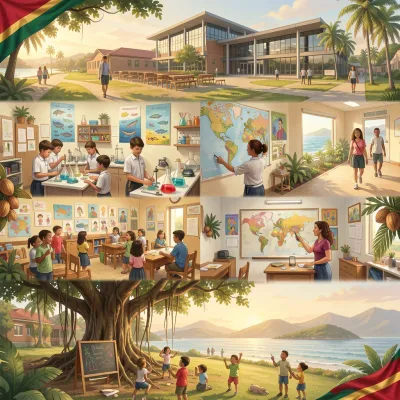
Education in Grenada has evolved from informal indigenous knowledge transmission through colonial missionary schools to a modern, government‑overseen system that blends public, grant‑aided, and private institutions. Early childhood education is guided by Ministry standards and emphasizes play‑based, culturally relevant learning; primary education follows a National Primary Curriculum that balances literacy, numeracy, science, social studies, arts, and health and family life, with assessment moving from high‑stakes exams to the holistic Caribbean Primary Exit Assessment. Secondary education offers a junior cycle of broad exposure and a senior cycle allowing specialization for the Caribbean Secondary Education Certificate (CAPE) and Caribbean Advanced Proficiency Examination (CAPE), while vocational and technical pathways are centred at the T.A. Marryshow Community College (TAMCC) and linked to industry needs. Higher education is provided by TAMCC, the private international St. George’s University, and the University of the West Indies Open Campus, offering associate degrees, diplomas, and pathways to bachelor’s and postgraduate studies.
Curriculum delivery stresses child‑centered, inquiry‑based methods, with play, storytelling, local culture, and outdoor exploration integral to preschools, and increasing use of ICT, project‑based learning, and differentiated instruction across levels. Teacher preparation begins at TAMCC, continues through in‑service training on inclusive education, technology integration, and leadership, and is supported by mentorship and regional partnerships. Assessment combines continuous school‑based work with regional examinations (CPEA, CSEC, CAPE) and School‑Based Assessments that reduce reliance on single high‑stakes tests. Special education needs are addressed through a shift toward inclusion, individualized education plans, resource teachers, assistive technology, and growing emphasis on early identification and support. Technology integration efforts focus on expanding internet access, interactive whiteboards, tablets, and online learning platforms, accelerated by the COVID‑19 pandemic, while ongoing challenges include equitable resource distribution, teacher retention, infrastructure vulnerability to hurricanes, and financing constraints.
The system benefits from strong community involvement—parent‑teacher associations, local businesses, NGOs, and international organizations such as UNESCO, UNICEF, the World Bank, and regional bodies like the OECS and CXC—providing funding, expertise, advocacy, and programs ranging from literacy campaigns to vocational apprenticeships. Innovations include curriculum reforms that embed 21st‑century skills, health and family life education, climate change resilience, entrepreneurship training, and data‑driven management through an evolving Educational Management Information System. Education contributes to national development by supplying a skilled workforce, reducing poverty, fostering entrepreneurship, improving public health, strengthening democratic participation, preserving culture, and supporting research. Ongoing challenges revolve around funding, equitable access, brain drain, and disaster resilience, but future prospects point to deeper technology integration, blended learning, expanded vocational‑industry linkages, heightened focus on inclusive practices and student well‑being, and sustained regional and international collaboration to ensure Grenada’s education system remains responsive, inclusive, and aligned with national development goals.
What You'll Find Inside:
- Explores the historical evolution of Grenada's education system, from indigenous knowledge systems and colonial foundations to post-independence reforms and the transformative Grenada Revolution (1979-1983).
- Provides an in-depth analysis of early childhood education structures, pedagogical approaches in preschools, and the Ministry of Education's standards for holistic child development.
- Details primary and secondary education frameworks, including curriculum design, teacher training programs at TAMCC, and the role of community and parental involvement in student success.
- Examines vocational and technical education pathways, higher education institutions like TAMCC and St. George's University, and efforts to enhance access and equity in tertiary education.
- Addresses critical challenges such as resource limitations, technology integration, and inclusive practices, alongside innovations and future strategies for Grenada's education system in a globalized world.
Who's It For:
This book is essential for educators, policymakers, and researchers focused on education in small island developing states, offering a comprehensive overview of Grenada's system from early childhood to higher education. It provides actionable insights into curriculum design, teacher training, and community engagement strategies. Students, parents, and NGOs invested in educational development will also benefit from its detailed analysis of challenges, innovations, and comparative Caribbean models. The book is particularly valuable for those seeking to understand how Grenada balances local cultural identity with global educational trends.
Table of Contents:
- Introduction
- Chapter 1: Historical Foundations of Grenadian Education
- Chapter 2: The Structure of Early Childhood Education in Grenada
- Chapter 3: Pedagogical Approaches in Grenadian Preschools
- Chapter 4: Primary Education: Curriculum and Standards
- Chapter 5: Teacher Training and Development for Primary Schools
- Chapter 6: The Role of Community in Primary Education
- Chapter 7: Secondary Education: Stages and Specializations
- Chapter 8: Vocational and Technical Education Pathways
- Chapter 9: Integrating Technology in Grenadian Classrooms
- Chapter 10: Special Education Needs and Inclusive Practices
- Chapter 11: Assessment and Examination Systems
- Chapter 12: Higher Education Institutions in Grenada
- Chapter 13: Access and Equity in Higher Education
- Chapter 14: Funding and Financing of Education
- Chapter 15: Education Policy and Governance
- Chapter 16: Challenges Facing the Grenadian Education System
- Chapter 17: Innovations and Reforms in Education
- Chapter 18: The Impact of Global Trends on Local Education
- Chapter 19: Adult Education and Lifelong Learning Initiatives
- Chapter 20: The Role of NGOs and International Organizations
- Chapter 21: Education's Contribution to National Development
- Chapter 22: Future Prospects for Grenadian Education
- Chapter 23: Case Studies of Successful Educational Programs
- Chapter 24: Parental Involvement in the Educational Process
- Chapter 25: A Comparative Look at Caribbean Education Models
Author:
Published By:
Date Published:
June 26, 2026
Type:
Nonfiction
Language:
English
Word Count:
44,197 words
Reading Time:
3 hours 6 minutes
Sample:
Order:
Order Education In Grenada (Hardcover) on MixCache.com:
Buy NowPrint copy is made to order and ships worldwide. Includes the ebook free, ready to read instantly.
$5 account credit for all new MixCache.com accounts, usable toward any ebook purchase!*