Browse by Category
Fiction
- Action & Adventure
- African American
- Anthologies
- Children's Fiction
- Classics
- Comics & Graphic Novels
- Coming of Age
- Contemporary
- Cultural & Regional
- Drama
- Erotica
- Fantasy
- General
- Historical Fiction
- Horror
- Humor & Satire
- Literary Fiction
- Mystery, Thriller & Suspense
- Poetry
- Religious & Inspirational
- Romance
- Science Fiction
- Short Stories
- War & Military
- Westerns
- Women's Fiction
- Young Adult
Non-Fiction
- Antiques & Collectibles
- Arts & Photography
- Biographies & Memoirs
- Business & Money
- Children's Non-Fiction
-
Computers & Technology
- Artificial Intelligence
- Computer Science
- Cybersecurity & Cryptography
- Data Science & Analytics
- Databases & Big Data
- Game Development & Design
- General
- Hardware & DIY
- Mobile App Development
- Networking & Cloud Computing
- Operating Systems
- Programming
- Robotics
- Software
- Software Engineering
- User Experience (UX) & Design
- Web Development & Design
- Cooking, Food & Wine
- Crafts, Hobbies & Home
- Education & Teaching
- Engineering
- General
- Health, Fitness & Dieting
-
History
- African History
- African History - North Africa
- African History - Sub-Saharan Africa
- American History
- American History - 20th Century
- American History - Civil War
- American History - Colonial Period
- Ancient History
- Asian History
- Asian History - China
- Asian History - India
- Asian History - Japan
- Asian History - Southeast Asia
- European History
- European History - Ancient Greece
- European History - Ancient Rome
- European History - Medieval
- European History - Modern
- European History - Renaissance
- General
- Middle Eastern History
- Military History
- Military History - Aviation
- Military History - Naval
- Social & Cultural History
- World History
- Humor & Entertainment
- Industrial Technology
- Language Learning
- Law
- LGBTQ+ Non-Fiction
- Literary Criticism
- Medical Books
- Parenting & Relationships
- Philosophy
- Politics & Social Sciences
- Reference
- Religion & Spirituality
-
Science & Math
- Agricultural Sciences
- Astronomy & Space Science
- Behavioral Sciences
- Biological Sciences
- Botany & Plant Science
- Chemistry
- Earth Sciences
- Engineering - Chemical
- Engineering - Civil
- Engineering - Electrical
- Engineering - Mechanical
- Environment
- General
- Geology
- Mathematics
- Nature & Ecology
- Oceanography
- Paleontology
- Physics
- Statistics
- Self-Help
- Sports & Outdoors
- Study Aids
- Sustainability & Green Living
- Textbooks
- Transportation
- Travel
- True Crime
- Urban Planning & Development
- Veterinary Medicine
- Writing & Publishing
Jump to Section

Want unlimited access to all books published by MixCache.com (plus their audiobooks)? Try MixCache.com Total Access. Look for the MTA badge on book covers to identify included titles.
Access to infinite ebooks: Don't see the book you want? Suggest it and we'll create it (free!) for you from scratch with our powerful AI book writer. Then read it with MTA - besides profiting from any sales it makes!
Education In Indonesia
MTA
A Comprehensive Overview from Early Childhood to Higher Education
About this book:
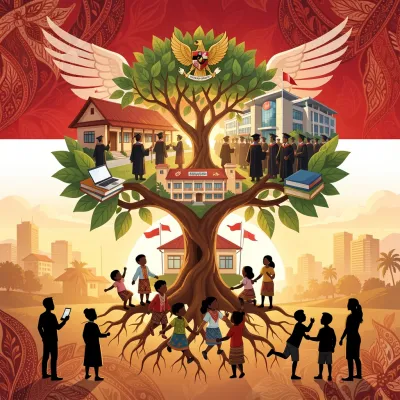
This book provides a comprehensive overview of Indonesia's education system, charting its historical evolution from pre-colonial times through the post-independence era and into the 21st century. It details the foundational philosophy rooted in Pancasila and the 1945 Constitution, which aims to develop well-rounded citizens who are morally upright, intellectually capable, and socially responsible. The system is structured into a 6-3-3-4 model, encompassing early childhood education (PAUD), six years of primary school, three years each of junior and senior secondary school, and at least four years of higher education. Governance is shared among three key ministries: the Ministry of Primary and Secondary Education, the Ministry of Higher Education, Science, and Technology, and the Ministry of Religious Affairs, which oversees Islamic education.
The book delves into the unique roles of different educational levels and types, such as vocational schools (SMK) and the deeply rooted Islamic education systems of *pesantren* and *madrasah*. It highlights the significant challenges the system faces, including vast regional disparities in access and quality, a shortage of qualified teachers—especially in remote areas—and the complex task of balancing national unity with the preservation of local cultures and languages. The ongoing implementation of the Merdeka Curriculum represents a major reform effort, designed to foster more flexible, student-centered, and competency-based learning, with a strong emphasis on character development through the Pancasila Learner Profile Strengthening Project (P5).
Further chapters explore critical contemporary issues such as the integration of technology and the digital divide, the push for inclusive education for diverse learners, and the impact of globalization on curriculum and language policy. The book also examines the vital roles of accreditation, teacher professional development, and community involvement in education. It concludes by looking at future directions, emphasizing a continued focus on improving educational quality, equity, and relevance to prepare Indonesia's youth for the demands of a rapidly changing world, all while staying true to the nation's foundational values.
What You'll Find Inside:
- The book traces Indonesia's educational evolution from pre-colonial indigenous learning systems through Dutch colonial policies to post-independence reforms, explaining how historical forces shaped today's structure.
- It details how Pancasila philosophy and the 1945 Constitution form the ideological foundation of Indonesian education, influencing curriculum design, assessment, and character development initiatives like the Pancasila Learner Profile Strengthening Project.
- Readers gain insight into Indonesia's dual education system, including the pesantren (Islamic boarding schools) and madrasah systems under the Ministry of Religious Affairs operating alongside secular schools overseen by the Ministry of Education.
- The book analyzes major contemporary reforms such as the Merdeka Curriculum (emphasizing flexible, student-centered learning) and Kampus Merdeka (providing university students with independent learning pathways), explaining their implementation challenges and potential impacts.
- It examines critical ongoing issues including geographic disparities in educational quality, teacher quality and distribution challenges, inclusive education for diverse learners, and efforts to integrate technology and education for sustainable development across the archipelago.
Who's It For:
This book is essential reading for educators, educational policymakers, and researchers seeking to understand Indonesia's complex education system. It will also benefit international development professionals, university students studying comparative education, and anyone interested in how nations balance national identity with global educational standards while addressing equity challenges in diverse, archipelagic contexts.
Author:
Published By:
Date Published:
June 25, 2026
Type:
Nonfiction
Language:
English
Word Count:
47,468 words
Reading Time:
3 hours 19 minutes
Sample:
Order:
Order Education In Indonesia (Hardcover) on MixCache.com:
Buy NowPrint copy is made to order and ships worldwide. Includes the ebook free, ready to read instantly.
$5 account credit for all new MixCache.com accounts, usable toward any ebook purchase!*