Browse by Category
Fiction
- Action & Adventure
- African American
- Anthologies
- Children's Fiction
- Classics
- Comics & Graphic Novels
- Coming of Age
- Contemporary
- Cultural & Regional
- Drama
- Erotica
- Fantasy
- General
- Historical Fiction
- Horror
- Humor & Satire
- Literary Fiction
- Mystery, Thriller & Suspense
- Poetry
- Religious & Inspirational
- Romance
- Science Fiction
- Short Stories
- War & Military
- Westerns
- Women's Fiction
- Young Adult
Non-Fiction
- Antiques & Collectibles
- Arts & Photography
- Biographies & Memoirs
- Business & Money
- Children's Non-Fiction
-
Computers & Technology
- Artificial Intelligence
- Computer Science
- Cybersecurity & Cryptography
- Data Science & Analytics
- Databases & Big Data
- Game Development & Design
- General
- Hardware & DIY
- Mobile App Development
- Networking & Cloud Computing
- Operating Systems
- Programming
- Robotics
- Software
- Software Engineering
- User Experience (UX) & Design
- Web Development & Design
- Cooking, Food & Wine
- Crafts, Hobbies & Home
- Education & Teaching
- Engineering
- General
- Health, Fitness & Dieting
-
History
- African History
- African History - North Africa
- African History - Sub-Saharan Africa
- American History
- American History - 20th Century
- American History - Civil War
- American History - Colonial Period
- Ancient History
- Asian History
- Asian History - China
- Asian History - India
- Asian History - Japan
- Asian History - Southeast Asia
- European History
- European History - Ancient Greece
- European History - Ancient Rome
- European History - Medieval
- European History - Modern
- European History - Renaissance
- General
- Middle Eastern History
- Military History
- Military History - Aviation
- Military History - Naval
- Social & Cultural History
- World History
- Humor & Entertainment
- Industrial Technology
- Language Learning
- Law
- LGBTQ+ Non-Fiction
- Literary Criticism
- Medical Books
- Parenting & Relationships
- Philosophy
- Politics & Social Sciences
- Reference
- Religion & Spirituality
-
Science & Math
- Agricultural Sciences
- Astronomy & Space Science
- Behavioral Sciences
- Biological Sciences
- Botany & Plant Science
- Chemistry
- Earth Sciences
- Engineering - Chemical
- Engineering - Civil
- Engineering - Electrical
- Engineering - Mechanical
- Environment
- General
- Geology
- Mathematics
- Nature & Ecology
- Oceanography
- Paleontology
- Physics
- Statistics
- Self-Help
- Sports & Outdoors
- Study Aids
- Sustainability & Green Living
- Textbooks
- Transportation
- Travel
- True Crime
- Urban Planning & Development
- Veterinary Medicine
- Writing & Publishing
Jump to Section

Want unlimited access to all books published by MixCache.com (plus their audiobooks)? Try MixCache.com Total Access. Look for the MTA badge on book covers to identify included titles.
Access to infinite ebooks: Don't see the book you want? Suggest it and we'll create it (free!) for you from scratch with our powerful AI book writer. Then read it with MTA - besides profiting from any sales it makes!
Education In Ethiopia
MTA
A Comprehensive Overview from Early Childhood to Higher Education
About this book:
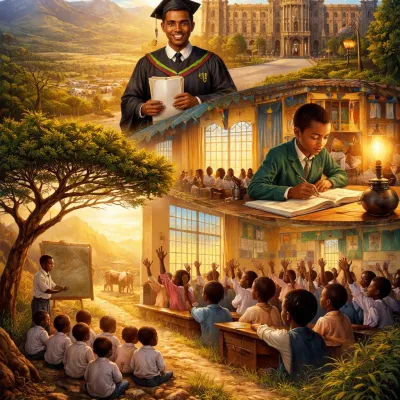
Education in Ethiopia traces its origins to ancient religious institutions, primarily the Ethiopian Orthodox Tewahedo Church and Islamic schools, which for centuries served as the sole providers of formal learning, emphasizing literacy in Ge'ez and Arabic, theological study, and cultural transmission through rigorous memorization and apprenticeship models. The advent of modern secular education began in the early 20th century under emperors Menelik II and Haile Selassie I, introducing Western curricula, foreign languages, and centralized administration, albeit facing initial resistance and reliance on expatriate teachers. The 1974 revolution and subsequent Derg era politicized education, while the 1994 Education and Training Policy (ETP) marked a pivotal shift toward decentralization, mother-tongue instruction in early primary grades, competency-based learning, and explicit commitments to equity, quality, and relevance across all levels, setting the stage for expansive but uneven growth.
The system continues to grapple with profound challenges despite significant progress in access. Primary education enrollment has surged, yet quality remains hampered by teacher shortages, inadequate materials, overcrowded classrooms, and uneven implementation of mother-tongue policies. Secondary education faces bottlenecks in transition rates, gender disparities widening at higher levels, curriculum relevance concerns, and the high-stakes Ethiopian University Entrance Examination (EUEE) promoting rote learning. Technical and Vocational Education and Training (TVET) struggles with perception and funding despite its competency-based focus on market-driven skills. Higher education has expanded rapidly to over 40 public universities but contends with faculty shortages, resource constraints, quality assurance difficulties, and brain drain. Cross-cutting issues include persistent rural-urban and gender disparities, special needs inclusion gaps, language-of-instruction complexities, financing inequities, and the struggle to align education with employment needs amid youth unemployment. Infrastructure deficits, particularly in rural and pastoralist regions, and the impact of technology integration barriers further complicate efforts.
Current and future reforms, guided by the Education Roadmap 2018-2030 and new curriculum frameworks, prioritize strengthening early childhood care, enhancing primary education quality through teacher development and relevant learning materials, diversifying secondary pathways with practical and STEM focus, elevating TVET's status via industry linkages, and boosting higher education research excellence and accountability through the Education & Training Authority (ETA). Key strategies include investing in teacher training and professional development, expanding mother-tongue instruction with adequate resources, leveraging technology for access and quality while addressing literacy and infrastructure gaps, intensifying gender-responsive interventions, adopting context-specific approaches for pastoralist communities, improving assessment balance to reduce high-stakes pressure, deepening private sector and NGO collaboration under national ownership, and pursuing sustainable financing. The overarching vision is to transform Ethiopia's education system into an equitable, relevant, and quality-driven engine for inclusive growth, social cohesion, and national prosperity in the 21st century.
What You'll Find Inside:
- Historical and Traditional Foundations: The book traces the evolution of Ethiopian education from ancient church and mosque schools to modern secular systems, highlighting the enduring influence of Ge'ez, Amharic, and indigenous knowledge on contemporary learning structures.
- Structural Overview of the Education System: It provides a comprehensive analysis of all educational levels—from early childhood care and education (ECCE) through primary, secondary, technical and vocational training (TVET), to higher education—examining access, curriculum, quality, and governance.
- Equity, Inclusion, and Marginalized Populations: Critical attention is given to gender disparities, girls’ education, special needs education, and the challenges of delivering quality education in rural, pastoralist, and emerging regions, with an emphasis on inclusive policies and targeted interventions.
- Policy, Governance, and Financing: The text explores the formulation and implementation of national education policies, decentralization of governance, financing mechanisms, and the roles of NGOs and international donors in shaping educational development and reform.
- Contemporary Challenges and Future Directions: The book addresses pressing issues such as teacher quality, language of instruction, examination systems, technology integration, and labor market alignment, while outlining strategic reforms and a vision for the future of Ethiopian education through 2030.
Who's It For:
This book is intended for policymakers, educators, researchers, and development practitioners interested in understanding the complexities of Ethiopia’s education system. It serves as a valuable resource for those involved in educational planning, reform, and international development, as well as graduate students and academics studying African education, comparative education policy, or sustainable development. Its detailed analysis makes it particularly useful for individuals seeking both historical context and forward-looking insights into one of Africa’s most dynamic and rapidly evolving educational landscapes.
Author:
Published By:
Date Published:
June 25, 2026
Type:
Nonfiction
Language:
English
Word Count:
44,167 words
Reading Time:
3 hours 6 minutes
Sample:
Order:
Order Education In Ethiopia (Hardcover) on MixCache.com:
Buy NowPrint copy is made to order and ships worldwide. Includes the ebook free, ready to read instantly.
$5 account credit for all new MixCache.com accounts, usable toward any ebook purchase!*