
Browse by Category
Fiction
- Action & Adventure
- African American
- Anthologies
- Children's Fiction
- Classics
- Comics & Graphic Novels
- Coming of Age
- Contemporary
- Cultural & Regional
- Drama
- Erotica
- Fantasy
- General
- Historical Fiction
- Horror
- Humor & Satire
- Literary Fiction
- Mystery, Thriller & Suspense
- Poetry
- Religious & Inspirational
- Romance
- Science Fiction
- Short Stories
- War & Military
- Westerns
- Women's Fiction
- Young Adult
Non-Fiction
- Antiques & Collectibles
- Arts & Photography
- Biographies & Memoirs
- Business & Money
- Children's Non-Fiction
-
Computers & Technology
- Artificial Intelligence
- Computer Science
- Cybersecurity & Cryptography
- Data Science & Analytics
- Databases & Big Data
- Game Development & Design
- General
- Hardware & DIY
- Mobile App Development
- Networking & Cloud Computing
- Operating Systems
- Programming
- Robotics
- Software
- Software Engineering
- User Experience (UX) & Design
- Web Development & Design
- Cooking, Food & Wine
- Crafts, Hobbies & Home
- Education & Teaching
- Engineering
- General
- Health, Fitness & Dieting
-
History
- African History
- African History - North Africa
- African History - Sub-Saharan Africa
- American History
- American History - 20th Century
- American History - Civil War
- American History - Colonial Period
- Ancient History
- Asian History
- Asian History - China
- Asian History - India
- Asian History - Japan
- Asian History - Southeast Asia
- European History
- European History - Ancient Greece
- European History - Ancient Rome
- European History - Medieval
- European History - Modern
- European History - Renaissance
- General
- Middle Eastern History
- Military History
- Military History - Aviation
- Military History - Naval
- Social & Cultural History
- World History
- Humor & Entertainment
- Industrial Technology
- Language Learning
- Law
- LGBTQ+ Non-Fiction
- Literary Criticism
- Medical Books
- Parenting & Relationships
- Philosophy
- Politics & Social Sciences
- Reference
- Religion & Spirituality
-
Science & Math
- Agricultural Sciences
- Astronomy & Space Science
- Behavioral Sciences
- Biological Sciences
- Botany & Plant Science
- Chemistry
- Earth Sciences
- Engineering - Chemical
- Engineering - Civil
- Engineering - Electrical
- Engineering - Mechanical
- Environment
- General
- Geology
- Mathematics
- Nature & Ecology
- Oceanography
- Paleontology
- Physics
- Statistics
- Self-Help
- Sports & Outdoors
- Study Aids
- Sustainability & Green Living
- Textbooks
- Transportation
- Travel
- True Crime
- Urban Planning & Development
- Veterinary Medicine
- Writing & Publishing
Jump to Section

Want unlimited access to all books published by MixCache.com (plus their audiobooks)? Try MixCache.com Total Access. Look for the MTA badge on book covers to identify included titles.
Access to infinite ebooks: Don't see the book you want? Suggest it and we'll create it (free!) for you from scratch with our powerful AI book writer. Then read it with MTA - besides profiting from any sales it makes!
Education In Estonia
MTA
A Comprehensive Overview from Early Childhood to Higher Education
About this book:
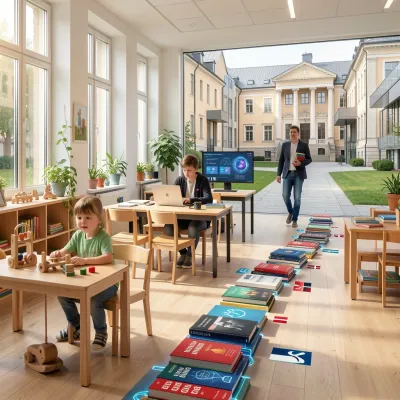
Estonia's educational system, spanning early childhood to higher education, is founded on historical principles of equity, accessibility, teacher respect, learner-centered approaches, digital literacy, and professional autonomy. Shaped by centuries of struggle for national identity and independence, particularly the post-Soviet reforms of 1991, the system prioritizes providing high-quality, free education to all children regardless of background or location. This commitment is evident in universally accessible, state-funded early childhood education focusing on play-based development, a nine-year basic education structure (grades 1-9) building foundational competencies through integrated, child-centered learning, and a curriculum emphasizing eight key transversal competencies like digital competence, learning to learn, and social civic skills alongside traditional subjects.
Assessment in Estonian basic education prioritizes formative feedback and developmental portfolios over high-stakes testing, with national examinations at the end of grade 9 serving as one factor among many for guiding upper secondary pathways. Upper secondary education offers two main routes: academically oriented gymnasiums (grades 10-12) featuring compulsory subjects, flexible electives, and rigorous state examinations for university access, and respected Vocational Education and Training (VET) programs closely aligned with industry needs through work-based learning and practical competencies. Throughout all levels, digital technology is seamlessly integrated as a core competence, not merely an add-on, supported by initiatives like Tiigrihüpe (Tiger Leap) and ProgeTiger, while inclusive education principles ensure individualized support for students with special needs within mainstream settings whenever possible.
Higher education operates under a binary structure of research-focused universities and professionally oriented institutions, aligned with the Bologna Process. Access is largely merit-based via state examinations, with tuition-free study places for Estonian and EU/EEA citizens in Estonian-taught programs contingent on academic progress, supplemented by needs-based allowances and loans. Estonia's universities are strong hubs of research and development, particularly in ICT, biomedicine, and digital governance, while lifelong learning initiatives robustly support adult upskilling and reskilling. The system's success, reflected in consistently high PISA results demonstrating excellence and equity, stems from a governance model balancing national frameworks with significant local and institutional autonomy, substantial investment in teacher education (requiring master's degrees) and continuous professional development, and a societal culture that deeply values education as a cornerstone of national development and personal fulfillment. Ongoing challenges include demographic shifts, teacher workload, linguistic integration, and maintaining relevance amid rapid technological change, met with continuous policy refinement and innovation in educational technology.
What You'll Find Inside:
- Comprehensive overview of Estonia's educational structure from early childhood to higher education, including historical context and guiding principles.
- In-depth analysis of the integration of digital technology in Estonian schools, highlighting its role in pedagogy, curriculum, and research.
- Examination of inclusive education practices and support systems for students with special educational needs across all levels.
- Detailed insights into teacher education, professional development, and the societal respect for the teaching profession in Estonia.
- Exploration of vocational education, higher education pathways, and the impact of PISA results on national educational strategies.
Who's It For:
This book is essential for educators, policymakers, and education administrators seeking to understand Estonia's educational success, particularly those interested in digital integration, inclusive practices, and teacher development. It also benefits researchers and stakeholders looking to adopt innovative educational models proven to enhance student outcomes and global competitiveness.
Author:
Published By:
Date Published:
June 24, 2026
Type:
Nonfiction
Language:
English
Word Count:
42,098 words
Reading Time:
2 hours 57 minutes
Sample:
MixCache.com Total Access
Get unlimited access to this book + all books published by MixCache.com for $11.99/month
Subscribe to MTAOr purchase this book individually below
Order:
Buy the Education In Estonia ebook on MixCache.com:
Buy Now
Full ebook will be available immediately
- read online or download as a PDF file.
$5 account credit for all new MixCache.com accounts, usable toward any ebook purchase!*




Ratings & Reviews
Ask Questions About This Book
Have a question about the content? Ask our AI assistant!
Start by asking a question about "Education In Estonia"
Example: "Does this book mention William Shakespeare?"
Thinking...