Browse by Category
Fiction
- Action & Adventure
- African American
- Anthologies
- Children's Fiction
- Classics
- Comics & Graphic Novels
- Coming of Age
- Contemporary
- Cultural & Regional
- Drama
- Erotica
- Fantasy
- General
- Historical Fiction
- Horror
- Humor & Satire
- Literary Fiction
- Mystery, Thriller & Suspense
- Poetry
- Religious & Inspirational
- Romance
- Science Fiction
- Short Stories
- War & Military
- Westerns
- Women's Fiction
- Young Adult
Non-Fiction
- Antiques & Collectibles
- Arts & Photography
- Biographies & Memoirs
- Business & Money
- Children's Non-Fiction
-
Computers & Technology
- Artificial Intelligence
- Computer Science
- Cybersecurity & Cryptography
- Data Science & Analytics
- Databases & Big Data
- Game Development & Design
- General
- Hardware & DIY
- Mobile App Development
- Networking & Cloud Computing
- Operating Systems
- Programming
- Robotics
- Software
- Software Engineering
- User Experience (UX) & Design
- Web Development & Design
- Cooking, Food & Wine
- Crafts, Hobbies & Home
- Education & Teaching
- Engineering
- General
- Health, Fitness & Dieting
-
History
- African History
- African History - North Africa
- African History - Sub-Saharan Africa
- American History
- American History - 20th Century
- American History - Civil War
- American History - Colonial Period
- Ancient History
- Asian History
- Asian History - China
- Asian History - India
- Asian History - Japan
- Asian History - Southeast Asia
- European History
- European History - Ancient Greece
- European History - Ancient Rome
- European History - Medieval
- European History - Modern
- European History - Renaissance
- General
- Middle Eastern History
- Military History
- Military History - Aviation
- Military History - Naval
- Social & Cultural History
- World History
- Humor & Entertainment
- Industrial Technology
- Language Learning
- Law
- LGBTQ+ Non-Fiction
- Literary Criticism
- Medical Books
- Parenting & Relationships
- Philosophy
- Politics & Social Sciences
- Reference
- Religion & Spirituality
-
Science & Math
- Agricultural Sciences
- Astronomy & Space Science
- Behavioral Sciences
- Biological Sciences
- Botany & Plant Science
- Chemistry
- Earth Sciences
- Engineering - Chemical
- Engineering - Civil
- Engineering - Electrical
- Engineering - Mechanical
- Environment
- General
- Geology
- Mathematics
- Nature & Ecology
- Oceanography
- Paleontology
- Physics
- Statistics
- Self-Help
- Sports & Outdoors
- Study Aids
- Sustainability & Green Living
- Textbooks
- Transportation
- Travel
- True Crime
- Urban Planning & Development
- Veterinary Medicine
- Writing & Publishing
Jump to Section

Want unlimited access to all books published by MixCache.com (plus their audiobooks)? Try MixCache.com Total Access. Look for the MTA badge on book covers to identify included titles.
Access to infinite ebooks: Don't see the book you want? Suggest it and we'll create it (free!) for you from scratch with our powerful AI book writer. Then read it with MTA - besides profiting from any sales it makes!
Education In Chad
MTA
A Comprehensive Overview from Early Childhood to Higher Education
About this book:
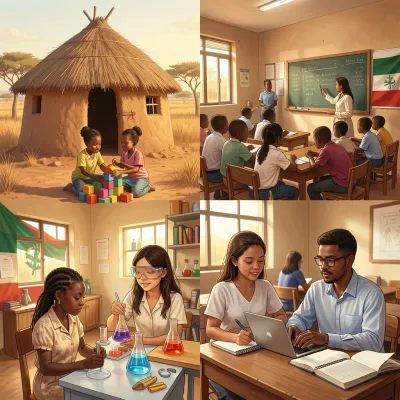
Education in Chad is a multifaceted system shaped by its colonial history, cultural diversity, and ongoing developmental challenges. The educational framework spans from early childhood care and primary schooling to secondary, technical/vocational, and higher education, with French and Arabic serving as official languages of instruction. However, the legacy of French colonialism left a system that prioritizes urban centers and French-language instruction, often marginalizing rural populations and indigenous languages. Despite government efforts to expand access and improve quality, the system grapples with inadequate infrastructure, a shortage of trained teachers, and high dropout rates, particularly in rural and conflict-affected regions. The curriculum, while aiming for relevance, struggles to balance local needs with standardized national requirements, exacerbating educational inequalities.
Geographic and socioeconomic disparities starkly define access and outcomes in Chad's education system. Rural areas face severe shortages of schools, learning materials, and qualified teachers, while urban regions benefit from better-resourced institutions. Poverty forces many children, especially girls, to abandon schooling for labor or early marriage, perpetuating cycles of disadvantage. Gender gaps widen at higher educational levels due to cultural norms and safety concerns, and children with disabilities encounter significant barriers to inclusion. The impact of conflict and instability further disrupts schooling, creating "lost generations" and straining resources. NGOs and international partners play a vital role in addressing these gaps, yet their efforts often struggle with sustainability and systemic integration.
Efforts to modernize and improve education in Chad include curriculum reforms, teacher training initiatives, and investments in digital literacy, though progress remains uneven. Technical and Vocational Education and Training (TVET) aims to bridge skills gaps and reduce unemployment, while higher education institutions like the Université de N'Djamena strive to align programs with global standards. Adult literacy and lifelong learning programs seek to empower marginalized populations, recognizing education as a continuous process. However, challenges persist in securing stable funding, aligning education with labor market needs, and building inclusive systems that cater to diverse linguistic and cultural contexts. International aid remains critical but highlights dependency issues that require long-term solutions.
Moving forward, Chad must prioritize equitable resource distribution, multilingual pedagogy, and teacher capacity-building to achieve quality education. Addressing geographic and gender disparities through targeted infrastructure investments, scholarships, and girl-friendly policies is essential. Harnessing technology incrementally, despite infrastructure limitations, could enhance access and learning. Strengthening the link between education and employment via demand-driven TVET and industry partnerships will improve youth outcomes. Sustainable reforms depend on increased domestic funding, robust governance, and coordinated efforts to transform education into a catalyst for national development and social equity.
What You'll Find Inside:
- A comprehensive historical analysis tracing Chad's educational evolution from indigenous learning systems through colonial French-imposed structures to post-independence reforms and current challenges.
- Detailed examination of access disparities across geographic (rural/urban), socioeconomic, gender, and special needs dimensions, revealing how these factors create unequal educational opportunities.
- In-depth exploration of key system components including teacher training quality, curriculum relevance, technical/vocational education (TVET), higher education institutions, and the critical role of NGOs and international partnerships.
- Analysis of persistent challenges such as education financing constraints, impact of conflict and instability on schooling, language of instruction barriers, and student retention/dropout rates across all education levels.
- Future-oriented recommendations for strengthening Chad's education system through strategic investment in foundational learning, curriculum relevance, teacher quality, equitable access, technology integration, and education-employment linkages.
Who's It For:
This book is essential for policymakers and government officials involved in Chad's education sector, educators and administrators working within the system, researchers studying African education or international development, and professionals from NGOs and international aid organizations focused on education in low-income, conflict-affected contexts. It also serves as a valuable resource for university students in education, public policy, or African studies programs seeking to understand the complexities of educational development in Chad.
Author:
Published By:
Date Published:
June 23, 2026
Type:
Nonfiction
Language:
English
Word Count:
41,181 words
Reading Time:
2 hours 53 minutes
Sample:
Order:
Order Education In Chad (Hardcover) on MixCache.com:
Buy NowPrint copy is made to order and ships worldwide. Includes the ebook free, ready to read instantly.
$5 account credit for all new MixCache.com accounts, usable toward any ebook purchase!*