Browse by Category
Fiction
- Action & Adventure
- African American
- Anthologies
- Children's Fiction
- Classics
- Comics & Graphic Novels
- Coming of Age
- Contemporary
- Cultural & Regional
- Drama
- Erotica
- Fantasy
- General
- Historical Fiction
- Horror
- Humor & Satire
- Literary Fiction
- Mystery, Thriller & Suspense
- Poetry
- Religious & Inspirational
- Romance
- Science Fiction
- Short Stories
- War & Military
- Westerns
- Women's Fiction
- Young Adult
Non-Fiction
- Antiques & Collectibles
- Arts & Photography
- Biographies & Memoirs
- Business & Money
- Children's Non-Fiction
-
Computers & Technology
- Artificial Intelligence
- Computer Science
- Cybersecurity & Cryptography
- Data Science & Analytics
- Databases & Big Data
- Game Development & Design
- General
- Hardware & DIY
- Mobile App Development
- Networking & Cloud Computing
- Operating Systems
- Programming
- Robotics
- Software
- Software Engineering
- User Experience (UX) & Design
- Web Development & Design
- Cooking, Food & Wine
- Crafts, Hobbies & Home
- Education & Teaching
- Engineering
- General
- Health, Fitness & Dieting
-
History
- African History
- African History - North Africa
- African History - Sub-Saharan Africa
- American History
- American History - 20th Century
- American History - Civil War
- American History - Colonial Period
- Ancient History
- Asian History
- Asian History - China
- Asian History - India
- Asian History - Japan
- Asian History - Southeast Asia
- European History
- European History - Ancient Greece
- European History - Ancient Rome
- European History - Medieval
- European History - Modern
- European History - Renaissance
- General
- Middle Eastern History
- Military History
- Military History - Aviation
- Military History - Naval
- Social & Cultural History
- World History
- Humor & Entertainment
- Industrial Technology
- Language Learning
- Law
- LGBTQ+ Non-Fiction
- Literary Criticism
- Medical Books
- Parenting & Relationships
- Philosophy
- Politics & Social Sciences
- Reference
- Religion & Spirituality
-
Science & Math
- Agricultural Sciences
- Astronomy & Space Science
- Behavioral Sciences
- Biological Sciences
- Botany & Plant Science
- Chemistry
- Earth Sciences
- Engineering - Chemical
- Engineering - Civil
- Engineering - Electrical
- Engineering - Mechanical
- Environment
- General
- Geology
- Mathematics
- Nature & Ecology
- Oceanography
- Paleontology
- Physics
- Statistics
- Self-Help
- Sports & Outdoors
- Study Aids
- Sustainability & Green Living
- Textbooks
- Transportation
- Travel
- True Crime
- Urban Planning & Development
- Veterinary Medicine
- Writing & Publishing
Jump to Section

Want unlimited access to all books published by MixCache.com (plus their audiobooks)? Try MixCache.com Total Access. Look for the MTA badge on book covers to identify included titles.
Access to infinite ebooks: Don't see the book you want? Suggest it and we'll create it (free!) for you from scratch with our powerful AI book writer. Then read it with MTA - besides profiting from any sales it makes!
Education In Congo
MTA
A Comprehensive Overview from Early Childhood to Higher Education
About this book:
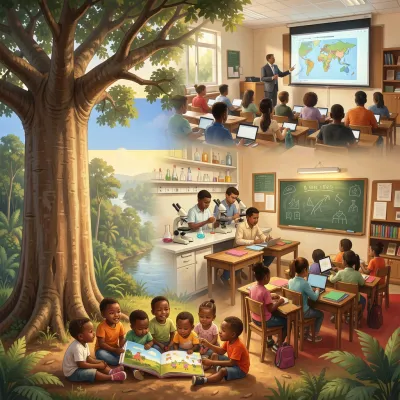
**Summary of "Education In Congo: A Comprehensive Overview from Early Childhood to Higher Education"**
The Democratic Republic of the Congo’s education system, shaped by a complex history of indigenous traditions, Belgian colonial rule, and post-independence struggles, reflects both resilience and systemic challenges. Colonial-era institutions, dominated by missionary schools and focused on utilitarian skills, evolved into a fragmented system overseen by the Ministries of Primary, Secondary, and Vocational Education and Higher Education. The 6-6 structure (six years of primary followed by six years of secondary education) and the 2019 policy of free public primary education mark key developments. However, the system grapples with limited access in rural areas, stark urban-rural disparities, and multilingual challenges, as instruction shifts from indigenous languages to French, creating a linguistic gap in learning outcomes.
Persistent issues include gender disparities, where girls face barriers like early marriage and inadequate sanitation, and insufficient support for children with special needs. Conflict zones, particularly in eastern DRC, severely disrupt education, with schools destroyed, teachers displaced, and students out of class. Funding shortages perpetuate dilapidated infrastructure, inadequate learning materials, and delayed teacher payments, exacerbating inequity. The "brain drain" phenomenon in higher education, driven by low salaries and instability, further undermines academic and professional development, while Technical and Vocational Education and Training (TVET) remains underfunded despite its potential to address youth unemployment.
Innovative initiatives offer hope. NGOs and international partners support emergency education, multilingual programs, and digital learning hubs powered by solar energy, bridging access gaps. Success stories include TVET programs aligned with industry needs, inclusive education models for children with disabilities, and community-led adult literacy efforts. Teacher training emphasizes conflict-sensitive methods and competency-based pedagogy, while partnerships with global organizations foster curriculum reform and digital resource development. However, challenges like inadequate infrastructure and resource allocation continue to hinder progress.
To achieve sustainable development, the book advocates for increased domestic education funding, teacher professionalization, curriculum modernization, and expanded TVET. Strengthening governance, promoting technology integration, and addressing equity through inclusive policies are critical. Education must also serve as a tool for peacebuilding, emphasizing psychosocial support in conflict zones and lifelong learning programs. The recommendations underscore a vision where strategic investments, community empowerment, and global cooperation can transform education into a catalyst for national progress and resilience.
What You'll Find Inside:
- Historical evolution of Congolese education from colonial times to post-independence reforms, highlighting the impact of conflict and instability on educational systems.
- Structure and policies of the Congolese education system, including the 6-6 primary-secondary framework, free primary education initiatives, and the dual ministry governance model.
- Challenges in access, equity, and quality, with focus on rural-urban disparities, gender gaps, language of instruction, and the effects of underfunding and resource shortages.
- Role of NGOs, international aid, and community partnerships in filling gaps in education delivery, especially in emergency settings and conflict-affected regions.
- Innovative approaches to education, including technology integration, inclusive education for children with special needs, and vocational training programs aligned with labor market demands.
Who's It For:
This book is essential for policymakers, educators, development practitioners, and researchers focused on education in the Democratic Republic of Congo. It provides a comprehensive analysis of the nation's educational challenges, including historical legacies, structural reforms, and innovative solutions. The content also benefits NGOs and international partners seeking to understand local contexts, as well as students and academics studying education in conflict-affected or resource-limited environments.
Author:
Published By:
Date Published:
June 22, 2026
Type:
Nonfiction
Language:
English
Word Count:
40,261 words
Reading Time:
2 hours 49 minutes
Sample:
Order:
Order Education In Congo (Hardcover) on MixCache.com:
Buy NowPrint copy is made to order and ships worldwide. Includes the ebook free, ready to read instantly.
$5 account credit for all new MixCache.com accounts, usable toward any ebook purchase!*