Browse by Category
Fiction
- Action & Adventure
- African American
- Anthologies
- Children's Fiction
- Classics
- Comics & Graphic Novels
- Coming of Age
- Contemporary
- Cultural & Regional
- Drama
- Erotica
- Fantasy
- General
- Historical Fiction
- Horror
- Humor & Satire
- Literary Fiction
- Mystery, Thriller & Suspense
- Poetry
- Religious & Inspirational
- Romance
- Science Fiction
- Short Stories
- War & Military
- Westerns
- Women's Fiction
- Young Adult
Non-Fiction
- Antiques & Collectibles
- Arts & Photography
- Biographies & Memoirs
- Business & Money
- Children's Non-Fiction
-
Computers & Technology
- Artificial Intelligence
- Computer Science
- Cybersecurity & Cryptography
- Data Science & Analytics
- Databases & Big Data
- Game Development & Design
- General
- Hardware & DIY
- Mobile App Development
- Networking & Cloud Computing
- Operating Systems
- Programming
- Robotics
- Software
- Software Engineering
- User Experience (UX) & Design
- Web Development & Design
- Cooking, Food & Wine
- Crafts, Hobbies & Home
- Education & Teaching
- Engineering
- General
- Health, Fitness & Dieting
-
History
- African History
- African History - North Africa
- African History - Sub-Saharan Africa
- American History
- American History - 20th Century
- American History - Civil War
- American History - Colonial Period
- Ancient History
- Asian History
- Asian History - China
- Asian History - India
- Asian History - Japan
- Asian History - Southeast Asia
- European History
- European History - Ancient Greece
- European History - Ancient Rome
- European History - Medieval
- European History - Modern
- European History - Renaissance
- General
- Middle Eastern History
- Military History
- Military History - Aviation
- Military History - Naval
- Social & Cultural History
- World History
- Humor & Entertainment
- Industrial Technology
- Language Learning
- Law
- LGBTQ+ Non-Fiction
- Literary Criticism
- Medical Books
- Parenting & Relationships
- Philosophy
- Politics & Social Sciences
- Reference
- Religion & Spirituality
-
Science & Math
- Agricultural Sciences
- Astronomy & Space Science
- Behavioral Sciences
- Biological Sciences
- Botany & Plant Science
- Chemistry
- Earth Sciences
- Engineering - Chemical
- Engineering - Civil
- Engineering - Electrical
- Engineering - Mechanical
- Environment
- General
- Geology
- Mathematics
- Nature & Ecology
- Oceanography
- Paleontology
- Physics
- Statistics
- Self-Help
- Sports & Outdoors
- Study Aids
- Sustainability & Green Living
- Textbooks
- Transportation
- Travel
- True Crime
- Urban Planning & Development
- Veterinary Medicine
- Writing & Publishing
Jump to Section

Want unlimited access to all books published by MixCache.com (plus their audiobooks)? Try MixCache.com Total Access. Look for the MTA badge on book covers to identify included titles.
Access to infinite ebooks: Don't see the book you want? Suggest it and we'll create it (free!) for you from scratch with our powerful AI book writer. Then read it with MTA - besides profiting from any sales it makes!
Education In Côte d'Ivoire
MTA
A Comprehensive Overview from Early Childhood to Higher Education
About this book:
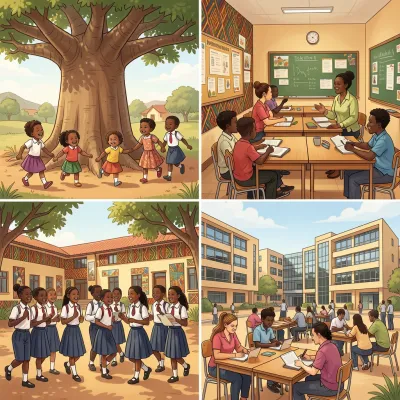
Education in Côte d'Ivoire has evolved from informal, community‑based learning rooted in indigenous traditions and Islamic scholarship to a French‑modeled colonial system designed to serve imperial administrative needs. After independence in 1960, the government expanded access dramatically—particularly through free and compulsory primary education introduced in 2015—while grappling with the legacy of limited infrastructure, teacher shortages, and curriculum misalignment. The system is overseen by multiple ministries: the Ministry of National Education and Literacy manages early childhood, general primary and secondary education; the Ministry of Technical Education, Vocational Training and Apprenticeship handles technical and vocational streams; and the Ministry of Higher Education and Scientific Research directs universities and research. This structure is supported by a legal framework that includes free compulsory education, the 2016‑2025 Education and Training Sector Plan, and various decentralization efforts aimed at improving local governance and accountability.
At the foundational level, early childhood education remains unevenly distributed, with public, private, and community providers offering crèches, nurseries, and preschools that emphasize play‑based, holistic development, though access is limited in rural areas. Primary education has seen near‑universal enrollment, yet challenges persist regarding urban‑rural disparities, indirect costs of schooling, gender gaps, learning outcomes, and teacher distribution. The curriculum blends French‑inherited subjects with local contextualization, moving toward competency‑based learning, and assessment relies on both continuous classroom evaluation and high‑stakes national exams such as the Certificate of Elementary Primary Education (CEPE). Teacher training centers (Écoles Normales d’Instituteurs) and ongoing professional development aim to improve pedagogical practice, but resource constraints and uneven deployment hinder quality, especially in remote regions.
Secondary education splits into a four‑year lower cycle (collège) ending with the BEPC and a three‑year upper cycle (lycée) culminating in the Baccalauréat, with students choosing between general, technical, or vocational streams. Technical and vocational education (VET) programs, overseen by the Ministry of Technical Education, provide industry‑aligned training through diplomas such as the Brevet de Technicien and Baccalauréat Technologique, seeking to bridge skills gaps via apprenticeships and private‑sector partnerships. Transition to higher education is competitive and largely merit‑based, with public universities (including the Félix Houphouët‑Boigny University and regional institutions) offering Licence‑Master‑Doctorat programs, while private institutions expand access in fields like business, IT, and health. Quality assurance is coordinated by the National Authority for Quality Assurance in Higher Education and Research (ANAQES), which accredits programs and institutions, and research priorities focus on agriculture, health, engineering, and socio‑economic issues, albeit constrained by funding, infrastructure, and brain‑drain challenges.
Cross‑cutting themes reveal persistent inequities: gender disparities remain evident in secondary and tertiary STEM participation; inclusive education initiatives strive to integrate children with disabilities and linguistic minorities; rural and underserved areas suffer from inadequate infrastructure, teacher shortages, and economic pressures that push children into labor. Socio‑economic factors—poverty, parental education, household size, and digital access—strongly influence attainment, prompting targeted interventions such as school feeding, conditional cash transfers, and infrastructure projects. Educational technology initiatives are emerging, aiming to narrow the digital divide through offline content, solar‑powered hubs, and mobile learning, though electricity and connectivity remain barriers. Ongoing reforms under the PSE 2025 plan emphasize expanding early childhood access, improving teacher quality and distribution, modernizing curricula with 21st‑century skills, boosting VET‑labor market linkages, increasing higher‑education research capacity, strengthening quality assurance, diversifying financing, and enhancing data‑driven decision‑making. The overarching goal is to build an equitable, high‑quality, and relevant education system that can drive Côte d'Ivoire’s human‑capital development and national prosperity.
What You'll Find Inside:
- Comprehensive historical evolution of Côte d'Ivoire's education system from pre-colonial traditions through French colonial influence to post-independence reforms and modern policy initiatives like free and compulsory education.
- In-depth analysis of structural governance across all levels—early childhood, primary, secondary (general and technical), and higher education—including the roles of multiple ministries, legal frameworks, and quality assurance mechanisms such as ANAQES.
- Critical examination of persistent challenges including urban-rural disparities, gender inequities, teacher shortages, infrastructure deficits, learning poverty, and the impact of socio-economic factors on educational access and attainment.
- Exploration of vocational and technical education (VTE) as a strategic response to labor market needs, alongside innovations in curriculum development, digital learning, and inclusive education for children with disabilities and marginalized groups.
- Forward-looking recommendations for systemic improvement, emphasizing expanded early childhood education, enhanced teacher quality, increased funding, EdTech integration, stronger research capacity, and robust data-driven governance to ensure equitable, high-quality education for all Ivorians.
Who's It For:
This book is essential for policymakers, educators, researchers, and international development practitioners engaged in shaping or understanding education systems in Côte d'Ivoire and similar West African contexts. It is also highly valuable for academics and students in comparative education, African studies, and public policy seeking a detailed, evidence-based overview of educational challenges, reforms, and future directions in a post-colonial developing nation.
Author:
Published By:
Date Published:
June 22, 2026
Type:
Nonfiction
Language:
English
Word Count:
44,918 words
Reading Time:
3 hours 9 minutes
Sample:
Order:
Order Education In Côte d'Ivoire (Paperback) on MixCache.com:
Buy NowPrint copy is made to order and ships worldwide. Includes the ebook free, ready to read instantly.
$5 account credit for all new MixCache.com accounts, usable toward any ebook purchase!*