
Browse by Category
Fiction
- Action & Adventure
- African American
- Anthologies
- Children's Fiction
- Classics
- Comics & Graphic Novels
- Coming of Age
- Contemporary
- Cultural & Regional
- Drama
- Erotica
- Fantasy
- General
- Historical Fiction
- Horror
- Humor & Satire
- Literary Fiction
- Mystery, Thriller & Suspense
- Poetry
- Religious & Inspirational
- Romance
- Science Fiction
- Short Stories
- War & Military
- Westerns
- Women's Fiction
- Young Adult
Non-Fiction
- Antiques & Collectibles
- Arts & Photography
- Biographies & Memoirs
- Business & Money
- Children's Non-Fiction
-
Computers & Technology
- Artificial Intelligence
- Computer Science
- Cybersecurity & Cryptography
- Data Science & Analytics
- Databases & Big Data
- Game Development & Design
- General
- Hardware & DIY
- Mobile App Development
- Networking & Cloud Computing
- Operating Systems
- Programming
- Robotics
- Software
- Software Engineering
- User Experience (UX) & Design
- Web Development & Design
- Cooking, Food & Wine
- Crafts, Hobbies & Home
- Education & Teaching
- Engineering
- General
- Health, Fitness & Dieting
-
History
- African History
- African History - North Africa
- African History - Sub-Saharan Africa
- American History
- American History - 20th Century
- American History - Civil War
- American History - Colonial Period
- Ancient History
- Asian History
- Asian History - China
- Asian History - India
- Asian History - Japan
- Asian History - Southeast Asia
- European History
- European History - Ancient Greece
- European History - Ancient Rome
- European History - Medieval
- European History - Modern
- European History - Renaissance
- General
- Middle Eastern History
- Military History
- Military History - Aviation
- Military History - Naval
- Social & Cultural History
- World History
- Humor & Entertainment
- Industrial Technology
- Language Learning
- Law
- LGBTQ+ Non-Fiction
- Literary Criticism
- Medical Books
- Parenting & Relationships
- Philosophy
- Politics & Social Sciences
- Reference
- Religion & Spirituality
-
Science & Math
- Agricultural Sciences
- Astronomy & Space Science
- Behavioral Sciences
- Biological Sciences
- Botany & Plant Science
- Chemistry
- Earth Sciences
- Engineering - Chemical
- Engineering - Civil
- Engineering - Electrical
- Engineering - Mechanical
- Environment
- General
- Geology
- Mathematics
- Nature & Ecology
- Oceanography
- Paleontology
- Physics
- Statistics
- Self-Help
- Sports & Outdoors
- Study Aids
- Sustainability & Green Living
- Textbooks
- Transportation
- Travel
- True Crime
- Urban Planning & Development
- Veterinary Medicine
- Writing & Publishing
Jump to Section

Want unlimited access to all books published by MixCache.com (plus their audiobooks)? Try MixCache.com Total Access. Look for the MTA badge on book covers to identify included titles.
Access to infinite ebooks: Don't see the book you want? Suggest it and we'll create it (free!) for you from scratch with our powerful AI book writer. Then read it with MTA - besides profiting from any sales it makes!
Education In Burundi
MTA
A Comprehensive Overview from Early Childhood to Higher Education
About this book:
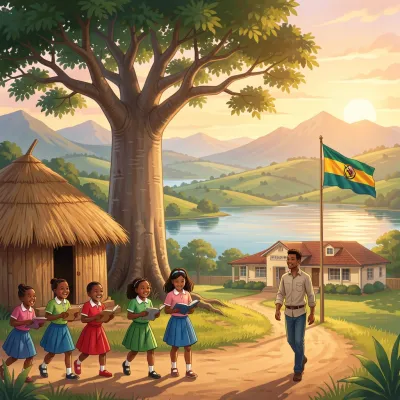
Education in Burundi has evolved from informal indigenous knowledge transmission through colonial missionary schooling to a post‑independence system shaped by periods of reform, conflict, and reconstruction. The Ministry of National Education and Scientific Research steers policy, while provincial directorates, communal inspectorates, and school‑level committees manage implementation. The system comprises early childhood (pre‑primary), six‑year free and compulsory primary education, a four‑year lower secondary cycle (Collège) followed by a three‑year upper secondary cycle (Lycée) that splits into general academic and technical‑vocational streams, and higher education led by the University of Burundi alongside growing public and private institutions. Governance balances central oversight with decentralized delivery, yet capacity constraints and resource gaps often hinder effective policy execution.
Access and quality remain uneven across the country. Free primary education (since 2005) boosted enrollment but strained infrastructure, leading to overcrowded classrooms, teacher shortages, and limited learning materials. Disparities persist along gender lines, especially in upper secondary and higher education where girls are under‑represented in STEM fields, and along the rural‑urban divide, with rural schools suffering from poorer facilities, fewer qualified teachers, and longer distances to school. Socio‑economic factors such as poverty, parental education, health, nutrition, and child labor heavily influence outcomes, while the 1993‑2005 civil war destroyed roughly a quarter of schools, displaced teachers and students, and exacerbated existing inequities. Special needs education and inclusivity are emerging priorities, hampered by a lack of trained specialists, accessible infrastructure, and adequate learning materials.
Recent efforts focus on curriculum reform—emphasizing Kirundization, competency‑based learning, ICT integration, peace education, and gender responsiveness—as well as expanding technical and vocational training to bridge skills gaps, strengthening teacher training and professional development, and leveraging international aid for infrastructure, materials, and capacity building. Success stories include community‑built schools, innovative TVET‑industry partnerships, mobile training units, and localized literacy initiatives. Looking forward, recommendations call for increased domestic financing, equitable access across all levels, continuous teacher quality improvement, robust ICT integration sustained by solar power and connectivity, inclusive education for children with disabilities, strengthened TVET‑private sector linkages, strategies to curb brain drain, and resilient, conflict‑sensitive planning to ensure that Burundi’s education system can support national development and social cohesion.
What You'll Find Inside:
- Comprehensive Historical and Policy Analysis: The book traces the evolution of Burundi's education system from pre-colonial traditions through German and Belgian colonial eras, post-independence reforms, and the devastating impact of the civil war, providing a deep understanding of how historical and political contexts have shaped current educational policies and governance structures.
- In-Depth Exploration of System Structure and Access: It details the entire educational pipeline—from early childhood to higher education—examining enrollment trends, transition bottlenecks, and persistent disparities related to gender, geography (rural vs. urban), and socioeconomic status, offering a holistic view of who gets access to what level of education.
- Critical Challenges and Systemic Barriers: The text identifies major obstacles including inadequate infrastructure, teacher shortages and training gaps, language-of-instruction debates (Kirundi, French, English), brain drain in higher education, and the lingering effects of conflict on educational quality and equity.
- Focus on Inclusion and Marginalized Groups: Special attention is given to gender disparities, special needs education, and non-formal learning pathways for out-of-school youth and adults, highlighting both the challenges and innovative approaches to ensuring education reaches the most vulnerable populations.
- Forward-Looking Recommendations and Innovations: The book showcases success stories and grassroots innovations while offering strategic recommendations for future development, such as increasing domestic financing, integrating technology, strengthening vocational training, and building a more resilient and equitable education system.
Who's It For:
This book is primarily intended for policymakers, educators, researchers, and international development practitioners engaged in educational planning or reform in Burundi and similar post-conflict, low-income contexts. It will also benefit graduate students and academics studying African education systems, comparative education, or development studies, as well as NGO professionals and donor agencies seeking a nuanced, evidence-based understanding of the structural, historical, and socioeconomic factors affecting educational outcomes in Burundi.
Author:
Published By:
Date Published:
June 21, 2026
Type:
Nonfiction
Language:
English
Word Count:
43,835 words
Reading Time:
3 hours 4 minutes
Sample:
MixCache.com Total Access
Get unlimited access to this book + all books published by MixCache.com for $11.99/month
Subscribe to MTAOr purchase this book individually below
Order:
Buy the Education In Burundi ebook on MixCache.com:
Buy Now
Full ebook will be available immediately
- read online or download as a PDF file.
$5 account credit for all new MixCache.com accounts, usable toward any ebook purchase!*



Ratings & Reviews
Ask Questions About This Book
Have a question about the content? Ask our AI assistant!
Start by asking a question about "Education In Burundi"
Example: "Does this book mention William Shakespeare?"
Thinking...