Browse by Category
Fiction
- Action & Adventure
- African American
- Anthologies
- Children's Fiction
- Classics
- Comics & Graphic Novels
- Coming of Age
- Contemporary
- Cultural & Regional
- Drama
- Erotica
- Fantasy
- General
- Historical Fiction
- Horror
- Humor & Satire
- Literary Fiction
- Mystery, Thriller & Suspense
- Poetry
- Religious & Inspirational
- Romance
- Science Fiction
- Short Stories
- War & Military
- Westerns
- Women's Fiction
- Young Adult
Non-Fiction
- Antiques & Collectibles
- Arts & Photography
- Biographies & Memoirs
- Business & Money
- Children's Non-Fiction
-
Computers & Technology
- Artificial Intelligence
- Computer Science
- Cybersecurity & Cryptography
- Data Science & Analytics
- Databases & Big Data
- Game Development & Design
- General
- Hardware & DIY
- Mobile App Development
- Networking & Cloud Computing
- Operating Systems
- Programming
- Robotics
- Software
- Software Engineering
- User Experience (UX) & Design
- Web Development & Design
- Cooking, Food & Wine
- Crafts, Hobbies & Home
- Education & Teaching
- Engineering
- General
- Health, Fitness & Dieting
-
History
- African History
- African History - North Africa
- African History - Sub-Saharan Africa
- American History
- American History - 20th Century
- American History - Civil War
- American History - Colonial Period
- Ancient History
- Asian History
- Asian History - China
- Asian History - India
- Asian History - Japan
- Asian History - Southeast Asia
- European History
- European History - Ancient Greece
- European History - Ancient Rome
- European History - Medieval
- European History - Modern
- European History - Renaissance
- General
- Middle Eastern History
- Military History
- Military History - Aviation
- Military History - Naval
- Social & Cultural History
- World History
- Humor & Entertainment
- Industrial Technology
- Language Learning
- Law
- LGBTQ+ Non-Fiction
- Literary Criticism
- Medical Books
- Parenting & Relationships
- Philosophy
- Politics & Social Sciences
- Reference
- Religion & Spirituality
-
Science & Math
- Agricultural Sciences
- Astronomy & Space Science
- Behavioral Sciences
- Biological Sciences
- Botany & Plant Science
- Chemistry
- Earth Sciences
- Engineering - Chemical
- Engineering - Civil
- Engineering - Electrical
- Engineering - Mechanical
- Environment
- General
- Geology
- Mathematics
- Nature & Ecology
- Oceanography
- Paleontology
- Physics
- Statistics
- Self-Help
- Sports & Outdoors
- Study Aids
- Sustainability & Green Living
- Textbooks
- Transportation
- Travel
- True Crime
- Urban Planning & Development
- Veterinary Medicine
- Writing & Publishing
Jump to Section

Want unlimited access to all books published by MixCache.com (plus their audiobooks)? Try MixCache.com Total Access. Look for the MTA badge on book covers to identify included titles.
Access to infinite ebooks: Don't see the book you want? Suggest it and we'll create it (free!) for you from scratch with our powerful AI book writer. Then read it with MTA - besides profiting from any sales it makes!
Education In Comoros
MTA
A Comprehensive Overview from Early Childhood to Higher Education
About this book:
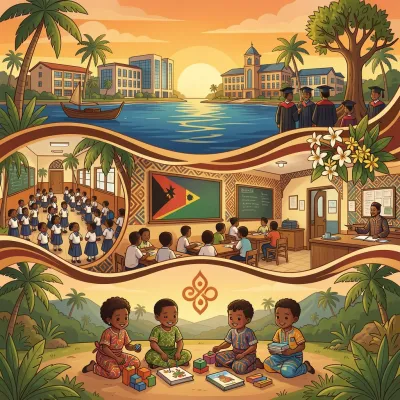
Education in Comoros: A Comprehensive Overview from Early Childhood to Higher Education provides an in-depth examination of the Union of Comoros' educational system, tracing its evolution from pre-colonial Islamic madrasas and French colonial influences to its present structure. The book outlines a system shaped by historical layers—traditional religious education, colonial legacies, and post-independence reforms—that have created a multilingual, multicultural educational framework blending Comorian (Shikomor), Arabic, and French. Governed centrally by the Ministry of National Education, the system spans early childhood, six-year primary education, lower and upper secondary cycles (collège and lycée), and higher education via the University of Comoros, alongside technical and vocational training. Key themes include the integration of Islamic studies, the challenges of a multilingual environment, and efforts toward decolonization and cultural relevance in curricula.
The book highlights persistent challenges in access and quality, particularly rural-urban disparities, inadequate infrastructure, teacher shortages, and resource limitations exacerbated by the island nation’s geographical spread. Early childhood and technical education remain nascent, while secondary education faces issues like overcrowding and language barriers. Gender parity has improved, yet cultural norms and economic pressures still hinder girls’ progression in certain regions. International aid plays a critical role in supplementing funding and expertise, but donor dependency and coordination complexities pose sustainability concerns. Innovations like digital literacy and non-formal education initiatives are emerging, though infrastructure gaps and limited connectivity remain barriers. The "brain drain" of educated Comorians further strains the system, reducing local expertise and talent circulation.
Looking forward, the book emphasizes strategic reforms aimed at sustainability and equity. These include expanding teacher training, modernizing technical education, and integrating technology to bridge geographical divides. Curriculum reforms seek to balance global standards with local cultural and developmental needs, while efforts to enhance infrastructure and community engagement aim to reduce disparities. The University of Comoros is pursuing diversification, research, and international partnerships to position itself as a regional hub. The vision for the future involves fostering lifelong learning, entrepreneurship, and inclusive education for children with special needs, alongside strengthening governance and resource allocation. Ultimately, the book underscores Comoros’ commitment to building an education system that empowers all citizens, rooted in cultural heritage yet responsive to a globalized, technology-driven world.
What You'll Find Inside:
- A comprehensive historical analysis tracing Comorian education from traditional Koranic schools through French colonial influences to post-independence reforms and current challenges
- Detailed examination of the Comorian educational system's structure, governance, and persistent challenges including funding limitations, infrastructure deficits, teacher quality issues, and rural-urban disparities
- In-depth exploration of equity and inclusion efforts focusing on gender parity, education for children with special needs, and bridging the gap between education and employment
- Analysis of critical systemic factors including language of instruction complexities, curriculum development challenges, the impact of culture and religion, and the role of technology in transforming learning
- Forward-looking perspectives on reforms, innovations in higher education, the future of early childhood education, and strategies for building a sustainable and equitable education system
Who's It For:
This book is essential reading for policymakers and education officials in Comoros seeking to understand and improve the national education system. It also serves as a valuable resource for educators, researchers, and international development partners working in or with Comoros who need a comprehensive understanding of the historical context, current challenges, and ongoing reforms. Academics studying education in small island developing states or post-colonial education systems will find particularly relevant insights.
Author:
Published By:
Date Published:
June 20, 2026
Type:
Nonfiction
Language:
English
Word Count:
40,348 words
Reading Time:
2 hours 50 minutes
Sample:
Order:
Order Education In Comoros (Hardcover) on MixCache.com:
Buy NowPrint copy is made to order and ships worldwide. Includes the ebook free, ready to read instantly.
$5 account credit for all new MixCache.com accounts, usable toward any ebook purchase!*