Browse by Category
Fiction
- Action & Adventure
- African American
- Anthologies
- Children's Fiction
- Classics
- Comics & Graphic Novels
- Coming of Age
- Contemporary
- Cultural & Regional
- Drama
- Erotica
- Fantasy
- General
- Historical Fiction
- Horror
- Humor & Satire
- Literary Fiction
- Mystery, Thriller & Suspense
- Poetry
- Religious & Inspirational
- Romance
- Science Fiction
- Short Stories
- War & Military
- Westerns
- Women's Fiction
- Young Adult
Non-Fiction
- Antiques & Collectibles
- Arts & Photography
- Biographies & Memoirs
- Business & Money
- Children's Non-Fiction
-
Computers & Technology
- Artificial Intelligence
- Computer Science
- Cybersecurity & Cryptography
- Data Science & Analytics
- Databases & Big Data
- Game Development & Design
- General
- Hardware & DIY
- Mobile App Development
- Networking & Cloud Computing
- Operating Systems
- Programming
- Robotics
- Software
- Software Engineering
- User Experience (UX) & Design
- Web Development & Design
- Cooking, Food & Wine
- Crafts, Hobbies & Home
- Education & Teaching
- Engineering
- General
- Health, Fitness & Dieting
-
History
- African History
- African History - North Africa
- African History - Sub-Saharan Africa
- American History
- American History - 20th Century
- American History - Civil War
- American History - Colonial Period
- Ancient History
- Asian History
- Asian History - China
- Asian History - India
- Asian History - Japan
- Asian History - Southeast Asia
- European History
- European History - Ancient Greece
- European History - Ancient Rome
- European History - Medieval
- European History - Modern
- European History - Renaissance
- General
- Middle Eastern History
- Military History
- Military History - Aviation
- Military History - Naval
- Social & Cultural History
- World History
- Humor & Entertainment
- Industrial Technology
- Language Learning
- Law
- LGBTQ+ Non-Fiction
- Literary Criticism
- Medical Books
- Parenting & Relationships
- Philosophy
- Politics & Social Sciences
- Reference
- Religion & Spirituality
-
Science & Math
- Agricultural Sciences
- Astronomy & Space Science
- Behavioral Sciences
- Biological Sciences
- Botany & Plant Science
- Chemistry
- Earth Sciences
- Engineering - Chemical
- Engineering - Civil
- Engineering - Electrical
- Engineering - Mechanical
- Environment
- General
- Geology
- Mathematics
- Nature & Ecology
- Oceanography
- Paleontology
- Physics
- Statistics
- Self-Help
- Sports & Outdoors
- Study Aids
- Sustainability & Green Living
- Textbooks
- Transportation
- Travel
- True Crime
- Urban Planning & Development
- Veterinary Medicine
- Writing & Publishing
Jump to Section

Want unlimited access to all books published by MixCache.com (plus their audiobooks)? Try MixCache.com Total Access. Look for the MTA badge on book covers to identify included titles.
Access to infinite ebooks: Don't see the book you want? Suggest it and we'll create it (free!) for you from scratch with our powerful AI book writer. Then read it with MTA - besides profiting from any sales it makes!
Education In Belarus
MTA
A Comprehensive Overview from Early Childhood to Higher Education
About this book:
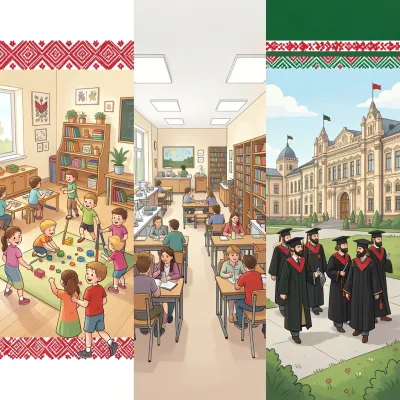
Education in Belarus has evolved from informal, community‑based learning under the Polotsk Principality and Grand Duchy of Lithuania through periods of Russification, Soviet expansion, and post‑independence reforms, resulting in a system that blends historical legacies with modern aspirations. Governance is highly centralized, with the Ministry of Education setting national standards, curricula, and oversight, while regional and local administrations implement policies. Early childhood education (nurseries and kindergartens) provides a holistic, play‑based foundation, and primary education (grades 1‑4) focuses on literacy, numeracy, and basic world knowledge through a uniform, teacher‑centered yet increasingly interactive curriculum.
Secondary education splits at the end of grade 9: students either continue to general secondary education (grades 10‑11) preparing for university via the Centralized Testing system, or enter the Vocational Education and Training (VET) system, which offers trade‑specific programs integrating theory, practice, and industry partnerships. Higher education is delivered through universities, academies, and institutes aligned with the Bologna Process, offering Bachelor’s, Master’s, and Doktor Nauk/Kandidat Nauk degrees; admission hinges on Centralized Testing scores and secondary school GPA, with instruction primarily in Russian but growing Belarusian‑ and English‑language options. Teacher training is rigorous, requiring subject‑specific degrees plus pedagogical preparation, and continuous professional development is mandated through specialized academies and institutes.
The system emphasizes inclusive education, aiming to integrate students with special needs into mainstream classrooms while maintaining specialized schools for more severe disabilities. Extracurricular activities, youth organizations (such as BRSM and BRPO), and a strong focus on Belarusian language and culture foster civic responsibility, national identity, and talent development. ICT is progressively embedded at all levels, from interactive whiteboards in kindergartens to advanced research tools in universities. International cooperation, funding primarily from the state budget, quality assurance via accreditation and inspections, and ongoing reforms addressing labor market relevance, teacher prestige, digital integration, and lifelong learning shape the current landscape. Adult education, private provision (regulated but growing), and future priorities—such as AI‑enhanced learning, industry‑academia partnerships, interdisciplinary curricula, and further internationalization—continue to guide Belarusian education toward a skilled, adaptable, and culturally grounded populace.
What You'll Find Inside:
- The Belarusian education system is highly centralized under the Ministry of Education, ensuring uniform standards and curriculum from early childhood through higher education.
- Students progress through clearly defined stages: early childhood (nurseries/kindergartens), primary (grades 1-4), basic secondary (grades 5-9), general secondary (grades 10-11), with options to pursue vocational training or continue to higher education.
- Higher education follows the Bologna Process, offering Bachelor's, Master's, and Doctoral degrees, with admission primarily based on centralized testing (ЦТ) and substantial state-funded places for academically meritorious students.
- The system emphasizes inclusive education, special support for students with disabilities, integration of Belarusian language and culture, and growing use of ICT across all levels.
- Ongoing reforms target labor market relevance, digital transformation, lifelong learning, and quality assurance while balancing state and private sectors to meet 21st-century challenges.
Who's It For:
This book is designed for educators, researchers, policymakers, and students who need a comprehensive understanding of the Belarusian education system from early childhood to higher education. It will also benefit anyone interested in comparative education, international educational policies, or the specific historical and structural aspects of learning in Belarus. Readers looking for insights into curriculum design, governance, vocational training, higher education admissions, and ongoing reforms will find this resource invaluable.
Author:
Published By:
Date Published:
June 20, 2026
Type:
Nonfiction
Language:
English
Word Count:
39,777 words
Reading Time:
2 hours 47 minutes
Sample:
Order:
Order Education In Belarus (Hardcover) on MixCache.com:
Buy NowPrint copy is made to order and ships worldwide. Includes the ebook free, ready to read instantly.
$5 account credit for all new MixCache.com accounts, usable toward any ebook purchase!*