Browse by Category
Fiction
- Action & Adventure
- African American
- Anthologies
- Children's Fiction
- Classics
- Comics & Graphic Novels
- Coming of Age
- Contemporary
- Cultural & Regional
- Drama
- Erotica
- Fantasy
- General
- Historical Fiction
- Horror
- Humor & Satire
- Literary Fiction
- Mystery, Thriller & Suspense
- Poetry
- Religious & Inspirational
- Romance
- Science Fiction
- Short Stories
- War & Military
- Westerns
- Women's Fiction
- Young Adult
Non-Fiction
- Antiques & Collectibles
- Arts & Photography
- Biographies & Memoirs
- Business & Money
- Children's Non-Fiction
-
Computers & Technology
- Artificial Intelligence
- Computer Science
- Cybersecurity & Cryptography
- Data Science & Analytics
- Databases & Big Data
- Game Development & Design
- General
- Hardware & DIY
- Mobile App Development
- Networking & Cloud Computing
- Operating Systems
- Programming
- Robotics
- Software
- Software Engineering
- User Experience (UX) & Design
- Web Development & Design
- Cooking, Food & Wine
- Crafts, Hobbies & Home
- Education & Teaching
- Engineering
- General
- Health, Fitness & Dieting
-
History
- African History
- African History - North Africa
- African History - Sub-Saharan Africa
- American History
- American History - 20th Century
- American History - Civil War
- American History - Colonial Period
- Ancient History
- Asian History
- Asian History - China
- Asian History - India
- Asian History - Japan
- Asian History - Southeast Asia
- European History
- European History - Ancient Greece
- European History - Ancient Rome
- European History - Medieval
- European History - Modern
- European History - Renaissance
- General
- Middle Eastern History
- Military History
- Military History - Aviation
- Military History - Naval
- Social & Cultural History
- World History
- Humor & Entertainment
- Industrial Technology
- Language Learning
- Law
- LGBTQ+ Non-Fiction
- Literary Criticism
- Medical Books
- Parenting & Relationships
- Philosophy
- Politics & Social Sciences
- Reference
- Religion & Spirituality
-
Science & Math
- Agricultural Sciences
- Astronomy & Space Science
- Behavioral Sciences
- Biological Sciences
- Botany & Plant Science
- Chemistry
- Earth Sciences
- Engineering - Chemical
- Engineering - Civil
- Engineering - Electrical
- Engineering - Mechanical
- Environment
- General
- Geology
- Mathematics
- Nature & Ecology
- Oceanography
- Paleontology
- Physics
- Statistics
- Self-Help
- Sports & Outdoors
- Study Aids
- Sustainability & Green Living
- Textbooks
- Transportation
- Travel
- True Crime
- Urban Planning & Development
- Veterinary Medicine
- Writing & Publishing
Jump to Section

Want unlimited access to all books published by MixCache.com (plus their audiobooks)? Try MixCache.com Total Access. Look for the MTA badge on book covers to identify included titles.
Access to infinite ebooks: Don't see the book you want? Suggest it and we'll create it (free!) for you from scratch with our powerful AI book writer. Then read it with MTA - besides profiting from any sales it makes!
Education In Bolivia
MTA
A Comprehensive Overview from Early Childhood to Higher Education
About this book:
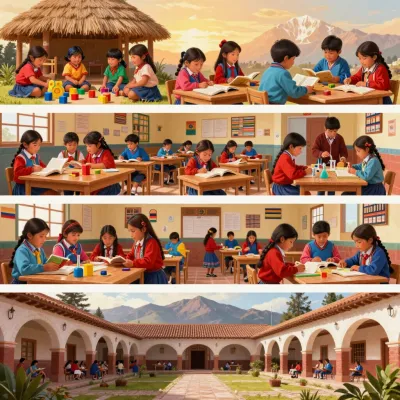
Education in Bolivia has evolved from informal, community-based knowledge transmission in pre-Columbian societies through colonial evangelization efforts that imposed Eurocentric models, to post-independence struggles for nationwide access. The 1952 National Revolution and its 1955 Educational Reform initiated a push for secular, universal schooling, later refined by the 1994 Reform Law that promoted decentralization and intercultural bilingual education. The Plurinational Constitution of 2009 and the Avelino Siñani‑Elizardo Pérez Educational Law No. 070 of 2010 represent the most transformative milestones, enshrining education as a fundamental right and mandating a decolonizing, intra‑ and intercultural, plurilingual, productive, and communitarian system aimed at overcoming historical inequities and affirming Bolivia’s diverse cultural heritage.
The Bolivian educational system is organized into three subsystems under Law 070: Regular Education (early childhood, primary, and secondary), Alternative and Special Education, and Higher Education for Professional Training. Early childhood education begins with a non‑formal cycle for ages 0‑3 and a formal cycle for ages 4‑5, emphasizing holistic development through play and mother‑tongue instruction. Primary education (six years) integrates community values, vocational orientation, and intercultural bilingualism, while secondary education (also six years) splits into a communal first cycle and a productive second cycle offering technical‑humanistic specializations. Technical and Vocational Education and Training (TVET) provides practice‑oriented pathways aligned with labor market needs, and higher education comprises public autonomous universities, private institutions, technical institutes, and teacher training colleges, all striving to incorporate productive, communitarian, and intercultural principles. Teacher preparation is centralized in the Escuelas Superiores de Formación de Maestros (ESFMs), which train educators in culturally responsive pedagogy, intercultural bilingual education, and the “Vivir Bien” philosophy.
Central to the system are persistent efforts to address access, equity, and quality. Intercultural bilingual education seeks to valorize Bolivia’s 36 official languages, yet implementation is hampered by teacher shortages, material scarcity, and linguistic diversity. Rural education contends with geographic isolation, multigrade classrooms, and limited infrastructure, whereas urban schools face overcrowding, socioeconomic stratification, and a digital divide. Special education and inclusive practices remain limited, with a large proportion of children with disabilities excluded from regular schooling. Funding relies heavily on state budget allocations, supplemented by municipal contributions, international cooperation, NGOs, and community support, but disparities in resource distribution persist, especially between urban and rural areas. Quality assurance is overseen by the Observatorio Plurinacional de la Calidad Educativa (OPCE), emphasizing formative, holistic assessment aligned with Law 070’s goals, while technology integration initiatives such as the “Quipus” laptop program struggle with connectivity, maintenance, and teacher training. Gender parity has improved at the primary level, but gaps endure in secondary and higher education enrollment, particularly in STEM fields, and sustainable development education integrates ancestral knowledge with modern science to foster environmental stewardship. Non‑formal and informal learning initiatives, including adult literacy and vocational workshops, complement formal provision, and international partnerships continue to support curriculum development, teacher training, and infrastructure. Social and political shifts—from the National Revolution to the indigenous‑led government of Evo Morales—have continually reshaped educational priorities, and future reforms focus on deepening the implementation of Law 070, improving learning outcomes, bridging equity gaps, expanding TVET and technology access, strengthening teacher development, and aligning higher education with national development and sustainability goals.
What You'll Find Inside:
- The book provides a comprehensive historical overview of Bolivian education, tracing its evolution from pre-Columbian indigenous knowledge systems through colonial imposition, revolutionary reforms in the mid-20th century, and the landmark Avelino Siñani-Elizardo Pérez Educational Law No. 070 of 2010.
- It examines the legal and policy frameworks governing Bolivia's education system, including the Plurinational Constitution of 2009 and Law 070, which enshrine education as a fundamental right and mandate intercultural bilingual, productive, and communitarian education models.
- The structure of the entire Bolivian educational system is detailed across all levels—early childhood, primary, secondary, technical and vocational (TVET), and higher education—alongside subsystems for alternative and special education, emphasizing inclusivity and cultural relevance.
- Critical challenges such as access and equity gaps between urban and rural areas, linguistic and cultural barriers for indigenous students, gender disparities, the marginalization of students with disabilities, and the digital divide are analyzed in depth.
- The book explores cross-cutting themes including teacher training reforms, educational funding and resource allocation, quality assurance mechanisms, the role of technology, community participation, and future perspectives for sustainable and decolonizing education in Bolivia.
Who's It For:
This book is primarily intended for educators, policymakers, researchers, and students of comparative education or Latin American studies who seek a thorough, scholarly examination of Bolivia's educational system. It will also be valuable for international development professionals, NGO workers, and educational consultants engaged in projects related to intercultural bilingual education, rural development, or inclusive education in the Andean region. Additionally, anyone interested in the intersection of indigenous rights, decolonization, and public policy will find this comprehensive overview an essential resource.
Author:
Published By:
Date Published:
June 20, 2026
Type:
Nonfiction
Language:
English
Word Count:
39,131 words
Reading Time:
2 hours 44 minutes
Sample:
Order:
Order Education In Bolivia (Hardcover) on MixCache.com:
Buy NowPrint copy is made to order and ships worldwide. Includes the ebook free, ready to read instantly.
$5 account credit for all new MixCache.com accounts, usable toward any ebook purchase!*