
Browse by Category
Fiction
- Action & Adventure
- African American
- Anthologies
- Children's Fiction
- Classics
- Comics & Graphic Novels
- Coming of Age
- Contemporary
- Cultural & Regional
- Drama
- Erotica
- Fantasy
- General
- Historical Fiction
- Horror
- Humor & Satire
- Literary Fiction
- Mystery, Thriller & Suspense
- Poetry
- Religious & Inspirational
- Romance
- Science Fiction
- Short Stories
- War & Military
- Westerns
- Women's Fiction
- Young Adult
Non-Fiction
- Antiques & Collectibles
- Arts & Photography
- Biographies & Memoirs
- Business & Money
- Children's Non-Fiction
-
Computers & Technology
- Artificial Intelligence
- Computer Science
- Cybersecurity & Cryptography
- Data Science & Analytics
- Databases & Big Data
- Game Development & Design
- General
- Hardware & DIY
- Mobile App Development
- Networking & Cloud Computing
- Operating Systems
- Programming
- Robotics
- Software
- Software Engineering
- User Experience (UX) & Design
- Web Development & Design
- Cooking, Food & Wine
- Crafts, Hobbies & Home
- Education & Teaching
- Engineering
- General
- Health, Fitness & Dieting
-
History
- African History
- African History - North Africa
- African History - Sub-Saharan Africa
- American History
- American History - 20th Century
- American History - Civil War
- American History - Colonial Period
- Ancient History
- Asian History
- Asian History - China
- Asian History - India
- Asian History - Japan
- Asian History - Southeast Asia
- European History
- European History - Ancient Greece
- European History - Ancient Rome
- European History - Medieval
- European History - Modern
- European History - Renaissance
- General
- Middle Eastern History
- Military History
- Military History - Aviation
- Military History - Naval
- Social & Cultural History
- World History
- Humor & Entertainment
- Industrial Technology
- Language Learning
- Law
- LGBTQ+ Non-Fiction
- Literary Criticism
- Medical Books
- Parenting & Relationships
- Philosophy
- Politics & Social Sciences
- Reference
- Religion & Spirituality
-
Science & Math
- Agricultural Sciences
- Astronomy & Space Science
- Behavioral Sciences
- Biological Sciences
- Botany & Plant Science
- Chemistry
- Earth Sciences
- Engineering - Chemical
- Engineering - Civil
- Engineering - Electrical
- Engineering - Mechanical
- Environment
- General
- Geology
- Mathematics
- Nature & Ecology
- Oceanography
- Paleontology
- Physics
- Statistics
- Self-Help
- Sports & Outdoors
- Study Aids
- Sustainability & Green Living
- Textbooks
- Transportation
- Travel
- True Crime
- Urban Planning & Development
- Veterinary Medicine
- Writing & Publishing
Jump to Section

Want unlimited access to all books published by MixCache.com (plus their audiobooks)? Try MixCache.com Total Access. Look for the MTA badge on book covers to identify included titles.
Access to infinite ebooks: Don't see the book you want? Suggest it and we'll create it (free!) for you from scratch with our powerful AI book writer. Then read it with MTA - besides profiting from any sales it makes!
Education In Bahrain
MTA
A Comprehensive Overview from Early Childhood to Higher Education
About this book:
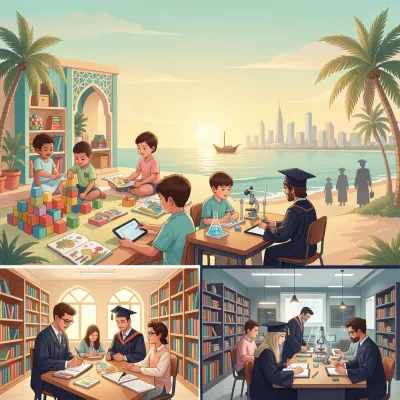
Bahrain’s education system is presented as a central pillar of national development, rooted in centuries of Islamic and practical learning and transformed over the past century into a modern, state-supported system. Beginning with traditional *kuttab* schools and mosque-based instruction, Bahrain moved toward formal modern schooling with the founding of Al-Hidaya Al-Khalifia School in 1919 and later expanded girls’ education with Khadija Al Kubra School in 1928. Oil-era prosperity, independence in 1971, and subsequent national development strategies accelerated the growth of schools, curricula, teacher training, and higher education institutions.
The book outlines the full structure of Bahraini education, from early childhood nurseries and kindergartens to primary, intermediate, secondary, technical and vocational, and higher education. Primary education builds foundational literacy, numeracy, Islamic and Arabic identity, science, social studies, and English skills. Intermediate education increases specialization and academic rigor, while secondary education offers pathways such as scientific, literary, commercial, and vocational tracks. Technical and vocational education is emphasized as essential for workforce readiness, with institutions such as the Bahrain Training Institute and Bahrain Polytechnic helping align skills with industry needs.
Bahrain’s higher education sector includes public institutions such as the University of Bahrain, Arabian Gulf University, and Bahrain Polytechnic, alongside private universities such as Ahlia University, Royal University for Women, Applied Science University, American University of Bahrain, British University of Bahrain, and RCSI Bahrain. The system is supported by government policy, funding, curriculum development, quality assurance, accreditation, and oversight from bodies including the Ministry of Education, Higher Education Council, and Education and Training Quality Authority. Public education is free for citizens and culturally anchored, while private and international schools provide diverse curricula, including British, American, IB, Indian, French, and other options, especially for expatriate communities.
Across the system, Bahrain is shown to be pursuing reform through digital learning, STEM education, teacher professional development, inclusive education, gifted and talented programs, student assessment reforms, lifelong learning, and stronger links between education and employment. The book also highlights ongoing challenges, including aligning graduates with labor market needs, maintaining teaching quality, expanding equitable access, balancing tradition with innovation, and improving the status of vocational education. Overall, Bahrain’s education system is portrayed as an evolving national project: deeply connected to Islamic and Bahraini identity, increasingly integrated with global standards, and strategically oriented toward building a skilled, innovative, and adaptable society for the future.
What You'll Find Inside:
- Traces Bahrain's educational evolution from traditional kuttab schools to a modern, diversified system spanning early childhood to higher education.
- Details the structure and pathways of the Bahraini education system, including public and private sectors, TVET, and international school options.
- Highlights curriculum reforms, teacher training, and the integration of educational technology and 21st‑century skills across all levels.
- Examines inclusive practices for special needs and gifted students, alongside quality assurance mechanisms and national accreditation frameworks.
- Analyzes the alignment of education with labor market needs, lifelong learning initiatives, and Bahrain's Vision 2030 goals for a knowledge‑based economy.
Who's It For:
This book is ideal for policymakers, education administrators, and curriculum developers seeking a comprehensive reference on Bahrain's education system. It also serves researchers, international educators, and expatriate families who need detailed insights into the Kingdom's educational structure, standards, and reform directions.
Author:
Published By:
Date Published:
June 19, 2026
Type:
Nonfiction
Language:
English
Word Count:
38,702 words
Reading Time:
2 hours 43 minutes
Sample:
MixCache.com Total Access
Get unlimited access to this book + all books published by MixCache.com for $11.99/month
Subscribe to MTAOr purchase this book individually below
Order:
Buy the Education In Bahrain ebook on MixCache.com:
Buy Now
Full ebook will be available immediately
- read online or download as a PDF file.
$5 account credit for all new MixCache.com accounts, usable toward any ebook purchase!*



Ratings & Reviews
Ask Questions About This Book
Have a question about the content? Ask our AI assistant!
Start by asking a question about "Education In Bahrain"
Example: "Does this book mention William Shakespeare?"
Thinking...