Browse by Category
Fiction
- Action & Adventure
- African American
- Anthologies
- Children's Fiction
- Classics
- Comics & Graphic Novels
- Coming of Age
- Contemporary
- Cultural & Regional
- Drama
- Erotica
- Fantasy
- General
- Historical Fiction
- Horror
- Humor & Satire
- Literary Fiction
- Mystery, Thriller & Suspense
- Poetry
- Religious & Inspirational
- Romance
- Science Fiction
- Short Stories
- War & Military
- Westerns
- Women's Fiction
- Young Adult
Non-Fiction
- Antiques & Collectibles
- Arts & Photography
- Biographies & Memoirs
- Business & Money
- Children's Non-Fiction
-
Computers & Technology
- Artificial Intelligence
- Computer Science
- Cybersecurity & Cryptography
- Data Science & Analytics
- Databases & Big Data
- Game Development & Design
- General
- Hardware & DIY
- Mobile App Development
- Networking & Cloud Computing
- Operating Systems
- Programming
- Robotics
- Software
- Software Engineering
- User Experience (UX) & Design
- Web Development & Design
- Cooking, Food & Wine
- Crafts, Hobbies & Home
- Education & Teaching
- Engineering
- General
- Health, Fitness & Dieting
-
History
- African History
- African History - North Africa
- African History - Sub-Saharan Africa
- American History
- American History - 20th Century
- American History - Civil War
- American History - Colonial Period
- Ancient History
- Asian History
- Asian History - China
- Asian History - India
- Asian History - Japan
- Asian History - Southeast Asia
- European History
- European History - Ancient Greece
- European History - Ancient Rome
- European History - Medieval
- European History - Modern
- European History - Renaissance
- General
- Middle Eastern History
- Military History
- Military History - Aviation
- Military History - Naval
- Social & Cultural History
- World History
- Humor & Entertainment
- Industrial Technology
- Language Learning
- Law
- LGBTQ+ Non-Fiction
- Literary Criticism
- Medical Books
- Parenting & Relationships
- Philosophy
- Politics & Social Sciences
- Reference
- Religion & Spirituality
-
Science & Math
- Agricultural Sciences
- Astronomy & Space Science
- Behavioral Sciences
- Biological Sciences
- Botany & Plant Science
- Chemistry
- Earth Sciences
- Engineering - Chemical
- Engineering - Civil
- Engineering - Electrical
- Engineering - Mechanical
- Environment
- General
- Geology
- Mathematics
- Nature & Ecology
- Oceanography
- Paleontology
- Physics
- Statistics
- Self-Help
- Sports & Outdoors
- Study Aids
- Sustainability & Green Living
- Textbooks
- Transportation
- Travel
- True Crime
- Urban Planning & Development
- Veterinary Medicine
- Writing & Publishing
Jump to Section

Want unlimited access to all books published by MixCache.com (plus their audiobooks)? Try MixCache.com Total Access. Look for the MTA badge on book covers to identify included titles.
Access to infinite ebooks: Don't see the book you want? Suggest it and we'll create it (free!) for you from scratch with our powerful AI book writer. Then read it with MTA - besides profiting from any sales it makes!
Education In Armenia
MTA
A Comprehensive Overview from Early Childhood to Higher Education
About this book:
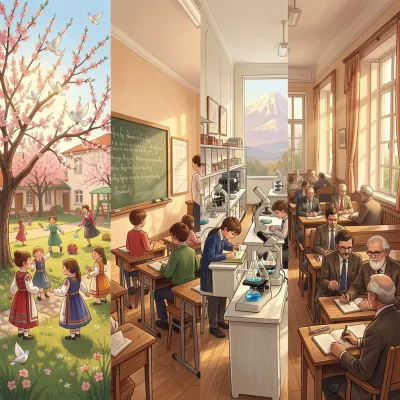
Education in Armenia has evolved from ancient monastic schools that preserved literacy and theology through the invention of the Armenian alphabet in 405 AD, to medieval institutions like Gladzor and Tatev, and later to a Soviet‑era system that ensured universal literacy and scientific training while suppressing religious instruction. After independence in 1991, Armenia undertook reforms to de‑ideologize curricula, reintroduce national content, and align with international standards, creating a multi‑tiered structure overseen by the Ministry of Education, Science, Culture and Sport. This structure begins with non‑compulsory early childhood education (nurseries and kindergartens), proceeds through four‑year primary schooling, five‑year basic secondary education, and two‑year upper secondary education offering general and specialized tracks (academic, artistic, sports, vocational). Vocational Education and Training (VET) provides market‑driven, competency‑based programs that often combine general education with practical skills in fields such as ICT, tourism, and crafts. Higher education comprises public and private universities, institutes, and academies offering Bachelor, Master, and PhD (Aspirantura) degrees; admission is based on unified state examinations and, for some programs, additional institutional tests, with quality assurance administered by the National Center for Professional Education Quality Assurance (ANQA) and aligned with the Bologna Process and ECTS.
Across all levels, Armenian education emphasizes Armenian as the primary language of instruction while supporting minority language schools and promoting foreign language learning, especially English and Russian. Teacher preparation centers on the Khachatur Abovian Armenian State Pedagogical University, complemented by a new national Continuous Professional Development Framework, voluntary certification incentives, and programs like Teach For Armenia. Special education has shifted toward universal inclusive education, with special schools being transformed into resource centers and Individual Education Plans guiding support. Educational technology is expanding through computer labs, internet connectivity, digital learning platforms, and emerging immersive tools, while financing relies mainly on the state budget supplemented by local contributions, tuition fees (particularly in higher education and private institutions), scholarships, international aid, and diaspora support. International cooperation—through Erasmus+, bilateral university agreements, joint research, and cross‑border institutions such as the American University of Armenia, Russian‑Armenian University, and French University in Armenia—enhances mobility, curriculum development, and research. The Armenian diaspora contributes financial, intellectual, and networking resources, supporting institution building, faculty exchanges, scholarships, and advocacy.
Curriculum reform has moved from knowledge‑centric to competency‑based approaches, integrating critical thinking, problem‑solving, digital literacy, and interdisciplinary themes; assessment increasingly uses formative, performance‑based, and digital methods alongside national examinations. Challenges include funding disparities, aging infrastructure, teacher quality and motivation, alignment of curricula with labor‑market needs, equitable inclusion of students with special educational needs, the digital divide, brain drain, and ensuring consistent quality assurance. Opportunities arise from Armenia’s growing tech sector, the transformative Academic City Armenia project (intended to unite top academic institutions with global expertise for interdisciplinary learning, research, and innovation), continued diaspora engagement, expanding non‑formal and lifelong learning avenues (adult vocational retraining, community centers, online micro‑credentials), and strong cultural valuations of education. Policy priorities center on competency‑based curricula, teacher quality enhancement, universal inclusive education, internationalization, labor‑market linkage, digital transformation, research‑teaching integration, sustainable financing, civic and environmental education, talent retention, and quality‑assurance strengthening, all aimed at preparing globally competitive, socially responsible citizens while preserving Armenian heritage. The arts, humanities, and STEM fields are all emphasized, with STEM benefitting from close ties to the ICT sector and initiatives like the Armenian‑Indian Center of Excellence in ICT and the Armenian National Engineering Laboratories, positioning Armenia within the global knowledge economy.
What You'll Find Inside:
- A historical overview of Armenian education, from Mesrop Mashtots and monastic schools to Soviet-era expansion and post-independence reform.
- A clear explanation of Armenia’s education structure, governance, and progression from early childhood through primary, secondary, vocational, and higher education.
- Insight into curriculum, pedagogy, admissions, accreditation, teacher training, language policy, and inclusive education practices.
- Analysis of major reform priorities, including competency-based learning, digital education, STEM, arts and humanities, and lifelong learning.
- A look at funding, socio-economic challenges, diaspora influence, international cooperation, and Armenia’s future direction in global education.
Who's It For:
This book is aimed at policymakers, education leaders, researchers, teachers, and students seeking a comprehensive overview of Armenia’s education system from early childhood through higher education. It will also be valuable for international organizations, donors, diaspora professionals, and comparative education scholars interested in reform, inclusion, quality assurance, and global integration. Readers looking for practical insight into Armenia’s educational history, current structures, and future directions will benefit most.
Author:
Published By:
Date Published:
June 17, 2026
Type:
Nonfiction
Language:
English
Word Count:
42,347 words
Reading Time:
2 hours 58 minutes
Sample:
Order:
Order Education In Armenia (Hardcover) on MixCache.com:
Buy NowPrint copy is made to order and ships worldwide. Includes the ebook free, ready to read instantly.
$5 account credit for all new MixCache.com accounts, usable toward any ebook purchase!*