
Browse by Category
Fiction
- Action & Adventure
- African American
- Anthologies
- Children's Fiction
- Classics
- Comics & Graphic Novels
- Coming of Age
- Contemporary
- Cultural & Regional
- Drama
- Erotica
- Fantasy
- General
- Historical Fiction
- Horror
- Humor & Satire
- Literary Fiction
- Mystery, Thriller & Suspense
- Poetry
- Religious & Inspirational
- Romance
- Science Fiction
- Short Stories
- War & Military
- Westerns
- Women's Fiction
- Young Adult
Non-Fiction
- Antiques & Collectibles
- Arts & Photography
- Biographies & Memoirs
- Business & Money
- Children's Non-Fiction
-
Computers & Technology
- Artificial Intelligence
- Computer Science
- Cybersecurity & Cryptography
- Data Science & Analytics
- Databases & Big Data
- Game Development & Design
- General
- Hardware & DIY
- Mobile App Development
- Networking & Cloud Computing
- Operating Systems
- Programming
- Robotics
- Software
- Software Engineering
- User Experience (UX) & Design
- Web Development & Design
- Cooking, Food & Wine
- Crafts, Hobbies & Home
- Education & Teaching
- Engineering
- General
- Health, Fitness & Dieting
-
History
- African History
- African History - North Africa
- African History - Sub-Saharan Africa
- American History
- American History - 20th Century
- American History - Civil War
- American History - Colonial Period
- Ancient History
- Asian History
- Asian History - China
- Asian History - India
- Asian History - Japan
- Asian History - Southeast Asia
- European History
- European History - Ancient Greece
- European History - Ancient Rome
- European History - Medieval
- European History - Modern
- European History - Renaissance
- General
- Middle Eastern History
- Military History
- Military History - Aviation
- Military History - Naval
- Social & Cultural History
- World History
- Humor & Entertainment
- Industrial Technology
- Language Learning
- Law
- LGBTQ+ Non-Fiction
- Literary Criticism
- Medical Books
- Parenting & Relationships
- Philosophy
- Politics & Social Sciences
- Reference
- Religion & Spirituality
-
Science & Math
- Agricultural Sciences
- Astronomy & Space Science
- Behavioral Sciences
- Biological Sciences
- Botany & Plant Science
- Chemistry
- Earth Sciences
- Engineering - Chemical
- Engineering - Civil
- Engineering - Electrical
- Engineering - Mechanical
- Environment
- General
- Geology
- Mathematics
- Nature & Ecology
- Oceanography
- Paleontology
- Physics
- Statistics
- Self-Help
- Sports & Outdoors
- Study Aids
- Sustainability & Green Living
- Textbooks
- Transportation
- Travel
- True Crime
- Urban Planning & Development
- Veterinary Medicine
- Writing & Publishing
Jump to Section

Want unlimited access to all books published by MixCache.com (plus their audiobooks)? Try MixCache.com Total Access. Look for the MTA badge on book covers to identify included titles.
Access to infinite ebooks: Don't see the book you want? Suggest it and we'll create it (free!) for you from scratch with our powerful AI book writer. Then read it with MTA - besides profiting from any sales it makes!
Winter Backcountry Mountaineering: Ski, Snow, and Avalanche Safety for Cold Seasons
MTA
Route planning, snowpack assessment, and winter alpine travel techniques
About this book:

# Summary of *Winter Backcountry Mountaineering*
*Winter Backcountry Mountaineering* is a comprehensive guide to safely navigating snow-covered terrain, written for backcountry skiers, splitboarders, and winter alpinists. The book emphasizes that winter mountains are fundamentally different from their summer counterparts—snow transforms familiar landscapes, introduces hidden hazards like avalanches, and amplifies the consequences of every decision. Rather than romanticizing adventure, the text focuses on building practical competence through systematic planning, snowpack assessment, and disciplined risk management. It integrates avalanche education, cold-weather survival, ski-mountaineering techniques, and winter campcraft into a single volume designed to help readers travel farther and higher while maintaining safety margins.
The book begins by establishing the "winter backcountry mindset," which prioritizes adaptability, humility, and process-oriented thinking over goal fixation. It covers the anatomy of snow and the seasonal snowpack in detail, explaining how ice crystals form, metamorphose, and create layered structures that determine stability. Weather fundamentals are explored thoroughly, including how temperature, wind, precipitation, and humidity interact to shape avalanche danger. Trip planning and route selection are presented as systematic processes involving pre-trip research, group skill assessment, identification of avalanche terrain and escape options, and the establishment of clear turnaround protocols. Navigation tools—both traditional (map and compass) and digital (GPS, smartphone apps)—are discussed with an emphasis on redundancy and the limitations of technology in harsh conditions.
A significant portion of the book is devoted to avalanche safety. It covers terrain recognition—understanding slope angle, aspect, elevation, and features like convex rolls, gullies, cornices, and terrain traps that amplify risk. Stability tests and snowpit interpretation are explained in practical detail, including the Compression Test, Extended Column Test, and Propagation Saw Test, with guidance on extrapolating findings from a single pit to broader terrain. The book also addresses the critical role of human factors—heuristics like familiarity, commitment bias, social proof, and expert halo—that can override even the best technical knowledge. Risk management frameworks such as the Avalanche Terrain Exposure Scale (ATES), the Stop or Go decision-making model, and the Avaluator are presented as structured tools to support judgment without replacing it.
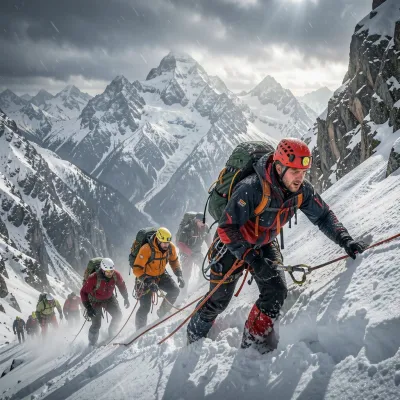
Travel techniques form another core section, covering efficient skinning, switchbacks, kick turns, and ascent strategies for ski touring, as well as descent tactics in variable snow conditions including powder, wind slab, breakable crust, and heavy wet snow. Steep snow and mixed terrain are addressed with instruction on ice axe use, crampon techniques (flat-footing, front-pointing, French and German methods), self-arrest, and roped glacier travel. Cold-weather physiology is explored in depth, with guidance on preventing and treating hypothermia, frostbite, dehydration, and other cold injuries. Clothing systems, layering principles, and personal gear selection are covered comprehensively, as are avalanche rescue procedures—beacon search, probing, and shoveling techniques—with emphasis on regular practice and team coordination.
The book also addresses winter campcraft, including shelter selection (four-season tents, snow caves, igloos), stove and fuel management, water procurement, and overnight routines. Multi-day traverses are discussed with attention to strategic planning, advanced gear considerations, expedition-style leadership, and managing fatigue and morale over extended trips. Communication tools—from whistles and radios to satellite messengers and PLBs—are reviewed alongside strategies for protecting electronics in extreme cold. Weather windows and timing are framed as strategic assets, with detailed guidance on identifying stable periods, setting turnaround criteria, and adapting plans when conditions change. Equipment maintenance and field repair techniques are provided for common failures like broken bindings, torn clothing, and malfunctioning stoves. Environmental ethics and winter Leave No Trace principles round out the practical content, emphasizing the fragility of winter ecosystems and the responsibility of backcountry travelers to minimize their impact.
The final chapter presents case studies drawn from real incidents and near misses, analyzing how human factors, environmental unpredictability, and equipment failures converge in actual emergencies. These stories illustrate lessons about complacency, the dangers of goal fixation, the importance of communication during rescue, the risks of solo travel, and the need for continuous reassessment of conditions. Collectively, the book argues that successful winter mountaineering is not measured by summits reached but by the confidence, competence, and sound judgment developed through preparation, practice, and respect for the mountains.
What You'll Find Inside:
- Develop a winter backcountry mindset prioritizing adaptability, humility, and conservative decision-making over summit ambitions to safely navigate dynamic snow and weather conditions.
- Understand snowpack anatomy and seasonal evolution, including weak layer formation (e.g., surface hoar, depth hoar) and wind slab dynamics, to assess avalanche potential in real time.
- Master weather interpretation beyond forecasts, focusing on freezing levels, wind effects on snow loading, humidity impacts on snow structure, and identifying reliable weather windows for trip planning.
- Integrate trip planning and route selection with avalanche bulletins, human factor awareness, and contingency protocols to make context-driven decisions that prioritize group safety over objectives.
- Acquire technical mountaineering skills for steep snow and mixed terrain—including crampon techniques, ice axe use, and rope management—to safely navigate complex alpine environments when ski travel ends and climbing begins.
Who's It For:
This book is designed for backcountry skiers, splitboarders, and winter alpinists who seek to expand their technical expertise and decision-making framework for cold-season mountain travel. It benefits individuals aiming to transition from recreational touring to more complex ski mountaineering objectives, as well as those who wish to deepen their understanding of avalanche safety, cold-weather survival, and risk management. Readers should have foundational backcountry experience and be committed to advancing their skills through deliberate practice and the integration of snow science, weather analysis, and group dynamics into every adventure.
Author:
Published By:
Date Published:
June 15, 2026
Type:
Nonfiction
Language:
English
Word Count:
53,531 words
Reading Time:
3 hours 45 minutes
Sample:
MixCache.com Total Access
Get unlimited access to this book + all books published by MixCache.com for $11.99/month
Subscribe to MTAOr purchase this book individually below
Order:
Buy the Winter Backcountry Mountaineering: Ski, Snow, and Avalanche Safety for Cold Seasons ebook on MixCache.com:
Buy Now
Full ebook will be available immediately
- read online or download as a PDF file.
$5 account credit for all new MixCache.com accounts, usable toward any ebook purchase!*




Ratings & Reviews
Ask Questions About This Book
Have a question about the content? Ask our AI assistant!
Start by asking a question about "Winter Backcountry Mountaineering: Ski, Snow, and Avalanche Safety for Cold Seasons"
Example: "Does this book mention William Shakespeare?"
Thinking...