
Browse by Category
Fiction
- Action & Adventure
- African American
- Anthologies
- Children's Fiction
- Classics
- Comics & Graphic Novels
- Coming of Age
- Contemporary
- Cultural & Regional
- Drama
- Erotica
- Fantasy
- General
- Historical Fiction
- Horror
- Humor & Satire
- Literary Fiction
- Mystery, Thriller & Suspense
- Poetry
- Religious & Inspirational
- Romance
- Science Fiction
- Short Stories
- War & Military
- Westerns
- Women's Fiction
- Young Adult
Non-Fiction
- Antiques & Collectibles
- Arts & Photography
- Biographies & Memoirs
- Business & Money
- Children's Non-Fiction
-
Computers & Technology
- Artificial Intelligence
- Computer Science
- Cybersecurity & Cryptography
- Data Science & Analytics
- Databases & Big Data
- Game Development & Design
- General
- Hardware & DIY
- Mobile App Development
- Networking & Cloud Computing
- Operating Systems
- Programming
- Robotics
- Software
- Software Engineering
- User Experience (UX) & Design
- Web Development & Design
- Cooking, Food & Wine
- Crafts, Hobbies & Home
- Education & Teaching
- Engineering
- General
- Health, Fitness & Dieting
-
History
- African History
- African History - North Africa
- African History - Sub-Saharan Africa
- American History
- American History - 20th Century
- American History - Civil War
- American History - Colonial Period
- Ancient History
- Asian History
- Asian History - China
- Asian History - India
- Asian History - Japan
- Asian History - Southeast Asia
- European History
- European History - Ancient Greece
- European History - Ancient Rome
- European History - Medieval
- European History - Modern
- European History - Renaissance
- General
- Middle Eastern History
- Military History
- Military History - Aviation
- Military History - Naval
- Social & Cultural History
- World History
- Humor & Entertainment
- Industrial Technology
- Language Learning
- Law
- LGBTQ+ Non-Fiction
- Literary Criticism
- Medical Books
- Parenting & Relationships
- Philosophy
- Politics & Social Sciences
- Reference
- Religion & Spirituality
-
Science & Math
- Agricultural Sciences
- Astronomy & Space Science
- Behavioral Sciences
- Biological Sciences
- Botany & Plant Science
- Chemistry
- Earth Sciences
- Engineering - Chemical
- Engineering - Civil
- Engineering - Electrical
- Engineering - Mechanical
- Environment
- General
- Geology
- Mathematics
- Nature & Ecology
- Oceanography
- Paleontology
- Physics
- Statistics
- Self-Help
- Sports & Outdoors
- Study Aids
- Sustainability & Green Living
- Textbooks
- Transportation
- Travel
- True Crime
- Urban Planning & Development
- Veterinary Medicine
- Writing & Publishing
Jump to Section

Want unlimited access to all books published by MixCache.com (plus their audiobooks)? Try MixCache.com Total Access. Look for the MTA badge on book covers to identify included titles.
Access to infinite ebooks: Don't see the book you want? Suggest it and we'll create it (free!) for you from scratch with our powerful AI book writer. Then read it with MTA - besides profiting from any sales it makes!
Disasters and Recovery in China's Provinces
MTA
Famine, earthquake, flood, and provincial resilience — one province per chapter
About this book:
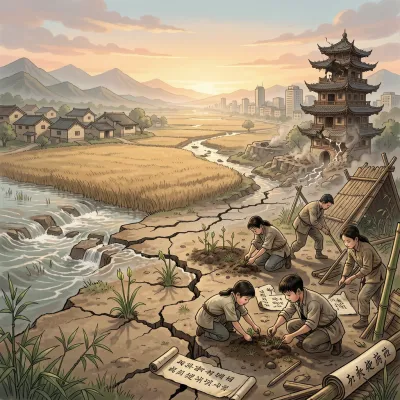
This book examines how China’s provincial governments and communities have navigated disasters—earthquakes, floods, typhoons, droughts, and landslides—through history and into the modern era, analyzing evolving strategies for resilience. Each chapter (e.g., Sichuan’s post-earthquake rebuilding, Henan’s Yellow River flood reforms, Gansu’s seismic risk management) explores the interplay of geography, institutional adaptation, and social dynamics in shaping recovery. The provincial lens highlights diverse hazard types and adaptive responses, from hard infrastructure (dams, seawalls) to nature-based solutions (wetland restoration, sponge cities) and community-driven initiatives (mutual aid networks, early warning systems). The analytical framework emphasizes hazard, exposure, vulnerability, and adaptive capacity, focusing on sensing, coordination, resource mobilization, communication, and learning to build multi-dimensional resilience.
The book underscores that recovery transcends mere reconstruction, requiring restoration of essential services, equitable aid distribution, and long-term risk reduction to avoid locking in future vulnerabilities. Historical cases (e.g., Shaanxi’s Huaxian earthquake, Hunan’s famine) inform modern policies, illustrating how disasters catalyze institutional reforms and innovation. Each province’s journey reflects unique challenges—Sichuan’s urban-rural divide, Guangdong’s coastal storm surges, or Guizhou’s karst water scarcity—while sharing common themes of integrating scientific advances, traditional knowledge, and social capital. Institutional evolution, from grassroots committees to centralized emergency management ministries, demonstrates how governance structures adapt to recurring or cascading risks.
Environmental degradation, climate change, and economic inequities remain persistent hurdles. Provinces like Shandong and Zhejiang emphasize managed retreat and ecological restoration to balance development with natural buffers, while Qinghai and Yunnan highlight the role of community resilience in isolated, geologically unstable regions. The book stresses that sustainable adaptation requires cross-sectoral coordination, inclusive planning, and continuous learning from past failures and successes. For instance, Jiangsu’s integrated water management and Beijing’s sponge city initiatives exemplify proactive, holistic approaches to hydrological extremes.
Ultimately, the book maps China’s evolving disaster resilience as a patchwork of localized strategies, revealing both universal lessons (e.g., the importance of hybrid engineering-ecological defenses) and region-specific innovations (e.g., Hainan’s supply-chain resilience, Shanghai’s compound flood mitigation). By juxtaposing historical legacies—from imperial-era granaries to modern early warning systems—it illustrates that resilience is an iterative, ongoing process of negotiating between hazard, governance, and societal needs, offering a foundation for future policies in an era of intensifying climate risks.
What You'll Find Inside:
- Explores how Chinese provinces have built adaptive capacity through hazard detection, interagency coordination, and post-disaster institutional reforms.
- Highlights innovative disaster management strategies, including sponge city initiatives in Wuhan and ecological flood control in Henan and Jiangsu.
- Analyzes the role of community-based mutual aid and traditional social capital in recovery efforts across provinces like Sichuan, Shaanxi, and Fujian.
- Examines cross-border cooperation and resource management challenges in provinces like Heilongjiang and Qinghai, particularly in shared river basins.
- Discusses lessons in balancing economic development with climate resilience, including managed retreat in Hunan and typhoon adaptation in Guangdong.
Who's It For:
This book is intended for disaster scholars, emergency management professionals, and policymakers interested in comparative regional resilience strategies. It offers empirical insights into how China's diverse provinces have addressed hazards like floods, earthquakes, and typhoons, making it a valuable resource for those designing adaptive policies and infrastructure solutions. Readers will benefit from case studies that reveal both successful innovations and ongoing challenges in disaster risk reduction.
Author:
Published By:
Date Published:
June 14, 2026
Type:
Nonfiction
Language:
English
Word Count:
44,495 words
Reading Time:
3 hours 7 minutes
Sample:
MixCache.com Total Access
Get unlimited access to this book + all books published by MixCache.com for $11.99/month
Subscribe to MTAOr purchase this book individually below
Order:
Buy the Disasters and Recovery in China's Provinces ebook on MixCache.com:
Buy Now
Full ebook will be available immediately
- read online or download as a PDF file.
$5 account credit for all new MixCache.com accounts, usable toward any ebook purchase!*




Ratings & Reviews
Ask Questions About This Book
Have a question about the content? Ask our AI assistant!
Start by asking a question about "Disasters and Recovery in China's Provinces"
Example: "Does this book mention William Shakespeare?"
Thinking...