Browse by Category
Fiction
- Action & Adventure
- African American
- Anthologies
- Children's Fiction
- Classics
- Comics & Graphic Novels
- Coming of Age
- Contemporary
- Cultural & Regional
- Drama
- Erotica
- Fantasy
- General
- Historical Fiction
- Horror
- Humor & Satire
- Literary Fiction
- Mystery, Thriller & Suspense
- Poetry
- Religious & Inspirational
- Romance
- Science Fiction
- Short Stories
- War & Military
- Westerns
- Women's Fiction
- Young Adult
Non-Fiction
- Antiques & Collectibles
- Arts & Photography
- Biographies & Memoirs
- Business & Money
- Children's Non-Fiction
-
Computers & Technology
- Artificial Intelligence
- Computer Science
- Cybersecurity & Cryptography
- Data Science & Analytics
- Databases & Big Data
- Game Development & Design
- General
- Hardware & DIY
- Mobile App Development
- Networking & Cloud Computing
- Operating Systems
- Programming
- Robotics
- Software
- Software Engineering
- User Experience (UX) & Design
- Web Development & Design
- Cooking, Food & Wine
- Crafts, Hobbies & Home
- Education & Teaching
- Engineering
- General
- Health, Fitness & Dieting
-
History
- African History
- African History - North Africa
- African History - Sub-Saharan Africa
- American History
- American History - 20th Century
- American History - Civil War
- American History - Colonial Period
- Ancient History
- Asian History
- Asian History - China
- Asian History - India
- Asian History - Japan
- Asian History - Southeast Asia
- European History
- European History - Ancient Greece
- European History - Ancient Rome
- European History - Medieval
- European History - Modern
- European History - Renaissance
- General
- Middle Eastern History
- Military History
- Military History - Aviation
- Military History - Naval
- Social & Cultural History
- World History
- Humor & Entertainment
- Industrial Technology
- Language Learning
- Law
- LGBTQ+ Non-Fiction
- Literary Criticism
- Medical Books
- Parenting & Relationships
- Philosophy
- Politics & Social Sciences
- Reference
- Religion & Spirituality
-
Science & Math
- Agricultural Sciences
- Astronomy & Space Science
- Behavioral Sciences
- Biological Sciences
- Botany & Plant Science
- Chemistry
- Earth Sciences
- Engineering - Chemical
- Engineering - Civil
- Engineering - Electrical
- Engineering - Mechanical
- Environment
- General
- Geology
- Mathematics
- Nature & Ecology
- Oceanography
- Paleontology
- Physics
- Statistics
- Self-Help
- Sports & Outdoors
- Study Aids
- Sustainability & Green Living
- Textbooks
- Transportation
- Travel
- True Crime
- Urban Planning & Development
- Veterinary Medicine
- Writing & Publishing
Jump to Section

Want unlimited access to all books published by MixCache.com (plus their audiobooks)? Try MixCache.com Total Access. Look for the MTA badge on book covers to identify included titles.
Access to infinite ebooks: Don't see the book you want? Suggest it and we'll create it (free!) for you from scratch with our powerful AI book writer. Then read it with MTA - besides profiting from any sales it makes!
Bohemian Crossroads: Prague’s Architecture, National Myths, and Cultural Revolutions
MTA
Gothic cathedrals, Baroque palaces, and the modern Czech imagination
About this book:
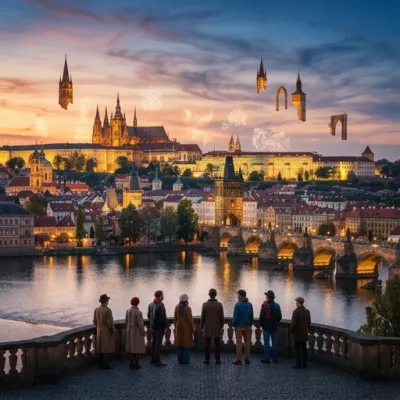
**Bohemian Crossroads: Prague’s Architecture, National Myths, and Cultural Revolutions** presents Prague as a dynamic palimpsest where architecture, politics, and cultural identity intersect dynamically across centuries. Beginning in the medieval period, the city's Gothic cathedrals, Baroque palaces, and structures like Charles Bridge embody evolving narratives of sovereignty, faith, and civic power. The book traces how each era—from the Habsburgs to the Czech National Revival—left indelible marks on the urban landscape, with architecture serving as both a tool of authority and a canvas for collective memory. Medieval foundations, Renaissance humanism, and Baroque theatrics are analyzed not just as styles but as expressions of Bohemian resilience and aspiration, shaping the city’s identity as a "crossroads" of European influences and indigenous traditions.
The 20th century brought profound ruptures: Nazi occupation, Soviet invasion in 1968, and decades of communist rule. Socialist Realism reshaped the city with ideological monumentalism, while the ubiquitous *panelák* housing estates imposed a utilitarian vision of collectivized life. Yet the book highlights how Prague’s citizens adapted these spaces, creating subcultures of dissent and resistance. The Velvet Revolution of 1989 and the post-communist transition brought new challenges: privatization, tourism-driven commodification, and debates over heritage preservation. Contemporary chapters explore how modern projects like the Žižkov Tower and the Dancing House test the city’s capacity to absorb innovations, while global media and diaspora communities project and reshape Prague’s mythic image, making it a symbol of romanticized European charm and political resilience.
The latter parts of the book pivot toward memory work and futuristic considerations. Museums, memorials, and public rituals—from the Jewish Quarter’s haunted stones to the sites of 1968 and 1989 resistance—reclaim history as an active process of interpretation. The author examines Prague’s global iconography, noting how its architecture becomes a stage for films, literature, and diasporic longing. Finally, the book contemplates Prague’s future amid climate change, cultural diversity, and technological shifts. The challenge lies in balancing preservation with sustainability, honoring historical layers while fostering inclusive, adaptive urbanism. Prague remains a "crossroads," where new myths will be forged—not just through grand monuments, but through the daily acts of inhabitants navigating the intersection of tradition, modernity, and ecological imperative.
What You'll Find Inside:
- Prague’s urban fabric operates as a living palimpsest where successive regimes layer, erase, and rewrite architectural meanings to assert power and identity.
- Key monuments such as St. Vitus Cathedral, Charles Bridge, and the National Theatre have served as tangible symbols of sovereignty, national myth, and civic resistance across centuries.
- Public squares—particularly Old Town and Wenceslas—have functioned as stages for political revolutions, from the 1968 invasion to the 1989 Velvet Revolution, embodying the clash between authority and popular dissent.
- The city’s architectural evolution showcases a dialogue of styles—Gothic, Baroque, Art Nouveau, Czech Cubism, Functionalist modernism, socialist panelák housing, and twenty‑first‑century experiments—each reflecting shifting ideologies and aspirations.
- Post‑communist memory work, heritage preservation, and tourism have transformed Prague into a global icon while prompting ongoing negotiations over difficult pasts, authenticity, and who gets to tell the city’s story.
Who's It For:
This book is ideal for scholars and students of urban history, architecture, and Central European studies who want an interdisciplinary analysis of how built environments shape national identity. It will also appeal to general readers fascinated by Prague’s layered past, cultural myths, and the ways cities negotiate memory, power, and change. Architects, urban planners, and heritage professionals seeking case studies in adaptive reuse and symbolic urbanism will find valuable insights, as will anyone interested in the interplay of tourism, politics, and place-making in a historic European capital.
Author:
Published By:
Date Published:
June 11, 2026
Type:
Nonfiction
Language:
English
Word Count:
59,956 words
Reading Time:
4 hours 12 minutes
Sample:
Order:
Order Bohemian Crossroads: Prague’s Architecture, National Myths, and Cultural Revolutions (Paperback) on MixCache.com:
Buy NowPrint copy is made to order and ships worldwide. Includes the ebook free, ready to read instantly.
$5 account credit for all new MixCache.com accounts, usable toward any ebook purchase!*