
Browse by Category
Fiction
- Action & Adventure
- African American
- Anthologies
- Children's Fiction
- Classics
- Comics & Graphic Novels
- Coming of Age
- Contemporary
- Cultural & Regional
- Drama
- Erotica
- Fantasy
- General
- Historical Fiction
- Horror
- Humor & Satire
- Literary Fiction
- Mystery, Thriller & Suspense
- Poetry
- Religious & Inspirational
- Romance
- Science Fiction
- Short Stories
- War & Military
- Westerns
- Women's Fiction
- Young Adult
Non-Fiction
- Antiques & Collectibles
- Arts & Photography
- Biographies & Memoirs
- Business & Money
- Children's Non-Fiction
-
Computers & Technology
- Artificial Intelligence
- Computer Science
- Cybersecurity & Cryptography
- Data Science & Analytics
- Databases & Big Data
- Game Development & Design
- General
- Hardware & DIY
- Mobile App Development
- Networking & Cloud Computing
- Operating Systems
- Programming
- Robotics
- Software
- Software Engineering
- User Experience (UX) & Design
- Web Development & Design
- Cooking, Food & Wine
- Crafts, Hobbies & Home
- Education & Teaching
- Engineering
- General
- Health, Fitness & Dieting
-
History
- African History
- African History - North Africa
- African History - Sub-Saharan Africa
- American History
- American History - 20th Century
- American History - Civil War
- American History - Colonial Period
- Ancient History
- Asian History
- Asian History - China
- Asian History - India
- Asian History - Japan
- Asian History - Southeast Asia
- European History
- European History - Ancient Greece
- European History - Ancient Rome
- European History - Medieval
- European History - Modern
- European History - Renaissance
- General
- Middle Eastern History
- Military History
- Military History - Aviation
- Military History - Naval
- Social & Cultural History
- World History
- Humor & Entertainment
- Industrial Technology
- Language Learning
- Law
- LGBTQ+ Non-Fiction
- Literary Criticism
- Medical Books
- Parenting & Relationships
- Philosophy
- Politics & Social Sciences
- Reference
- Religion & Spirituality
-
Science & Math
- Agricultural Sciences
- Astronomy & Space Science
- Behavioral Sciences
- Biological Sciences
- Botany & Plant Science
- Chemistry
- Earth Sciences
- Engineering - Chemical
- Engineering - Civil
- Engineering - Electrical
- Engineering - Mechanical
- Environment
- General
- Geology
- Mathematics
- Nature & Ecology
- Oceanography
- Paleontology
- Physics
- Statistics
- Self-Help
- Sports & Outdoors
- Study Aids
- Sustainability & Green Living
- Textbooks
- Transportation
- Travel
- True Crime
- Urban Planning & Development
- Veterinary Medicine
- Writing & Publishing
Jump to Section

Want unlimited access to all books published by MixCache.com (plus their audiobooks)? Try MixCache.com Total Access. Look for the MTA badge on book covers to identify included titles.
Access to infinite ebooks: Don't see the book you want? Suggest it and we'll create it (free!) for you from scratch with our powerful AI book writer. Then read it with MTA - besides profiting from any sales it makes!
Imperial Madrid: Court, Colony, and the City That Ruled an Empire
MTA
Madrid’s rise as Spain’s capital and its global connections, 16th–20th centuries
About this book:
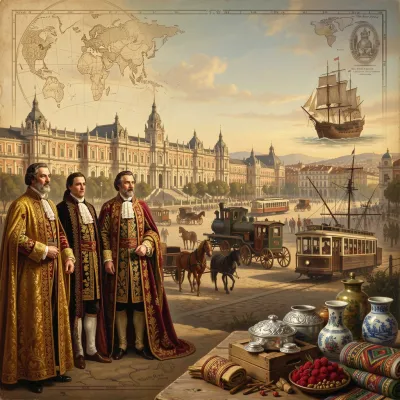
Imperial Madrid traces how a modest Castilian town became the political heart of a global empire after Philip II fixed the court there in 1561. The book shows that the city’s growth was driven by the need to house royal palaces, bureaucratic councils, and religious institutions that transformed paper, silver, and stone into instruments of rule. From the Alcázar’s reconstruction and the Plaza Mayor’s ceremonial spaces to the Segovia Aqueduct and the Royal Tobacco Factory, urban form followed imperial function, while councils such as the State, Finance, and especially the Indies turned Madrid into a clearinghouse of petitions, reports, and legislation that bound the Americas, the Philippines, and Europe to the Castilian plain.
The work details how empire was sustained through fiscal networks—American silver moving overland to the royal treasury, foreign credit from Genoese and Fugger bankers, monopolies on tobacco and grain, and the royal mint’s coinage—while knowledge‑making projects (cosmographers, archives, Relaciones Geográficas) turned distant observations into maps, legal codes, and propaganda. Rituals of sovereignty—royal entries, autos‑da‑fé, and festivals—projected Habsburg and Bourbon power onto the streets, simultaneously policing belief and behavior through the Inquisition, sumptuary laws, and municipal ordinances. Madrid’s social world blended grandees, petitioners, foreign financiers, artisans, enslaved and free Afro‑Iberians, colonial visitors, and a burgeoning bureaucracy, all negotiating power in households, confraternities, markets, and the imperial court.
From the Bourbon administrative reforms and enlightened urbanism of the eighteenth century to the crises of Napoleonic occupation, the loss of mainland colonies, and the retention of Cuba, Puerto Rico, and the Philippines, the book charts Madrid’s struggle to redefine itself after 1898. It examines how the city remembered and forgot its imperial past through monuments, education, and political discourse, and how its legacies persisted in linguistic, cultural, and economic ties to Latin America, the persistence of imperial‑era institutions, and the continued flow of people, commodities, and ideas that kept Madrid a global city well into the twentieth century.
What You'll Find Inside:
- How Madrid's councils and secretariats transformed colonial reports, decrees, and petitions into imperial governance from the Alcázar's administrative chambers
- The fiscal foundations of empire: American silver flowing through credit networks, royal monopolies (tobacco, mint), and taxation that funded Madrid's court and bureaucracy
- Urban ceremonies as political theater: royal entries, autos-da-fé, and festivals that projected Habsburg and Bourbon power through choreographed spectacle in Madrid's streets
- The city's social worlds: interplay of grandees, petitioners, foreign financiers, Afro-Iberian communities, and colonial visitors negotiating power and patronage
- Infrastructure as imperial expression: from the Segovia Aqueduct to the Puerta de Alcalá, how water, lighting, and transport systems embodied and enabled Madrid's rule
Who's It For:
This book is ideal for scholars of early modern European history, imperial studies, and urban history seeking a deep analysis of how administrative mechanisms, economic systems, and cultural practices shaped a capital city's role in governing a global empire. It will also benefit graduate students working with primary sources, as the text incorporates archival documents like council records, petitions, and account books to illustrate imperial mechanics. Educated general readers interested in the concrete ways distant colonies influenced a European capital's daily life—from grain markets to religious confraternities—will find Madrid's story accessible and illuminating.
Author:
Published By:
Date Published:
June 8, 2026
Type:
Nonfiction
Language:
English
Word Count:
57,824 words
Reading Time:
4 hours 3 minutes
Sample:
MixCache.com Total Access
Get unlimited access to this book + all books published by MixCache.com for $11.99/month
Subscribe to MTAOr purchase this book individually below
Order:
Buy the Imperial Madrid: Court, Colony, and the City That Ruled an Empire ebook on MixCache.com:
Buy Now
Full ebook will be available immediately
- read online or download as a PDF file.
$5 account credit for all new MixCache.com accounts, usable toward any ebook purchase!*




Ratings & Reviews
Ask Questions About This Book
Have a question about the content? Ask our AI assistant!
Start by asking a question about "Imperial Madrid: Court, Colony, and the City That Ruled an Empire"
Example: "Does this book mention William Shakespeare?"
Thinking...