Browse by Category
Fiction
- Action & Adventure
- African American
- Anthologies
- Children's Fiction
- Classics
- Comics & Graphic Novels
- Coming of Age
- Contemporary
- Cultural & Regional
- Drama
- Erotica
- Fantasy
- General
- Historical Fiction
- Horror
- Humor & Satire
- Literary Fiction
- Mystery, Thriller & Suspense
- Poetry
- Religious & Inspirational
- Romance
- Science Fiction
- Short Stories
- War & Military
- Westerns
- Women's Fiction
- Young Adult
Non-Fiction
- Antiques & Collectibles
- Arts & Photography
- Biographies & Memoirs
- Business & Money
- Children's Non-Fiction
-
Computers & Technology
- Artificial Intelligence
- Computer Science
- Cybersecurity & Cryptography
- Data Science & Analytics
- Databases & Big Data
- Game Development & Design
- General
- Hardware & DIY
- Mobile App Development
- Networking & Cloud Computing
- Operating Systems
- Programming
- Robotics
- Software
- Software Engineering
- User Experience (UX) & Design
- Web Development & Design
- Cooking, Food & Wine
- Crafts, Hobbies & Home
- Education & Teaching
- Engineering
- General
- Health, Fitness & Dieting
-
History
- African History
- African History - North Africa
- African History - Sub-Saharan Africa
- American History
- American History - 20th Century
- American History - Civil War
- American History - Colonial Period
- Ancient History
- Asian History
- Asian History - China
- Asian History - India
- Asian History - Japan
- Asian History - Southeast Asia
- European History
- European History - Ancient Greece
- European History - Ancient Rome
- European History - Medieval
- European History - Modern
- European History - Renaissance
- General
- Middle Eastern History
- Military History
- Military History - Aviation
- Military History - Naval
- Social & Cultural History
- World History
- Humor & Entertainment
- Industrial Technology
- Language Learning
- Law
- LGBTQ+ Non-Fiction
- Literary Criticism
- Medical Books
- Parenting & Relationships
- Philosophy
- Politics & Social Sciences
- Reference
- Religion & Spirituality
-
Science & Math
- Agricultural Sciences
- Astronomy & Space Science
- Behavioral Sciences
- Biological Sciences
- Botany & Plant Science
- Chemistry
- Earth Sciences
- Engineering - Chemical
- Engineering - Civil
- Engineering - Electrical
- Engineering - Mechanical
- Environment
- General
- Geology
- Mathematics
- Nature & Ecology
- Oceanography
- Paleontology
- Physics
- Statistics
- Self-Help
- Sports & Outdoors
- Study Aids
- Sustainability & Green Living
- Textbooks
- Transportation
- Travel
- True Crime
- Urban Planning & Development
- Veterinary Medicine
- Writing & Publishing
Jump to Section
MixCache.com Total Access
Unlimited reading and audiobooks for every book published by MixCache.com.
Included titles carry the MTA badge.
Learn more →
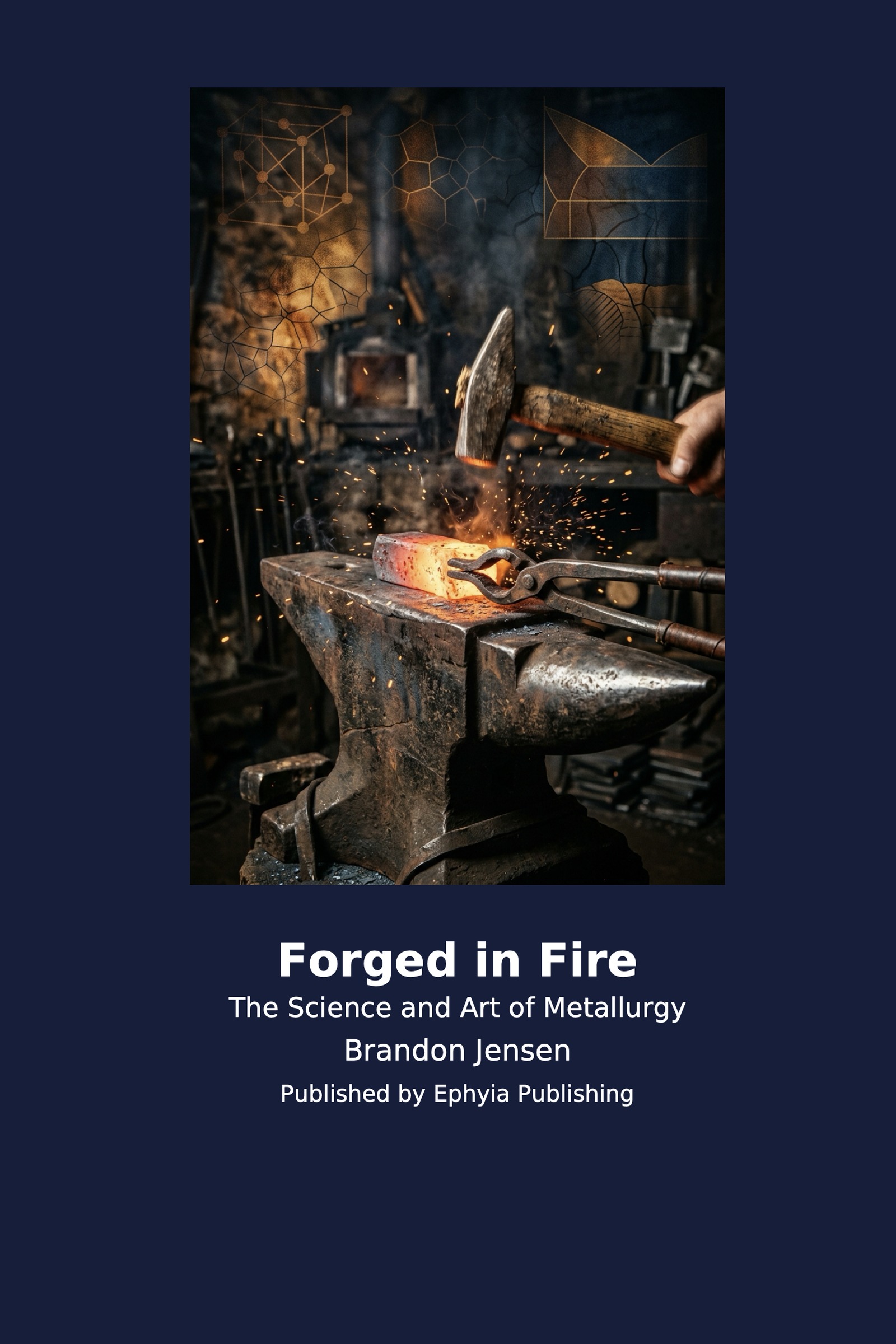
Forged in Fire
The Science and Art of Metallurgy
About this book:
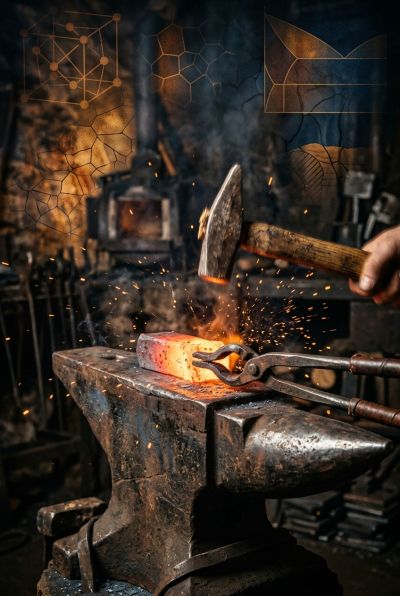
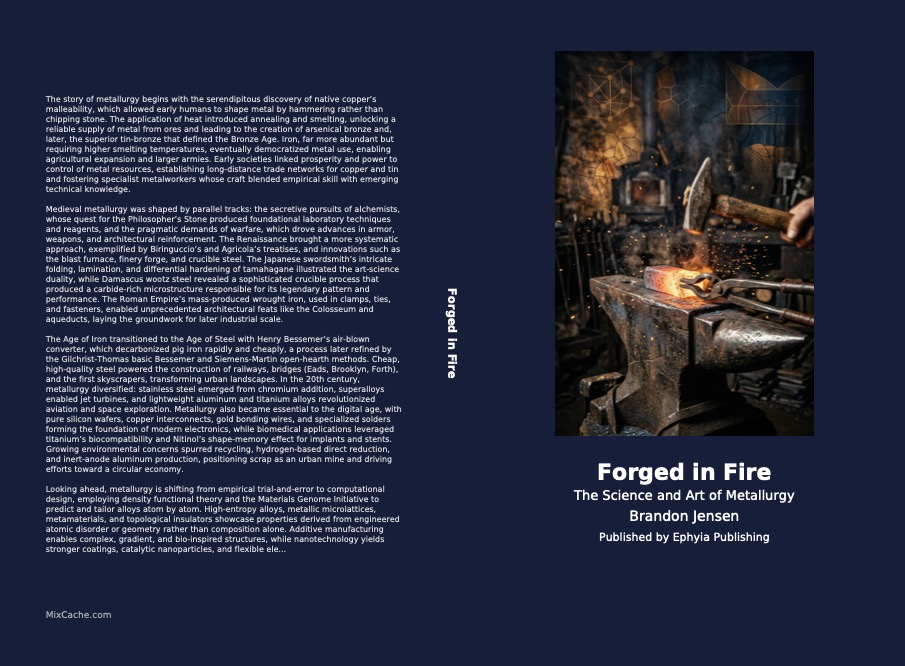
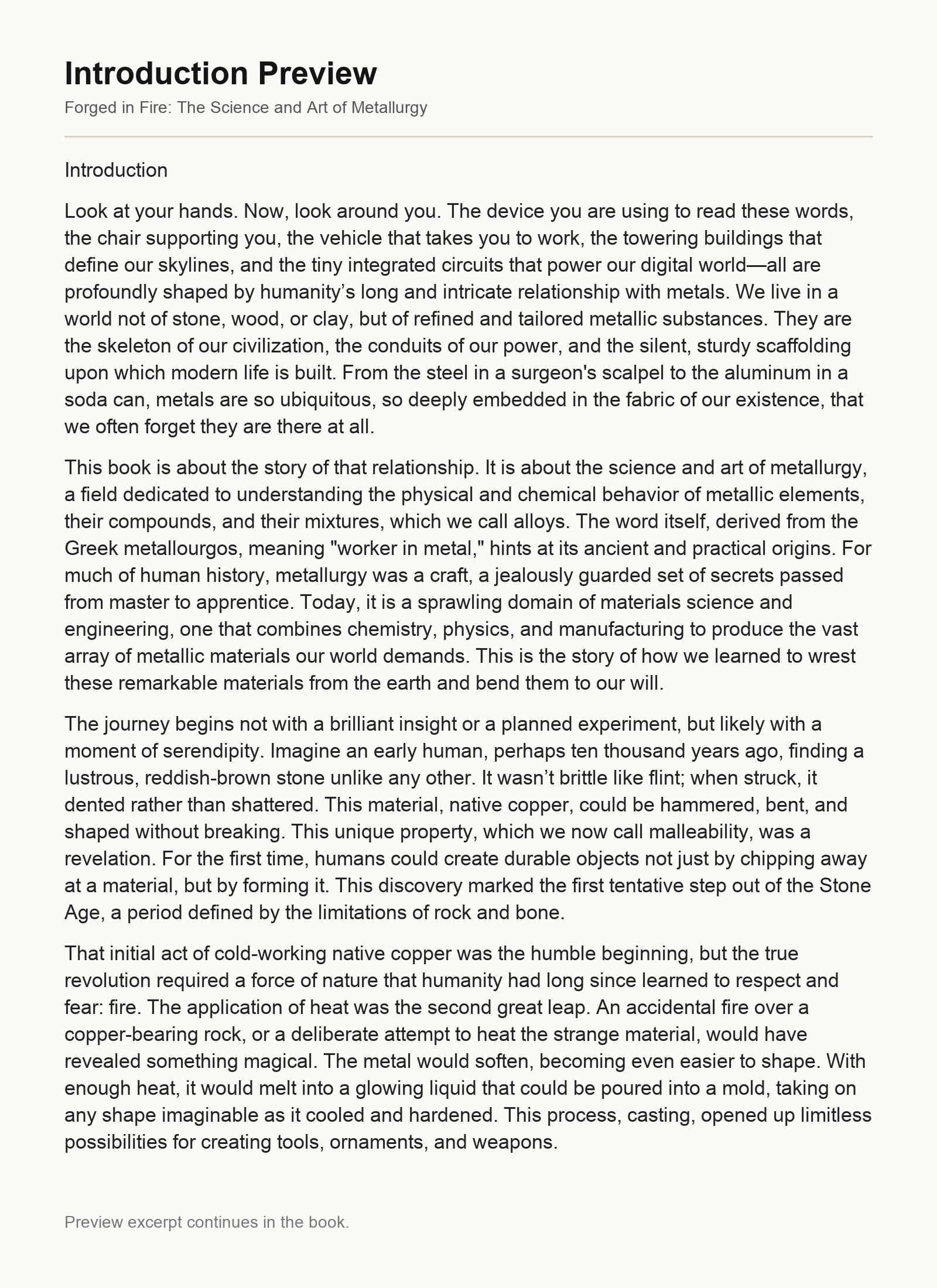
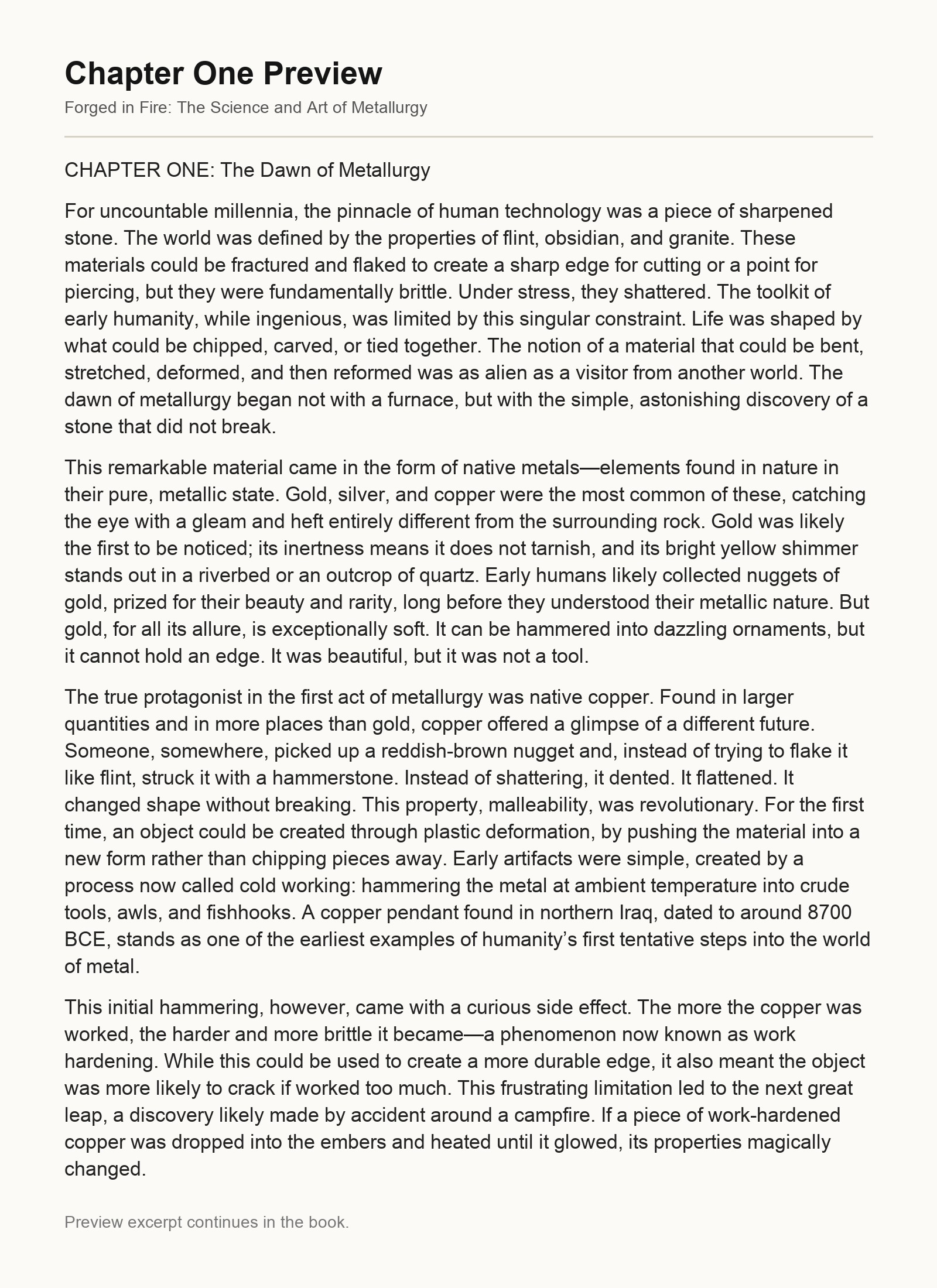
The story of metallurgy begins with the serendipitous discovery of native copper’s malleability, which allowed early humans to shape metal by hammering rather than chipping stone. The application of heat introduced annealing and smelting, unlocking a reliable supply of metal from ores and leading to the creation of arsenical bronze and, later, the superior tin‑bronze that defined the Bronze Age. Iron, far more abundant but requiring higher smelting temperatures, eventually democratized metal use, enabling agricultural expansion and larger armies. Early societies linked prosperity and power to control of metal resources, establishing long‑distance trade networks for copper and tin and fostering specialist metalworkers whose craft blended empirical skill with emerging technical knowledge.
Medieval metallurgy was shaped by parallel tracks: the secretive pursuits of alchemists, whose quest for the Philosopher’s Stone produced foundational laboratory techniques and reagents, and the pragmatic demands of warfare, which drove advances in armor, weapons, and architectural reinforcement. The Renaissance brought a more systematic approach, exemplified by Biringuccio’s and Agricola’s treatises, and innovations such as the blast furnace, finery forge, and crucible steel. The Japanese swordsmith’s intricate folding, lamination, and differential hardening of tamahagane illustrated the art‑science duality, while Damascus wootz steel revealed a sophisticated crucible process that produced a carbide‑rich microstructure responsible for its legendary pattern and performance. The Roman Empire’s mass‑produced wrought iron, used in clamps, ties, and fasteners, enabled unprecedented architectural feats like the Colosseum and aqueducts, laying the groundwork for later industrial scale.
The Age of Iron transitioned to the Age of Steel with Henry Bessemer’s air‑blown converter, which decarbonized pig iron rapidly and cheaply, a process later refined by the Gilchrist‑Thomas basic Bessemer and Siemens‑Martin open‑hearth methods. Cheap, high‑quality steel powered the construction of railways, bridges (Eads, Brooklyn, Forth), and the first skyscrapers, transforming urban landscapes. In the 20th century, metallurgy diversified: stainless steel emerged from chromium addition, superalloys enabled jet turbines, and lightweight aluminum and titanium alloys revolutionized aviation and space exploration. Metallurgy also became essential to the digital age, with pure silicon wafers, copper interconnects, gold bonding wires, and specialized solders forming the foundation of modern electronics, while biomedical applications leveraged titanium’s biocompatibility and Nitinol’s shape‑memory effect for implants and stents. Growing environmental concerns spurred recycling, hydrogen‑based direct reduction, and inert‑anode aluminum production, positioning scrap as an urban mine and driving efforts toward a circular economy.
Looking ahead, metallurgy is shifting from empirical trial‑and‑error to computational design, employing density functional theory and the Materials Genome Initiative to predict and tailor alloys atom by atom. High‑entropy alloys, metallic microlattices, metamaterials, and topological insulators showcase properties derived from engineered atomic disorder or geometry rather than composition alone. Additive manufacturing enables complex, gradient, and bio‑inspired structures, while nanotechnology yields stronger coatings, catalytic nanoparticles, and flexible electronic inks. Throughout, the metallurgist serves as a bridge between fundamental science and practical engineering, tasked with creating sustainable, high‑performance materials that meet the demands of energy, transportation, healthcare, and technology while stewarding the planet’s finite metallic resources.
What You'll Find Inside:
- Traces metallurgy's evolution from native copper discoveries to advanced nanomaterials, showing how each breakthrough enabled civilizational advances
- Explains the scientific principles behind metal properties (crystal structures, alloying, heat treatment) while honoring the intuitive artistry of traditional metalworkers
- Details metallurgy's pivotal role in shaping history - from Bronze Age weapons to Roman architecture, Industrial Revolution infrastructure, and aerospace innovation
- Addresses modern sustainability challenges and innovations in recycling, green steel production, and critical mineral management for green technologies
- Explores cutting-edge frontiers including computational materials design, high-entropy alloys, metallic metamaterials, and quantum materials
Who's It For:
This book is ideal for materials science and engineering students seeking historical context, professionals in metallurgy or related technical fields wanting to deepen their understanding of the discipline's evolution, and educated general readers fascinated by how materials shape human civilization. It will particularly appeal to those interested in the intersection of science, history, and technology, offering both accessible explanations of metallurgical principles and engaging narratives of human ingenuity across millennia.
Table of Contents:
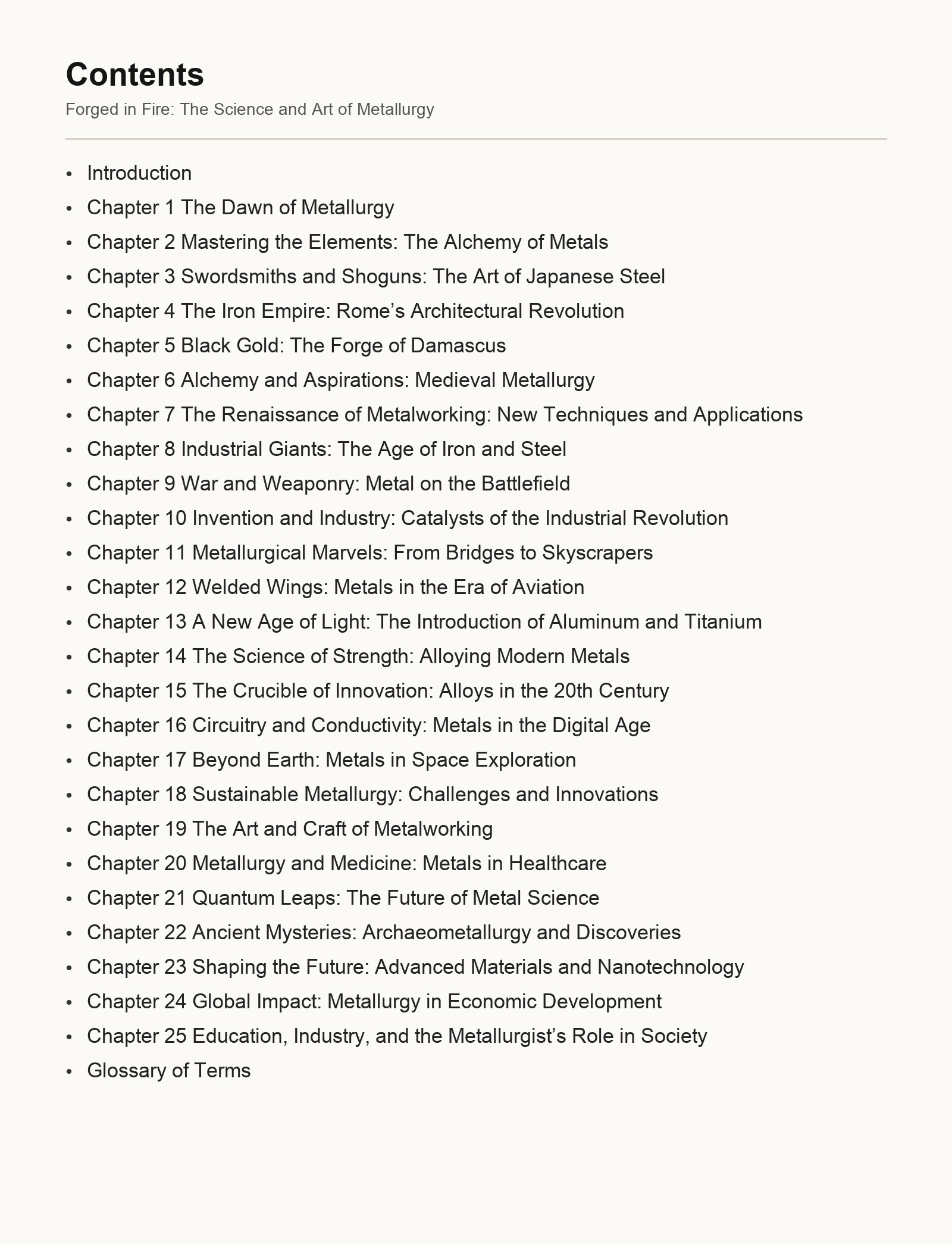
- Introduction
- Chapter 1 The Dawn of Metallurgy
- Chapter 2 Mastering the Elements: The Alchemy of Metals
- Chapter 3 Swordsmiths and Shoguns: The Art of Japanese Steel
- Chapter 4 The Iron Empire: Rome’s Architectural Revolution
- Chapter 5 Black Gold: The Forge of Damascus
- Chapter 6 Alchemy and Aspirations: Medieval Metallurgy
- Chapter 7 The Renaissance of Metalworking: New Techniques and Applications
- Chapter 8 Industrial Giants: The Age of Iron and Steel
- Chapter 9 War and Weaponry: Metal on the Battlefield
- Chapter 10 Invention and Industry: Catalysts of the Industrial Revolution
- Chapter 11 Metallurgical Marvels: From Bridges to Skyscrapers
- Chapter 12 Welded Wings: Metals in the Era of Aviation
- Chapter 13 A New Age of Light: The Introduction of Aluminum and Titanium
- Chapter 14 The Science of Strength: Alloying Modern Metals
- Chapter 15 The Crucible of Innovation: Alloys in the 20th Century
- Chapter 16 Circuitry and Conductivity: Metals in the Digital Age
- Chapter 17 Beyond Earth: Metals in Space Exploration
- Chapter 18 Sustainable Metallurgy: Challenges and Innovations
- Chapter 19 The Art and Craft of Metalworking
- Chapter 20 Metallurgy and Medicine: Metals in Healthcare
- Chapter 21 Quantum Leaps: The Future of Metal Science
- Chapter 22 Ancient Mysteries: Archaeometallurgy and Discoveries
- Chapter 23 Shaping the Future: Advanced Materials and Nanotechnology
- Chapter 24 Global Impact: Metallurgy in Economic Development
- Chapter 25 Education, Industry, and the Metallurgist’s Role in Society
- Glossary of Terms
Author:
Published By:
Date Published:
May 21, 2026
Type:
Nonfiction
Language:
English
Also Available In:
Word Count:
53,531 words
Reading Time:
3 hours 45 minutes
Sample:
Order:
Order Forged in Fire (Hardcover) on MixCache.com:
Buy NowPrint copy is made to order and ships worldwide. Includes the ebook free, ready to read instantly.
$5 account credit for all new MixCache.com accounts, usable toward any ebook purchase!*