Browse by Category
Fiction
- Action & Adventure
- African American
- Anthologies
- Children's Fiction
- Classics
- Comics & Graphic Novels
- Coming of Age
- Contemporary
- Cultural & Regional
- Drama
- Erotica
- Fantasy
- General
- Historical Fiction
- Horror
- Humor & Satire
- Literary Fiction
- Mystery, Thriller & Suspense
- Poetry
- Religious & Inspirational
- Romance
- Science Fiction
- Short Stories
- War & Military
- Westerns
- Women's Fiction
- Young Adult
Non-Fiction
- Antiques & Collectibles
- Arts & Photography
- Biographies & Memoirs
- Business & Money
- Children's Non-Fiction
-
Computers & Technology
- Artificial Intelligence
- Computer Science
- Cybersecurity & Cryptography
- Data Science & Analytics
- Databases & Big Data
- Game Development & Design
- General
- Hardware & DIY
- Mobile App Development
- Networking & Cloud Computing
- Operating Systems
- Programming
- Robotics
- Software
- Software Engineering
- User Experience (UX) & Design
- Web Development & Design
- Cooking, Food & Wine
- Crafts, Hobbies & Home
- Education & Teaching
- Engineering
- General
- Health, Fitness & Dieting
-
History
- African History
- African History - North Africa
- African History - Sub-Saharan Africa
- American History
- American History - 20th Century
- American History - Civil War
- American History - Colonial Period
- Ancient History
- Asian History
- Asian History - China
- Asian History - India
- Asian History - Japan
- Asian History - Southeast Asia
- European History
- European History - Ancient Greece
- European History - Ancient Rome
- European History - Medieval
- European History - Modern
- European History - Renaissance
- General
- Middle Eastern History
- Military History
- Military History - Aviation
- Military History - Naval
- Social & Cultural History
- World History
- Humor & Entertainment
- Industrial Technology
- Language Learning
- Law
- LGBTQ+ Non-Fiction
- Literary Criticism
- Medical Books
- Parenting & Relationships
- Philosophy
- Politics & Social Sciences
- Reference
- Religion & Spirituality
-
Science & Math
- Agricultural Sciences
- Astronomy & Space Science
- Behavioral Sciences
- Biological Sciences
- Botany & Plant Science
- Chemistry
- Earth Sciences
- Engineering - Chemical
- Engineering - Civil
- Engineering - Electrical
- Engineering - Mechanical
- Environment
- General
- Geology
- Mathematics
- Nature & Ecology
- Oceanography
- Paleontology
- Physics
- Statistics
- Self-Help
- Sports & Outdoors
- Study Aids
- Sustainability & Green Living
- Textbooks
- Transportation
- Travel
- True Crime
- Urban Planning & Development
- Veterinary Medicine
- Writing & Publishing
Jump to Section

Want unlimited access to all books published by MixCache.com (plus their audiobooks)? Try MixCache.com Total Access. Look for the MTA badge on book covers to identify included titles.
Access to infinite ebooks: Don't see the book you want? Suggest it and we'll create it (free!) for you from scratch with our powerful AI book writer. Then read it with MTA - besides profiting from any sales it makes!
Gunpowder and Kingdoms: How Firearms Remade Early Modern Warfare
MTA
State formation, empire building, and the military impact of gunpowder technology
About this book:
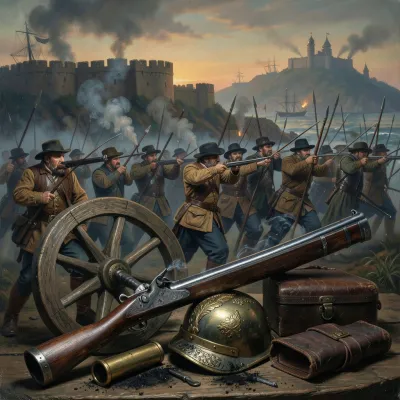
*Gunpowder and Kingdoms* explores the transformative period between 1400 and 1800, tracing how the evolution of firearms and artillery reshaped the global landscape. The book argues that the "gunpowder revolution" was not merely a tactical shift on the battlefield but a fundamental driver of state formation. To sustain the high costs of casting cannon, drilling professional infantry, and building geometric "star forts" (the *trace italienne*), rulers were forced to create the "fiscal-military state." This necessitated the development of permanent taxation systems, sophisticated credit markets, and expansive bureaucracies capable of managing complex supply chains for saltpeter, sulfur, and charcoal.
The narrative examines how gunpowder technology took different forms across the globe, from the "Gunpowder Empires" of the Ottomans, Safavids, and Mughals—who blended steppe cavalry traditions with heavy artillery—to the Ming and Qing dynasties in East Asia. The text highlights that while firearms facilitated Iberian and other European conquests in the Atlantic and Indian Oceans, they also empowered indigenous and African polities to adapt and resist through local innovation and trade. Warfare at sea further magnified these shifts, as naval artillery transformed ships into floating fortresses, necessitating global chokepoints and dockyards that linked maritime power directly to commercial wealth.
A central theme of the book is the rationalization of war through discipline and science. The rise of infantry, specifically the "pike and shot" formation, eclipsed the medieval mounted elite and ushered in an era of rigorous drill and standardized manufacturing. The proliferation of print culture allowed military knowledge—such as ballistics, fortification geometry, and tactical manuals—to be codified and disseminated worldwide. This intellectual shift turned war into a predictable, administrative process, where the expertise of engineers and bureaucrats became as vital as the bravery of soldiers.
By 1800, the book concludes that gunpowder had irrevocably altered the relationship between the ruler and the ruled. The immense resource requirements of modern warfare had centralized state power but also forced governments to negotiate with their subjects over taxation and representation. While the revolution reached its limits against the constraints of geography, disease, and finance, it established the institutional foundations of the modern world. The legacy of this era is a global order defined by centralized states, professional militaries, and an inextricable link between technological capability and political sovereignty.
What You'll Find Inside:
- How gunpowder technology drove the creation of fiscal-military states through taxation, borrowing, and administrative systems capable of sustaining prolonged warfare
- The global diffusion and uneven impact of firearms across Europe, the Islamic world, East Asia, Africa, and the Americas, showing how different societies adopted, adapted, or resisted gunpowder's demands
- The evolution of fortification design from medieval walls to trace italienne and Vauban's scientific siegecraft in response to increasingly powerful artillery
- The transformation of infantry tactics from cavalry dominance to pike and shot formations requiring drill, discipline, and sophisticated logistical support
- The development of global supply chains for saltpeter, sulfur, and charcoal that linked distant regions through the black powder economy and shaped imperial power
Who's It For:
This book is ideal for students and scholars of early modern history, military historians, and readers interested in the history of technology and warfare. It will particularly benefit those studying state formation, empire-building, and the global interconnectedness of different regions during the 1400-1800 period. Researchers examining how military technology influences political and economic systems will find the comprehensive analysis of the fiscal-military state especially valuable.
Author:
Published By:
Date Published:
May 7, 2026
Type:
Nonfiction
Language:
English
Word Count:
68,731 words
Reading Time:
4 hours 49 minutes
Sample:
Order:
Order Gunpowder and Kingdoms: How Firearms Remade Early Modern Warfare (Paperback) on MixCache.com:
Buy NowPrint copy is made to order and ships worldwide. Includes the ebook free, ready to read instantly.
$5 account credit for all new MixCache.com accounts, usable toward any ebook purchase!*